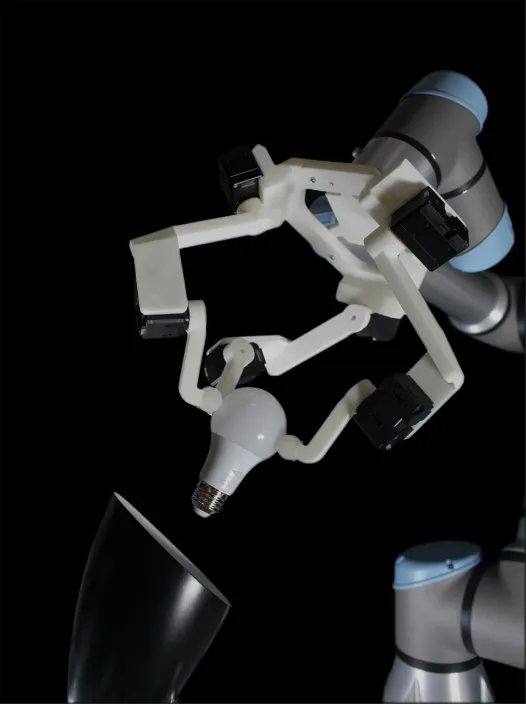
Researchers at Yale University, led by doctoral candidate Vatsal Patel in Professor Aaron Dollar’s laboratory, have developed the Sphinx, a novel robotic hand detailed in a recent publication in Nature Machine Intelligence. The device addresses limitations inherent in conventional robotic wrist mechanisms – typically possessing three degrees of freedom: roll, pitch, and yaw – by integrating grasping and rotational functionality into a single spherical mechanism. This design allows for consistent achievement of roll, pitch, and yaw rotations without reliance on sensors or cameras, facilitating efficient operation and reducing spatial footprint. Crucially, the spherical configuration enables these rotations to occur proximal to the manipulated object, thereby minimising the need for extensive robotic arm movement and enabling operation within confined spaces, a significant advancement over existing systems.
Robotic Manipulation Challenges
Robotic manipulation continues to present significant challenges, particularly when transitioning from highly structured industrial settings to the complexities of unstructured, real-world environments. While robots excel at repetitive tasks with defined parameters, even seemingly simple actions – such as manipulating a light bulb or operating a door handle – demand a level of dexterity and adaptability that remains elusive for many robotic systems.
A core limitation stems from the conventional architecture of robotic wrists, typically comprising three degrees of freedom – roll, pitch, and yaw – which, despite their versatility, introduce mechanical complexity and spatial demands. The inherent bulkiness of these traditional wrist mechanisms necessitates substantial movements of the entire robotic arm to complete tasks, resulting in inefficient operation and a considerable spatial footprint.
This is particularly problematic in confined spaces or scenarios requiring fine motor control. Researchers at Yale University, led by doctoral candidate Vatsal Patel and Professor Aaron Dollar, have sought to address these limitations through the development of a novel robotic hand, named the Sphinx.
Their work, recently published in Nature Machine Intelligence, details a spherical mechanism designed to integrate grasping and rotational functionalities, effectively consolidating the roles of both traditional wrists and grippers. The Sphinx hand’s core innovation lies in its ability to achieve roll, pitch, and yaw rotations directly at the point of contact with the manipulated object.
This is achieved through a mechanically simplified design that eliminates the need for complex control algorithms or external sensors – a significant departure from many contemporary robotic manipulation systems. According to Patel, the device’s simplicity is a key advantage, enabling efficient operation and reducing the spatial requirements for movement.
By performing rotations closer to the object, the system minimizes the need for large-scale arm movements, resulting in faster, more efficient, and more spatially compact manipulation. The design represents a departure from conventional approaches to robotic dexterity, which often rely on increasing the number of degrees of freedom or employing sophisticated sensor fusion techniques.
The Yale team’s focus on mechanical integration, rather than complex control, offers a potentially scalable solution for improving robotic manipulation capabilities in unstructured environments. This approach may prove particularly valuable in applications where space is limited, or where real-time responsiveness is critical, such as in surgical robotics or in-home assistance.
The development of the Sphinx hand, therefore, represents a significant contribution to the field of soft robotic hand design and manipulation.
The Sphinx hand design, developed by Vatsal Patel, doctoral candidate, and Professor Aaron Dollar at Yale University, represents a novel approach to robotic manipulation. Published in Nature Machine Intelligence, the research details a spherical mechanism intended to consolidate the functions of both robotic wrists and grippers into a single, integrated unit.
This design fundamentally alters the conventional paradigm of robotic dexterity, which typically relies on increasing degrees of freedom – alongside roll rotations.
More information
External Link: Click Here For More