

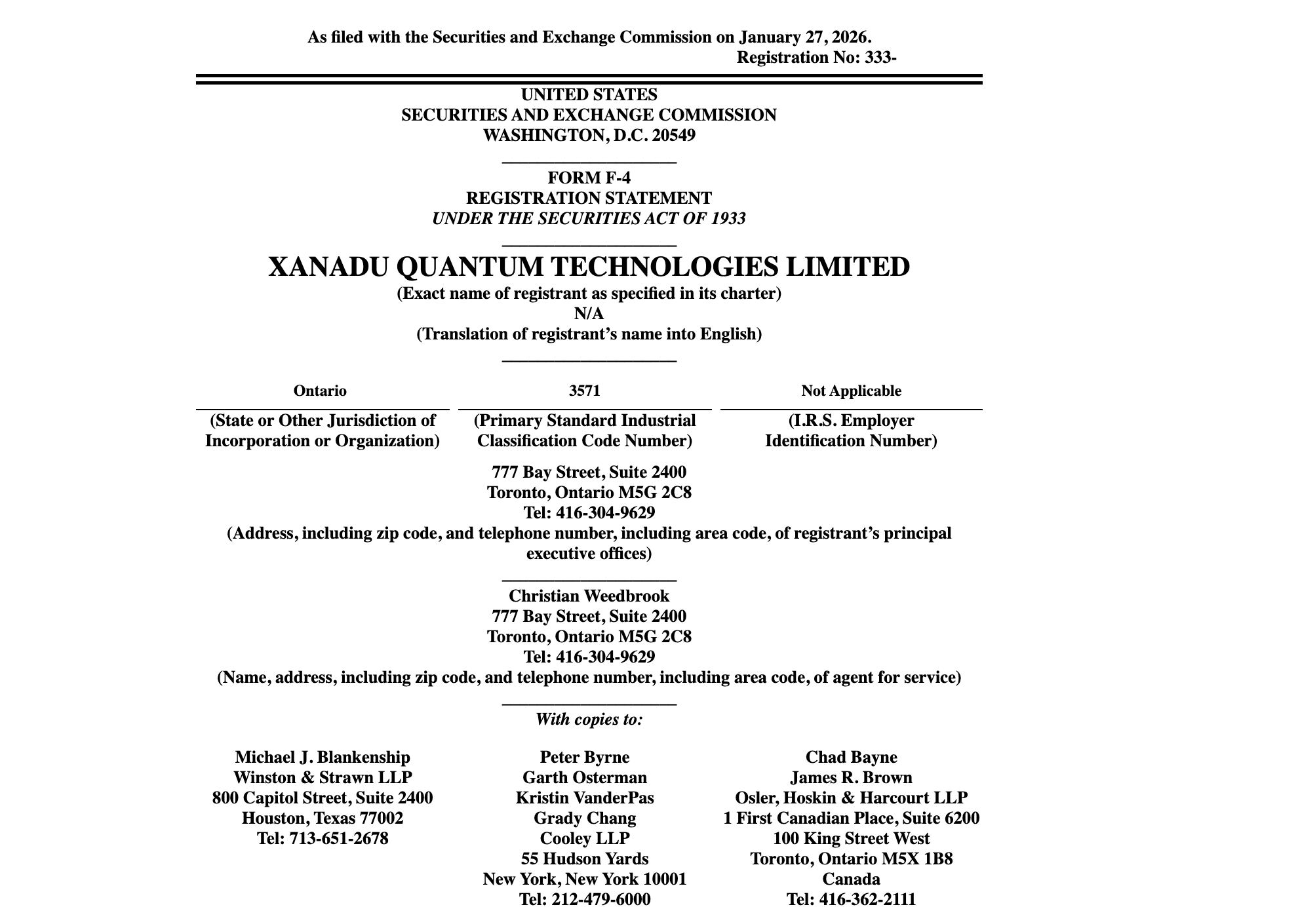
Xanadu Quantum Technologies Inc. is poised to become the first publicly traded pure-play photonic quantum computing company following the public filing of its Form F-4 with the U.S. Securities and Exchange Commission on January 28, 2026. The $3.1 billion proposed business combination with Crane Harbor Acquisition Corp. will support Xanadu’s innovative approach to quantum computing, including its PennyLane software platform and development of a commercially viable, fault-tolerant quantum computer. “We are excited to reach this milestone as we move one step closer to becoming a publicly traded company,” said Christian Weedbrook, Founder and Chief Executive Officer of Xanadu. Founded in 2016, Xanadu previously achieved quantum supremacy in 2022 and uniquely operates at room temperature, potentially revolutionizing the global compute ecosystem.
$3.1 Billion Business Combination with Crane Harbor Acquisition Corp.
Xanadu Quantum Technologies Inc. is charting a course toward becoming the first publicly traded, single-focus photonic quantum computing firm, fueled by a $3.1 billion business combination with Crane Harbor Acquisition Corp. The company submitted its Form F-4 filing with the U.S. This move isn’t simply about financial gain; it’s a validation of Xanadu’s distinct approach to quantum processing—one that eschews the cryogenic complexities of many rivals. Xanadu’s technology operates at room temperature, a significant advantage in terms of scalability and energy efficiency.
Their Aurora system, described as the world’s first networked, modular, and scalable quantum computer, demonstrates this commitment to practical implementation. This focus extends beyond hardware, with the PennyLane software platform gaining traction as the most widely used application development framework, allowing researchers to program quantum circuits across diverse modalities. The financial injection, expected to yield approximately US$500 million in gross proceeds, will accelerate Xanadu’s ambitious goals. Recent progress highlights this momentum, including advancement to Stage B of DARPA’s Quantum Benching Initiative—placing Xanadu among a select group of ten organizations demonstrating credible paths to utility-scale quantum computing. A CAD $23 million commitment from the Canadian Quantum Champions Program further cements Canada’s position as a quantum technology leader.
Beyond funding, Xanadu has bolstered its leadership team, appointing Michael Trzupek as Chief Financial Officer and Natalie Wilmore as Chief Legal Officer. Strategic partnerships are also driving innovation. Collaborations with Rolls-Royce and Riverlane have dramatically reduced simulation runtimes for jet engine airflow, shrinking calculation costs “from weeks to less than an hour.” A Memorandum of Understanding with A*STAR in Singapore aims to establish joint quantum laboratories, while research into photodynamic cancer therapy demonstrates potential applications in healthcare. “This filing represents a significant moment in Xanadu’s plans to list on the Nasdaq and the TSX,” stated Bill Fradin, Chief Executive Officer of Crane Harbor. “We are excited about this transaction and believe Xanadu is well positioned to take the important step of becoming a publicly traded company, supported by a strong leadership team with deep technical and operational experience.”
Room-Temperature Photonic Quantum Computing with Borealis & Aurora
Xanadu Quantum Technologies is pioneering a distinctly different path in the race to build practical quantum computers, one that bypasses the extreme cooling requirements plaguing many competing designs. This approach, leveraging light rather than superconducting materials or trapped ions, allows Xanadu’s systems to operate at room temperature—a game-changer for scalability and accessibility. Central to this innovation is the Borealis system, which in 2022 marked a historic achievement as the first pure-play quantum computing company to demonstrate quantum supremacy with its 216-qubit processor.
However, Borealis is not merely a proof-of-concept; it’s a stepping stone to Aurora, Xanadu’s networked, modular, and scalable quantum computer. This modularity is key, allowing for the expansion of quantum processing power without the limitations of monolithic designs. Beyond hardware, Xanadu is also developing the software ecosystem to unlock the potential of photonic quantum computing. The company’s progress has also been recognized through initiatives like DARPA’s Quantum Benching Initiative, where Xanadu is positioned amongst only ten organizations demonstrating a credible path toward utility-scale quantum computing.
Furthermore, selection for the Canadian Quantum Champions Program, securing up to CAD $23M, underscores national investment in Xanadu’s long-term vision.
PennyLane Framework Drives Quantum Software & Application Development
Xanadu Quantum Technologies is rapidly establishing PennyLane as the dominant platform for quantum application development, a move critical to translating theoretical quantum advantages into practical real-world solutions. Beyond building the quantum hardware itself, the company recognizes the necessity of a robust software ecosystem, and PennyLane is at its core, enabling programming across diverse quantum modalities and cloud platforms. This isn’t simply about creating another programming language; it’s about lowering the barrier to entry for researchers and developers eager to explore quantum algorithms. The framework’s versatility is evident in a growing number of collaborative projects.
This demonstrates a clear pathway toward commercialization, moving beyond purely academic exercises. This international collaboration underscores the framework’s growing influence and adoption within the quantum community. Xanadu’s commitment extends to pioneering applications in vital fields like healthcare. The development of a novel quantum computational framework to accelerate photodynamic cancer therapy research showcases the potential for fault-tolerant quantum computers to revolutionize medical treatments. “We believe Xanadu’s new research demonstrates how fault-tolerant quantum computers can accelerate research into cutting-edge cancer treatments,” highlighting the direct impact of their work.
This research builds on their 2022 achievement of quantum supremacy with the 216-qubit Borealis system, providing a powerful foundation for these advanced software applications.
Xanadu’s ability to leverage photonics as the only medium universally compatible across all quantum modalities for commercialization.
DARPA & Canadian Programs Validate Xanadu’s Quantum Progress
Xanadu Quantum Technologies is gaining significant validation for its approach to quantum computing through key partnerships with both the U.S. Defense Advanced Research Projects Agency (DARPA) and the Canadian government, demonstrating growing confidence in the company’s technology. This milestone underscores the potential of Xanadu’s technology to address complex computational challenges relevant to national security and scientific advancement. The Canadian government has also signaled strong support, selecting Xanadu to participate in the Canadian Quantum Champions Program, providing up to CAD $23 million in funding.
This “first-of-its-kind” initiative is explicitly designed to “accelerate the development of fault-tolerant quantum computing capabilities in Canada and anchor the country’s quantum leadership for the long term,” demonstrating a national commitment to fostering innovation in this critical field. Xanadu’s ability to secure this funding highlights its position as a key player in Canada’s burgeoning quantum ecosystem, and the country’s commitment to becoming a global hub for quantum technologies. Beyond government backing, Xanadu is actively forging collaborations with industry leaders to explore practical applications of its quantum platform. “By integrating Xanadu’s PennyLane software and Riverlane’s state-of-the-art quantum algorithms, the project enabled Rolls-Royce to achieve a reduction in simulation runtimes by orders of magnitude,” showcasing the potential for quantum computing to revolutionize complex engineering problems. This result isn’t merely theoretical; it unlocks “new prototyping opportunities for the aerospace industry.”
These advancements are occurring as Xanadu prepares to become a publicly traded company, having filed a Form F-4 with the SEC on January 28, 2026.
We are excited to reach this milestone as we move one step closer to becoming a publicly traded company.
Christian Weedbrook, Founder and Chief Executive Officer of Xanadu
Partnerships Accelerate Quantum Computing Across Industries
Xanadu Quantum Technologies is forging collaborative pathways with industry leaders, demonstrating a strategic shift towards practical quantum applications beyond fundamental research. The company’s recent activity highlights a growing trend: quantum computing is moving from theoretical possibility to tangible solutions, driven by partnerships that leverage specialized expertise. On November 3, 2025, Xanadu entered into a definitive business combination agreement with Crane Harbor Acquisition Corp., a move anticipated to close in the first quarter of 2026, pending SEC approval and shareholder votes. This financial backing is fueling expanded collaborations across diverse sectors, from aerospace to healthcare.
A prime example is the partnership with Rolls-Royce and Riverlane, focused on dramatically improving jet engine airflow simulations. By integrating Xanadu’s PennyLane software with Riverlane’s algorithms, researchers achieved a significant reduction in simulation time—from weeks to under an hour. This speed increase, unlocking new prototyping opportunities, illustrates the potential of quantum computing to address complex engineering challenges. Furthermore, Xanadu is actively expanding its international reach, evidenced by a Memorandum of Understanding with the Agency for Science, Technology and Research (A*STAR) in Singapore. This collaboration aims to establish long-term research partnerships and potentially create joint quantum laboratories, solidifying Xanadu’s global presence.
This framework promises to expedite the discovery of next-generation photosensitizers, potentially leading to more effective cancer treatments. Complementing this software innovation, Xanadu is also focused on hardware advancements, partnering with Thorlabs to develop customized optical fiber components crucial for scaling photonic quantum computing systems. This collaboration ensures a pathway from proof-of-concept to high-volume manufacturing. “Xanadu has built a leading quantum computing platform focused on practical, real-world applications, with a clear pathway to both hardware and software commercialization and scalability,” Weedbrook added.


