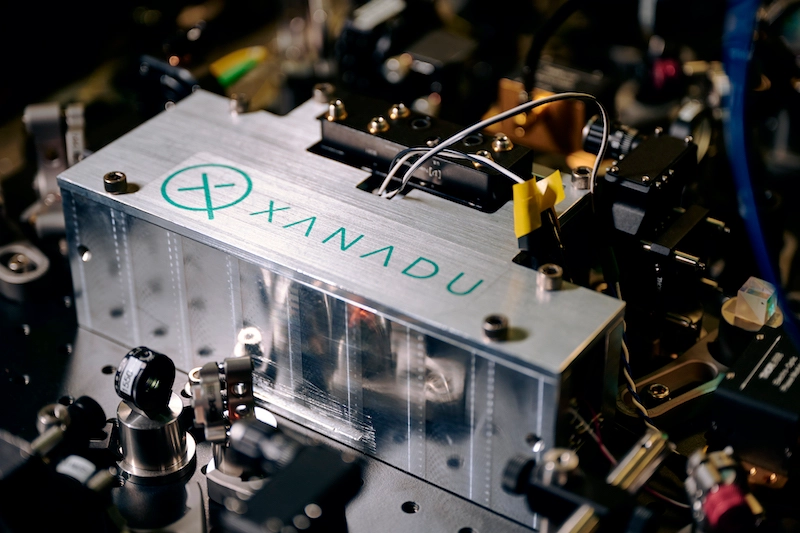
Xanadu Quantum Technologies has published research in Physical Review Letters demonstrating that photonic qubits can be utilized for any quantum error correction (QEC) code, significantly reducing the number of physical qubits required. Their approach employs Gottesman-Kitaev-Preskill (GKP) qubits, which enhance error correction and enable simple computational gates. By leveraging linear optics, Xanadu achieves entanglement with relatively straightforward hardware.
The study also simulated two quantum low-density-parity-check (qLDPC) codes, showcasing competitive error thresholds and efficient resource use. This advancement underscores the potential for more resource-efficient fault-tolerant quantum computing, aligning with Xanadu’s mission to develop accessible quantum technologies.
Exploring Xanadu’s Research on GKP Qubits
Xanadu’s work focuses on GKP qubits, which offer an additional layer of error correction and support simple physical gates for computation. These qubits can be entangled using linear optics, enabling the implementation of diverse QEC codes with relatively straightforward hardware configurations. This approach is particularly advantageous for early utility-scale quantum computers where resource efficiency is critical.
Simulating Quantum Low-Density Parity-Check Codes
Xanadu conducted simulations of two specific quantum low-density parity-check (qLDPC) codes. These simulations revealed that the codes achieve competitive error correction thresholds with efficient resource utilization, leading to a notable reduction in overhead associated with fault-tolerant computing. This finding suggests potential for scalable fault-tolerant quantum computing.
Evaluating qLDPC Codes
Xanadu’s evaluation of qLDPC codes involved comprehensive simulations to assess their error correction capabilities and resource efficiency. The results demonstrated that these codes could achieve competitive thresholds with efficient use of resources, indicating potential for scalable fault-tolerant quantum computing. Xanadu identified parameters that enhanced performance by analysing different configurations, providing valuable insights into the practical implementation of qLDPC codes.
Piloting Advantageous Architecture in Xanadu’s Aurora Hardware
Xanadu’s research demonstrates that their photonic architecture, leveraging GKP qubits, enables the implementation of any QEC code. This capability significantly reduces the number of physical qubits required for fault-tolerant quantum computation while maintaining competitive error thresholds compared to leading QEC approaches. Using GKP qubits provides an additional layer of error correction and supports simple physical gates for computation.
Conclusion
Xanadu’s advancements in quantum error correction represent a major step forward in the field of quantum computing. By leveraging GKP qubits and implementing diverse QEC codes, Xanadu has demonstrated the potential for more efficient and practical fault-tolerant quantum computation. Their work underscores the importance of systematic evaluations and innovative approaches to overcoming challenges in scaling quantum systems.
More information
External Link: Click Here For More