On April 18, 2025, researchers Gaetano Campi, Massimiliano Catricala, Giuseppe Chita, and colleagues published Lattice Quantum Geometry Controlling 118 K Multigap Superconductivity in Heavily Overdoped CuBa2Ca3Cu4O10+d, detailing how the nanoscale lattice geometry of a high-temperature superconductor influences its multigap superconducting properties, offering insights into advanced superconducting materials design.
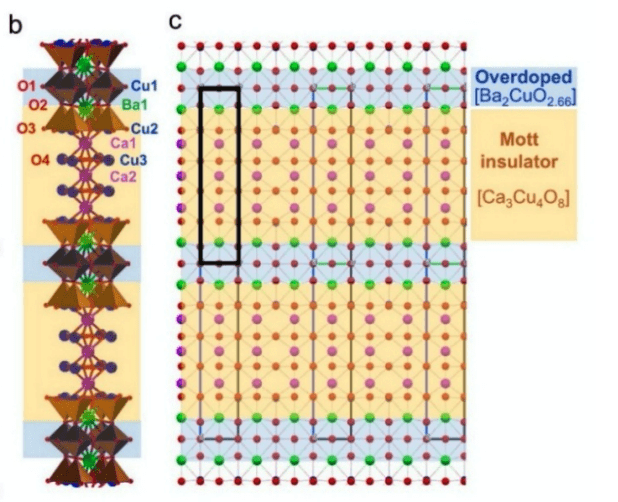
Synchrotron X-ray diffraction reveals structural transitions in Cu1234 superconductor at Tc (118 K), marked by c-axis contraction and Cu-O negative thermal expansion. These changes correlate with lattice reorganization due to multiple superconducting gap openings and oxygen defect rearrangements above 200 K. A phase diagram linking temperature, c/a ratio, and Cu-O strain highlights regions of gap opening and oxygen rearrangement, offering insights into how lattice geometry influences superconductivity in advanced nanoscale heterostructures.
Recent research has deepened our understanding of high-temperature cuprate superconductors—materials capable of conducting electricity without resistance at higher temperatures than conventional superconductors. The study focuses on heavily hole-overdoped cuprates, revealing critical insights into their electronic structure and the mechanisms that underpin their superconducting properties.
The research identifies multiple bands in these materials, with nesting instabilities playing a significant role in shaping their electronic behavior. Nesting instabilities occur when electrons interact in ways that can lead to pronounced changes in a material’s electronic properties, potentially enhancing its superconductivity. This finding underscores the importance of these interactions in determining the material’s functionality.
Using advanced computational methods, scientists have modeled the Fermi surface—the boundary separating occupied from unoccupied electron states at the lowest energy level. Their analysis reveals that heavily hole-overdoped cuprates form an almost half-filled Fermi surface. This condition is particularly conducive to strong nesting instabilities and extended s-wave pairing symmetry. Extended s-wave pairing suggests a more complex mechanism than the traditional isotropic s-wave pairing observed in conventional superconductors, potentially offering new pathways for achieving high-temperature superconductivity.
The study also examines phase separation, a phenomenon where regions of different electronic properties coexist within the material. This competition between phases can influence the critical temperature (Tc) at which superconductivity occurs. Understanding how phase separation affects Tc is crucial for optimizing superconducting materials.
The findings suggest that controlling doping levels and Fermi surface structure could be key to enhancing superconducting properties. These insights are particularly relevant for materials engineering aimed at improving energy transmission and advancing quantum computing technologies. While the computational methods used, such as density functional theory, are sophisticated tools for modeling electronic properties from first principles, their specifics were not detailed in this context.
In conclusion, this research advances our understanding of high-temperature superconductors and provides a foundation for designing materials with enhanced superconducting properties. By identifying critical factors like nesting instabilities and Fermi surface structure, the study offers a roadmap for future advancements in quantum technologies.
👉 More information
🗞 Lattice Quantum Geometry Controlling 118 K Multigap Superconductivity in Heavily Overdoped CuBa2Ca3Cu4O10+d
🧠 DOI: https://doi.org/10.48550/arXiv.2504.13796