
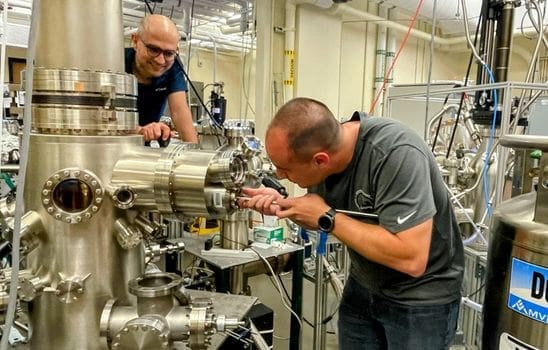
Lian Li, a researcher at West Virginia University, is working on a project to speed up the discovery of new quantum materials. The project, supported by a $980,000 grant from the National Science Foundation, aims to streamline the discovery and design of new quantum materials with properties like enhanced conductivity, durability, and strength. The team, including graduate student Joseph Benigno and postdoctoral research associate Pedram Tavazohi, will use pseudospin to help discover new materials. The ultimate goal is to build materials for quantum computing and superconductors, which could be used in high-speed trains.
“Every era in human history is characterized by the kind of materials we use, from stone to silicone,” he said. “And now we’re going into the quantum age, and the speed of discovery is really fast. Hopefully, we’ll be able to do it two or five or 10 times faster.”
Lian Li
Quantum Material Discovery Acceleration
A researcher at West Virginia University (WVU) is working on a project to speed up the discovery of new quantum materials. The traditional method of trial and error in finding and creating new materials with unique properties, such as superconductors and novel magnets, is time-consuming and struggles to keep pace with technological advancements in the quantum age. The researcher, Lian Li, is aiming to accelerate this process with a four-year project supported by a $980,000 grant from the National Science Foundation’s Designing Materials to Revolutionize and Engineer our Future program.
The goal of this project is to streamline the discovery and design of new quantum materials with properties like enhanced conductivity, durability, and strength using computational and experimental tools and a data-driven approach. Quantum materials’ unique properties come from the spinning movement of electrons. For example, superconductors have infinite conductivity, and magnets can be controlled with electric current because of how their electrons spin. Li and his research team will employ pseudospin — a quantum analog of electron spin — to help discover new materials, which will be created by growing one atomic layer at a time in a series of stainless steel vacuum chambers.
Collaborative Approach to Quantum Material Discovery
The WVU team, which includes graduate student Joseph Benigno and postdoctoral research associate Pedram Tavazohi, is working on the project with researchers from the University of Wisconsin-Milwaukee. The team is responsible for creating these materials based on theoretical predictions. They then perform targeted experiments to validate the theory predictions. This iterative closed-loop approach is expected to speed up materials discovery.
Precision in Quantum Material Synthesis
The process of materials synthesis requires precision, likened to baking rather than cooking. Varying the “ingredients” and the procedures that go into the recipe for a new quantum material will produce different finished products, some of which will be desirable, while others will not. The team assesses the finished product based on its properties such as conductivity, structure, and symmetry.
Real-world Applications of Quantum Materials
Beyond the laboratory, the research may prove useful in real-world applications. The ultimate goal is to build materials that allow for advancements in quantum computing and superconductors, which transfer electricity without resistance. A real-world application for superconductors is high-speed trains. Traditional train tracks produce a lot of resistance, but superconducting magnets float the train above the track and allow for significantly faster speeds. The speed could potentially reach over 600 miles per hour with the development of new materials.
Educating the Next Generation of Scientists
Li’s team will also teach the next generation of scientists about these advanced materials and methods. This will include undergraduates as well as outreach to high school students. The team plans to organize an MGI day during the annual WVU Research Week and a biannual two-day MGI Summit of Students, Teachers and Researchers. These programs aim to encourage students to take the leap to quantum science and technology at a relatively early age.
“For over 100 years, the approach has always been to try, and if something doesn’t work, try again,” Li said. “The story goes that when Edison discovered the filaments for his light bulb, he tried 1,600 different materials to make more than 6,000 filaments. Clearly, it’s time consuming.” “We aim to harness this new pseudospin to design materials with new properties,” Li said.
“The theorists are there,” Li said. “Here, we are responsible for actually creating these materials. They make predictions up there, and then we’ll take those predictions and perform targeted experiments to ensure that we can make the quantum materials to validate the theory prediction. This iterative closed-loop MGI approach will speed up materials discovery.”
“It’s not like cooking, where you can mix some things up a little bit. For baking, you have to be very accurate.” – Joseph Benigno
“The conductivity will be different, or the structure or the symmetry,” Li said. “We ask, ‘Does it look like the shape I want? Does it have the right color?’ That’s why we call this materials discovery.”
“Ultimately the goal is to build materials that allow us to do things like quantum computing,” he said. “Another one is superconductors, which transfer electricity without resistance. A real-world application for superconductors is high-speed trains.”
“Right now, the speed is around 220 miles per hour,” Li said. “It could reach over 600 miles per hour.”
Summary
Researchers at West Virginia University are developing a faster method to discover and create new quantum materials with unique properties, such as superconductors and novel magnets, using computational and experimental tools. This accelerated process could potentially lead to real-world applications such as quantum computing and high-speed trains powered by superconductors.
- A research team led by Lian Li at West Virginia University (WVU) is working to speed up the discovery and creation of new quantum materials, such as superconductors and novel magnets.
- The project, supported by a $980,000 grant from the National Science Foundation, aims to streamline the process using computational and experimental tools and a data-driven approach.
- Quantum materials’ unique properties, such as infinite conductivity in superconductors, come from the spinning movement of electrons. The team will use pseudospin, a quantum analog of electron spin, to discover new materials.
- The materials will be created one atomic layer at a time in stainless steel vacuum chambers.
- The team, which includes graduate student Joseph Benigno and postdoctoral research associate Pedram Tavazohi, is collaborating with researchers from the University of Wisconsin-Milwaukee.
- The research could have real-world applications, such as quantum computing and high-speed trains. The team is also aiming to develop a room temperature superconductor.
- The WVU team will also educate the next generation of scientists about these advanced materials and methods, including organising an MGI day during the annual WVU Research Week and a biannual two-day MGI Summit of Students, Teachers and Researchers.