
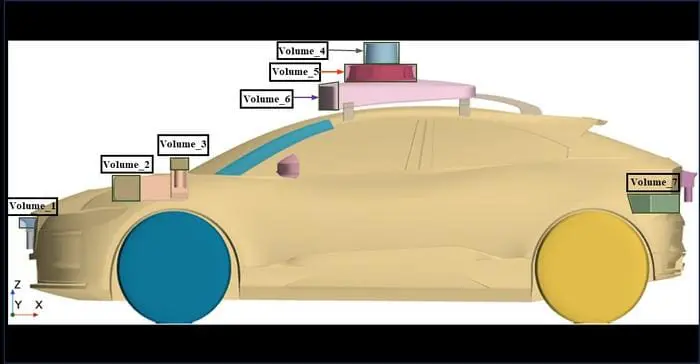
Researchers at Wuhan University of Technology have made strides in enhancing the aerodynamic performance of autonomous vehicles by reducing drag caused by externally mounted sensors such as cameras and light detection and ranging instruments. Led by author Yiping Wang, the team used a combination of computational and experimental methods to optimize the design of these sensors, resulting in a 3.44 percent decrease in total aerodynamic drag.
This improvement could enable autonomous vehicles to travel longer distances, which is particularly important as their adoption increases in passenger transport, delivery, and logistics applications. The study, published in Physics of Fluids, was conducted by Jian Zhao, Chuqi Su, Xun Liu, Junyan Wang, Dongxu Tang, and Yiping Wang, and its findings could inform the design of more aerodynamically efficient autonomous vehicles, potentially benefiting companies involved in their development and deployment.
Introduction to Autonomous Vehicles and Aerodynamic Drag
The development of autonomous vehicles (AVs) has been rapidly advancing, thanks to significant progress in information technology and artificial intelligence. As a result, AVs are now being utilized for logistics delivery and low-speed public transportation. However, despite the advancements in control algorithms to enhance safety, there is a need to improve aerodynamic performance to reduce energy consumption and extend driving range. Aerodynamic drag issues have been hindering self-driving vehicles from achieving acceleration comparable to regular vehicles. Researchers from Wuhan University of Technology in China have focused on enhancing the aerodynamic performance of AVs by reducing drag induced by externally mounted sensors, such as cameras and light detection and ranging (LiDAR) instruments.
The importance of addressing aerodynamic drag cannot be overstated, as it has a significant impact on the overall efficiency and range of autonomous vehicles. Externally mounted sensors, which are necessary for AV functionality, significantly increase aerodynamic drag, particularly by increasing the proportion of interference drag within the total aerodynamic drag. To mitigate this issue, researchers have employed a combination of computational and experimental methods to optimize the structural shapes of AV sensors. By establishing an automated computational platform and combining experimental design with a substitute model and optimization algorithm, the team aimed to improve the aerodynamic performance of AVs.
The use of computational fluid dynamics (CFD) and wind tunnel experiments has enabled researchers to investigate the effects of drag reduction and examine improvements in the aerodynamic performance of optimized models. The findings of this study have significant implications for the design of more aerodynamically efficient autonomous vehicles, enabling them to travel longer distances while reducing energy consumption. As the adoption of autonomous vehicles increases, not only in passenger transport but also in delivery and logistics applications, the importance of optimizing aerodynamic performance will become even more critical.
The optimization of AV sensor design is a complex task that requires careful consideration of various factors, including the interactions among sensors and the impact of geometric dimensions on interference drag. By performing a comprehensive optimization of the sensors during the design phase, researchers can minimize aerodynamic drag and improve overall vehicle efficiency. The development of more efficient autonomous vehicles will have far-reaching consequences, enabling the widespread adoption of this technology and reducing the environmental impact of transportation.
Aerodynamic Drag Reduction through Sensor Optimization
The reduction of aerodynamic drag is crucial for improving the efficiency and range of autonomous vehicles. To achieve this goal, researchers have focused on optimizing the design of externally mounted sensors, such as cameras and LiDAR instruments. By modifying the sensor shapes and adjusting the control points on deformation control volumes, the team was able to reduce the total aerodynamic drag of an AV by 3.44%. Compared with the baseline model, the optimized model reduced the aerodynamic drag coefficient by 5.99% in simulations and significantly improved aerodynamic performance in unsteady simulations.
The optimization process involved a combination of computational and experimental methods, including CFD and wind tunnel experiments. The use of these techniques enabled researchers to investigate the effects of drag reduction and examine improvements in the aerodynamic performance of optimized models. The findings of this study demonstrate the potential for significant reductions in aerodynamic drag through sensor optimization, which can have a substantial impact on the overall efficiency and range of autonomous vehicles.
The importance of optimizing sensor design cannot be overstated, as it has a direct impact on the aerodynamic performance of AVs. By minimizing interference drag and reducing the proportion of total aerodynamic drag, researchers can improve the overall efficiency of autonomous vehicles. The development of more efficient AVs will enable the widespread adoption of this technology, reducing energy consumption and greenhouse gas emissions.
The use of computational models and experimental techniques has enabled researchers to investigate the complex interactions between sensors and the surrounding airflow. By analyzing the effects of sensor shape and position on aerodynamic drag, researchers can optimize the design of AV sensors to minimize interference drag and improve overall vehicle efficiency. The findings of this study have significant implications for the development of more efficient autonomous vehicles, enabling them to travel longer distances while reducing energy consumption.
Computational Methods for Aerodynamic Drag Reduction
The use of computational methods has played a crucial role in the optimization of AV sensor design for aerodynamic drag reduction. By employing CFD and other numerical techniques, researchers can simulate the complex interactions between sensors and the surrounding airflow, enabling the investigation of various design parameters and their impact on aerodynamic drag. The development of automated computational platforms has facilitated the optimization process, allowing researchers to quickly evaluate different design scenarios and identify the most efficient solutions.
The use of computational models has enabled researchers to investigate the effects of sensor shape, size, and position on aerodynamic drag. By analyzing the flow patterns around the sensors and the resulting pressure distributions, researchers can optimize the design of AV sensors to minimize interference drag and improve overall vehicle efficiency. The findings of this study demonstrate the potential for significant reductions in aerodynamic drag through the use of computational methods, which can have a substantial impact on the overall efficiency and range of autonomous vehicles.
The importance of computational methods in aerodynamic drag reduction cannot be overstated, as they enable researchers to quickly evaluate different design scenarios and identify the most efficient solutions. The development of more efficient autonomous vehicles will rely heavily on the use of computational models and numerical techniques, enabling the optimization of AV sensor design and the minimization of interference drag.
The use of computational methods has also enabled researchers to investigate the complex interactions between sensors and other vehicle components, such as the body and wheels. By analyzing the effects of these interactions on aerodynamic drag, researchers can optimize the design of AVs to minimize interference drag and improve overall vehicle efficiency. The findings of this study have significant implications for the development of more efficient autonomous vehicles, enabling them to travel longer distances while reducing energy consumption.
Experimental Methods for Aerodynamic Drag Reduction
The use of experimental methods has played a crucial role in the validation of computational models and the optimization of AV sensor design for aerodynamic drag reduction. By employing wind tunnel experiments and other experimental techniques, researchers can investigate the complex interactions between sensors and the surrounding airflow, enabling the evaluation of various design parameters and their impact on aerodynamic drag. The development of advanced experimental facilities has facilitated the investigation of aerodynamic phenomena, allowing researchers to quickly evaluate different design scenarios and identify the most efficient solutions.
The use of wind tunnel experiments has enabled researchers to investigate the effects of sensor shape, size, and position on aerodynamic drag. By analyzing the flow patterns around the sensors and the resulting pressure distributions, researchers can optimize the design of AV sensors to minimize interference drag and improve overall vehicle efficiency. The findings of this study demonstrate the potential for significant reductions in aerodynamic drag through the use of experimental methods, which can have a substantial impact on the overall efficiency and range of autonomous vehicles.
The importance of experimental methods in aerodynamic drag reduction cannot be overstated, as they enable researchers to validate computational models and evaluate the performance of optimized designs. The development of more efficient autonomous vehicles will rely heavily on the use of experimental methods, enabling the optimization of AV sensor design and the minimization of interference drag.
Experimental methods have also enabled researchers to investigate the complex interactions between sensors and other vehicle components, such as the body and wheels. By analyzing the effects of these interactions on aerodynamic drag, researchers can optimize the design of AVs to minimize interference drag and improve overall vehicle efficiency. The findings of this study have significant implications for the development of more efficient autonomous vehicles, enabling them to travel longer distances while reducing energy consumption.
External Link: Click Here For More