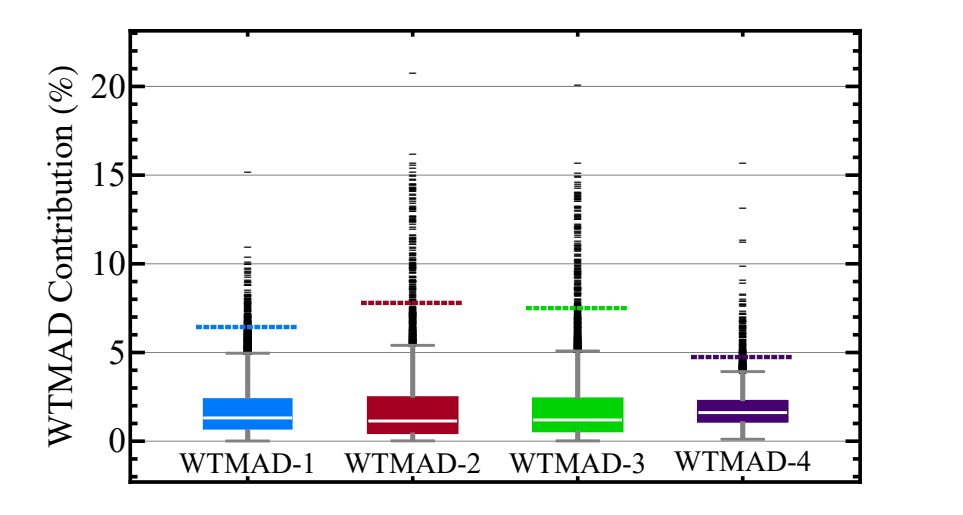
Assessing the accuracy of computational methods for predicting molecular properties presents a significant challenge, and researchers routinely employ benchmark datasets like GMTKN55 to evaluate performance. Kyle R. Bryenton from Dalhousie University and Erin R. Johnson, affiliated with both Dalhousie University and the University of Cambridge, alongside their colleagues, have identified a fundamental flaw in the standard methods used to analyse results from this crucial dataset. Their work reveals that commonly used weighting schemes unfairly penalise certain benchmarks, potentially leading to misleading conclusions about the effectiveness of different computational approaches. To address this issue, the team proposes a new weighting scheme, WTMAD-4, which ensures a more balanced and accurate assessment of 135 different computational methods, ultimately advancing the field of computational chemistry by providing a fairer basis for comparison and improvement.
DFT Accuracy For Noncovalent Interactions
This research details a computational chemistry study focused on evaluating the performance of various Density Functional Theory (DFT) methods, particularly in predicting molecular properties and understanding non-covalent interactions. Scientists assessed a range of functionals and dispersion corrections using the GMTKN55 benchmark dataset, aiming to identify accurate and reliable methods for modeling chemical systems. The study systematically investigates how different computational approaches perform when calculating energies and predicting reaction outcomes. The research centers on computational chemistry, employing DFT to model molecular systems and utilizing the GMTKN55 dataset as a crucial benchmark for objectively comparing the performance of different functionals.
Dispersion corrections, essential for accurately modeling weak interactions like van der Waals forces, were also a key focus. Scientists used statistical measures to assess the accuracy of each method, with a particular emphasis on accurately modeling non-covalent interactions, vital in processes like molecular recognition and protein folding. The authors acknowledge the potential for bias in benchmarking, referencing Goodhart’s Law, which cautions against optimizing methods solely for performance on a specific dataset. This highlights the importance of ensuring that methods are generally predictive, rather than simply performing well on a limited set of tests.
GMTKN55 Benchmark Evaluation and WTMAD Improvement
Scientists meticulously examined the widely used GMTKN55 benchmark dataset, a compilation of 55 tests spanning thermochemistry, reaction barriers, and non-covalent interactions, to identify inconsistencies in how performance is measured. The study revealed a fundamental flaw in commonly used weighted mean absolute deviation (WTMAD) metrics, discovering that certain benchmarks were significantly underweighted compared to others. To address this, the team proposed a new metric, WTMAD-4, grounded in the typical errors observed from well-behaved density-functional approximations, ensuring a fairer evaluation across all benchmarks. The research involved a comprehensive assessment of 135 dispersion-corrected density-functional approximations, combining previously published data with new calculations performed using the FHI-aims code, leveraging its capabilities in exchange-hole dipole moment and many-body dispersion corrections.
Scientists carefully analyzed the weighting of each benchmark, identifying that some benchmarks unduly influenced the overall WTMAD score while others contributed negligibly. To establish a more balanced evaluation, the team developed WTMAD-4 based on the observed errors of reliable density-functional approximations, effectively normalizing the contribution of each benchmark. This new metric was designed to address inconsistencies inherent in previous weighting schemes, where the average reference energy varied between publications, creating confusion and potentially biased results. Scientists identified that commonly used weighted mean absolute deviation (WTMAD) metrics disproportionately weight certain benchmarks, masking the true performance of density functional approximations (DFAs). Specifically, benchmarks with larger datasets unduly influenced the results, while others received minimal consideration, creating a biased evaluation. To rectify this, the team proposed a new WTMAD-4 metric, constructed similarly to an earlier scheme but with weights based on expected error magnitudes rather than absolute energy scales.
This ensures each of the 55 benchmarks within GMTKN55 contributes meaningfully to the overall score, with contributions ranging from approximately 1 to 3 percent of the total. The researchers demonstrated that previous weighting schemes failed to fully correct for this bias, with some benchmarks contributing orders of magnitude more than others. The study involved a comprehensive assessment of 135 dispersion-corrected DFAs, combining previously published data with new results implemented in the FHI-aims code. The team identified that existing metrics unintentionally under-weighted certain benchmarks, leading to potentially skewed assessments of functional accuracy. Consequently, they developed a new weighting scheme, WTMAD-4, grounded in typical errors observed for well-behaved density functionals, to ensure a more balanced evaluation across all benchmarks. Applying this new metric to a comprehensive assessment of 135 dispersion-corrected density functionals revealed significant reordering in performance rankings, particularly among hybrid functionals.
The results demonstrate that the underlying density functional approximation generally exerts a stronger influence on overall performance than the specific dispersion correction employed. Notably, the B86bPBE0 functional, in combination with the XDM dispersion correction, achieved a particularly low error on a challenging set of automated molecules, suggesting its ability to accurately capture relevant physical interactions. The study highlights the importance of careful metric selection when evaluating electronic structure methods and provides a more robust framework for assessing functional performance. The authors acknowledge that the WTMAD-4 metric, while an improvement, is still a single-valued assessment and may not fully capture the nuanced performance of functionals across all chemical scenarios.
👉 More information
🗞 WTMAD-4: A Fair Weighting Scheme for GMTKN55
🧠 ArXiv: https://arxiv.org/abs/2509.23498