

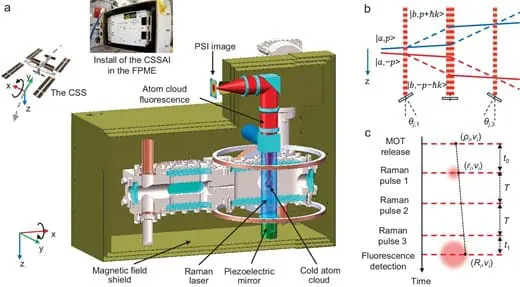
A research team led by Mingsheng Zhan from the Chinese Academy of Sciences developed the China Space Station Atom Interferometer (CSSAI), which was installed on the China Space Station in November 2022. The CSSAI successfully realized cold atom gyroscope measurements, achieving a rotational measurement uncertainty better than 3.0×10^-5 rad/s and an acceleration resolution better than 1.1×10^-6 m/s². The team analyzed error sources affecting space-based measurements and compared their results with classical gyroscopes on the CSS, demonstrating good agreement. This work marks the first realization of a space-based cold atom gyroscope and was published in the National Science Review.
High-precision space-based gyroscopes and their importance
High-precision space-based gyroscopes play a crucial role in both fundamental physics research and practical engineering applications. These devices are essential for testing relativistic effects such as frame-dragging, which helps explore the boundaries of general relativity and potentially discover new physical theories.
Several satellite projects have utilized traditional gyroscopes to test these effects. For instance, GP-B achieved an accuracy of 19%, while LARES reached 2%, demonstrating significant advancements in this field. However, atom interferometers (AIs) have emerged as a more promising technology for inertial measurements due to their ability to achieve higher precision in space. The CSSAI payload, developed by Mingsheng Zhan’s team at the Chinese Academy of Sciences, represents a major leap forward. Launched in 2022 and installed on the Chinese Space Station (CSS), CSSAI employs rubidium atoms for shearing interference fringes, achieving remarkable measurement accuracies. The team identified a “magic shearing angle” to minimize errors and developed calibration methods for precise measurements.
Implications for future high-precision quantum inertial sensors
The CSSAI payload represents a significant advancement in space-based quantum technology, utilizing rubidium atoms for shearing interference fringes to measure inertial quantities such as acceleration and rotation with high precision. A key innovation in its design is the identification of a “magic shearing angle,” which optimizes interference patterns to minimize measurement errors. This optimization enhances data accuracy and contributes significantly to the overall performance of the instrument. The CSSAI team implemented advanced calibration methods tailored to the space environment to ensure reliability. These methods address challenges posed by microgravity and other spatial conditions, enabling the interferometer to maintain high precision despite operational constraints. The analysis of error sources, including shearing angle inaccuracies and atom cloud parameters, is critical for improving future designs and meeting stringent performance requirements in space-based applications.
Comprehensive testing validated CSSAI’s measurements against those from classical gyroscopes on the Chinese Space Station, demonstrating consistent results and confirming the reliability of this new technology. This validation underscores CSSAI’s potential as a robust tool for advancing space-based research and applications in quantum inertial sensing.
More information
External Link: Click Here For More


