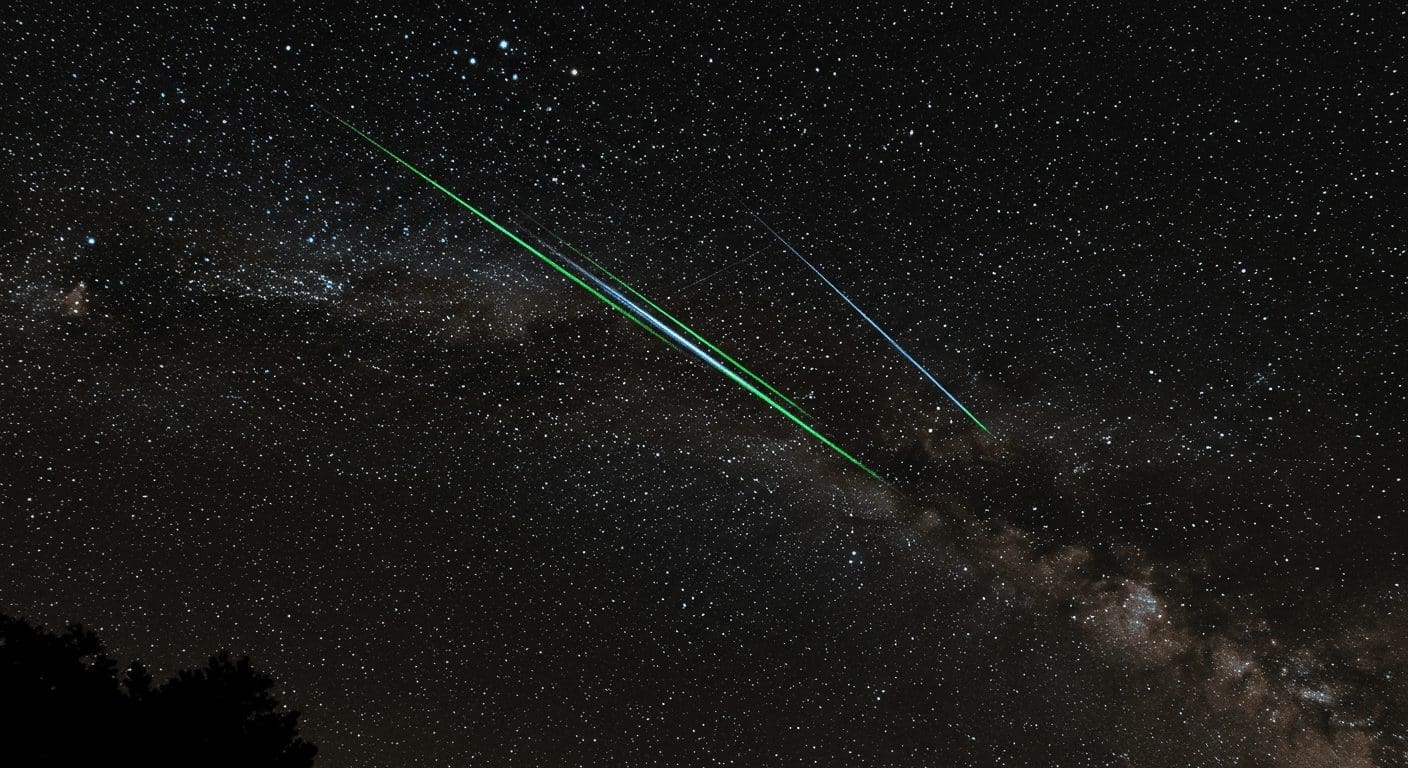
On April 1, 2025, researchers published A Comparison of Geminid Models with the PSP/WISPR-observed Phaethon Dust Trail, revealing discrepancies between observed dust trail dynamics and existing Geminid meteoroid models, suggesting that the parent body’s orbit may differ from Phaethon’s current trajectory.
White-light observations from WISPR on Parker Solar Probe identified a narrow dust trail near asteroid 3200 Phaethon’s orbit, linked to Geminids but misaligned with known orbits. Comparing these findings with Geminid models revealed the trail likely represents the density core of the stream. However, all models place this core inside Phaethon’s orbit due to Poynting-Robertson forces, conflicting with WISPR observations showing an exterior position. This suggests Phaethon’s current orbit doesn’t match its parent body’s original orbit, implying a larger semi-major axis in the past. These insights provide new parameters for future Geminid modeling.
Meteoroids—small rocky or metallic bodies hurtling through space—are among the most enigmatic objects in our solar system. While they may seem like mere specks in the vastness of space, their origins and behavior hold clues to some of the universe’s most fundamental processes. Recent studies have shed new light on these celestial wanderers, revealing a complex interplay between cosmic dynamics, planetary evolution, and the forces that shape our solar system.
The Origins of Meteoroids
Meteoroids are remnants from the early days of the solar system, born out of the same primordial material that formed planets and stars. Many originate from the asteroid belt, a region of rocky debris located between Mars and Jupiter. Others are fragments ejected from comets as they approach the Sun, their icy surfaces vaporizing under the intense heat. These cosmic particles travel through space at breathtaking speeds, often exceeding tens of thousands of kilometers per hour.
Understanding how meteoroids move and interact with their environment is crucial to unraveling their role in shaping our solar system. As they traverse space, meteoroids are influenced by gravitational forces from planets and other celestial bodies. For instance, Jupiter’s massive gravity can alter the trajectory of passing meteoroids, sometimes flinging them into new orbits that bring them closer to Earth. This dynamic interplay highlights the interconnected nature of our solar system.
Detecting meteoroids is no easy feat, given their small size and high velocity. However, technological advancements have enabled scientists to track these elusive particles with greater precision. Ground-based telescopes and space-based observatories work in tandem to monitor meteoroid activity, providing valuable data on their composition, trajectory, and frequency. This information not only enhances our understanding of meteoroids but also helps mitigate the risks they pose to satellites and spacecraft.
While most meteoroids burn up harmlessly in Earth’s atmosphere, some do reach the surface, leaving behind craters that serve as a record of cosmic collisions throughout history. These impacts have played a significant role in shaping Earth’s geology and even influencing its climate. For example, the Chicxulub crater in Mexico is widely believed to be the result of an asteroid impact that led to the extinction of the dinosaurs. Understanding these events helps us better prepare for future encounters with potentially hazardous objects.
As our understanding of meteoroids continues to grow, so too does the potential for groundbreaking discoveries. By studying these cosmic particles, scientists hope to gain insights into the formation and evolution of our solar system, as well as the conditions that may have led to the emergence of life on Earth. Additionally, advancements in space exploration could one day allow us to harness meteoroids as a resource for future missions, marking a new chapter in humanity’s relationship with these enigmatic wanderers.
In conclusion, meteoroids are more than just shooting stars; they are cosmic messengers carrying secrets from the depths of space. By studying them, we not only gain a deeper understanding of our solar system but also prepare ourselves for the challenges and opportunities that lie ahead in our quest to explore the universe.
👉 More information
🗞A Comparison of Geminid Models with the PSP/WISPR-observed Phaethon Dust Trail
🧠 DOI: https://doi.org/10.48550/arXiv.2504.00616