WiMi Hologram Cloud Inc. developed a new Lean Classical-Quantum Hybrid Neural Network (LCQHNN) framework to maximize learning efficiency. The technology utilizes a four-layer variational quantum circuit (4-layer VQC) which achieved performance comparable to deeper circuits while reducing resource consumption. This marks a key step toward practical deployment of quantum neural networks.
Lean Classical-Quantum Hybrid Neural Network (LCQHNN) Architecture
The classical portion employs convolutional and fully connected layers for initial feature extraction and data preparation, outputting data embedded into a quantum state space for further processing. This embedding maps high-dimensional classical features into a multi-dimensional quantum Hilbert space, allowing the model to capture complex data with fewer parameters. WiMi’s design strategically incorporates controlled rotation and CNOT gates to create entanglement, improving the expressive power of the quantum feature space and nonlinear discrimination.
Quantum Feature Amplification & Entanglement Structure
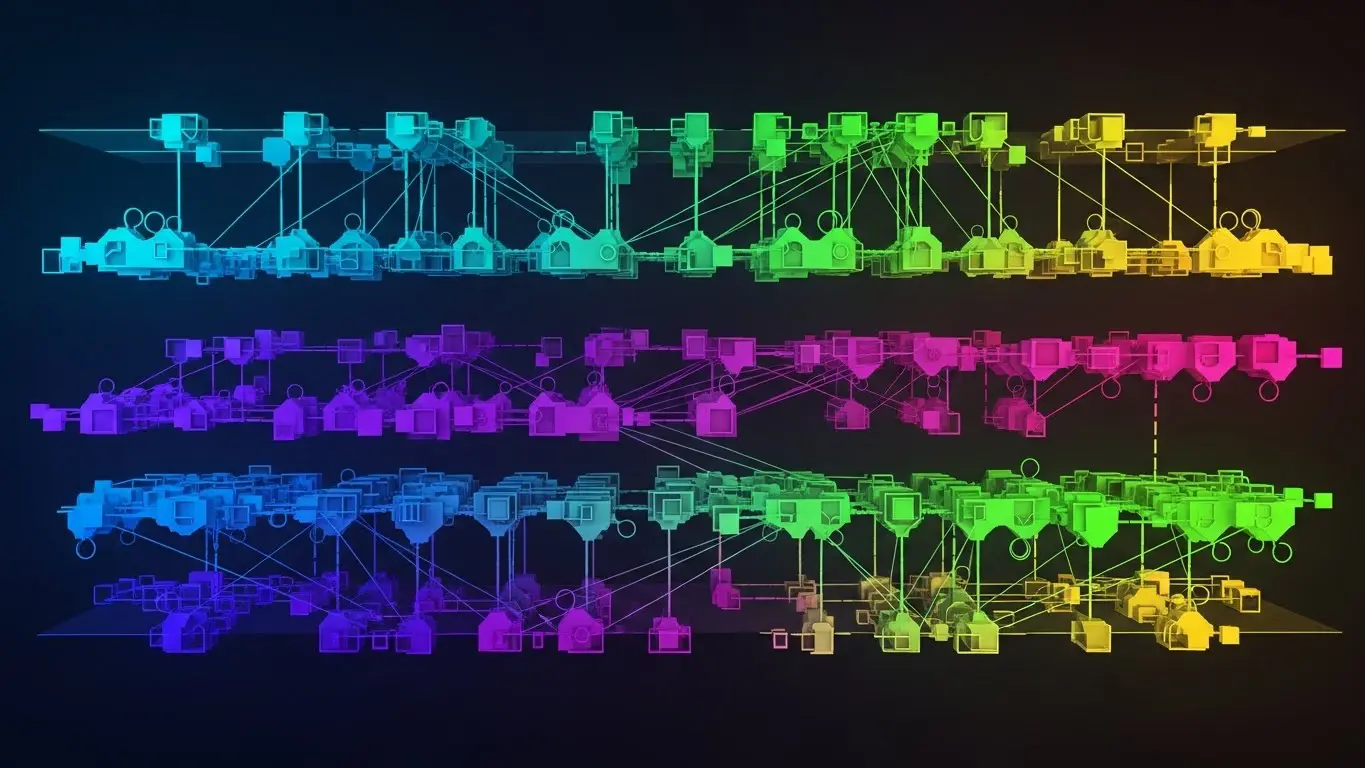
The LCQHNN framework centers on boosting quantum features while using classical optimization for efficiency. An appropriate number of entanglement layers is critical to performance; the four-layer variational circuit balances capability with practical implementation. Parameterized rotation and phase shift gates within each layer are adjusted through a gradient estimation method, reducing the quantum measurements needed for training.
Parameter Shift Rule for Efficient Hybrid Optimization
WiMi’s LCQHNN utilizes an efficient training mechanism based on the parameter shift rule to optimize quantum circuit parameters. This method reduces the quantum measurements needed for each parameter update, directly improving both the speed and stability of the overall training process. By minimizing measurement counts, the system addresses a key challenge in leveraging quantum resources for machine learning tasks. Classical optimizers, such as Adam or L-BFGS, adjust circuit parameters based on data gathered via this parameter shift rule approach. These adjustments aim to minimize classification error by refining the relationship between quantum state outputs and target categories. This coordinated classical-quantum optimization highlights how the model leverages quantum expressiveness alongside classical computational stability.
LCQHNN Demonstrates Strong Image Classification Performance
The LCQHNN framework achieves strong image classification results with a remarkably lean four-layer variational quantum circuit. This design is notable because it delivers performance equal to, or exceeding, that of deeper quantum circuits while minimizing resource demands and potential errors. Specifically, the network balances performance with practical implementation by focusing on quantum feature amplification combined with classical optimization techniques. WiMi’s approach generates distinct feature clusters during training, demonstrating strong separation between image categories within the quantum state space. The system uses amplitude encoding to compress data into qubits, allowing classical information to be stored efficiently in a quantum format.
Furthermore, optimized parameter updates—using an improved gradient estimation method—reduce the number of quantum measurements needed during training, speeding up the learning process.
This technology balances implementability and performance superiority in its design, marking a key step for quantum neural networks from theoretical feasibility toward practical deployment.
WiMi Hologram Cloud Inc.