
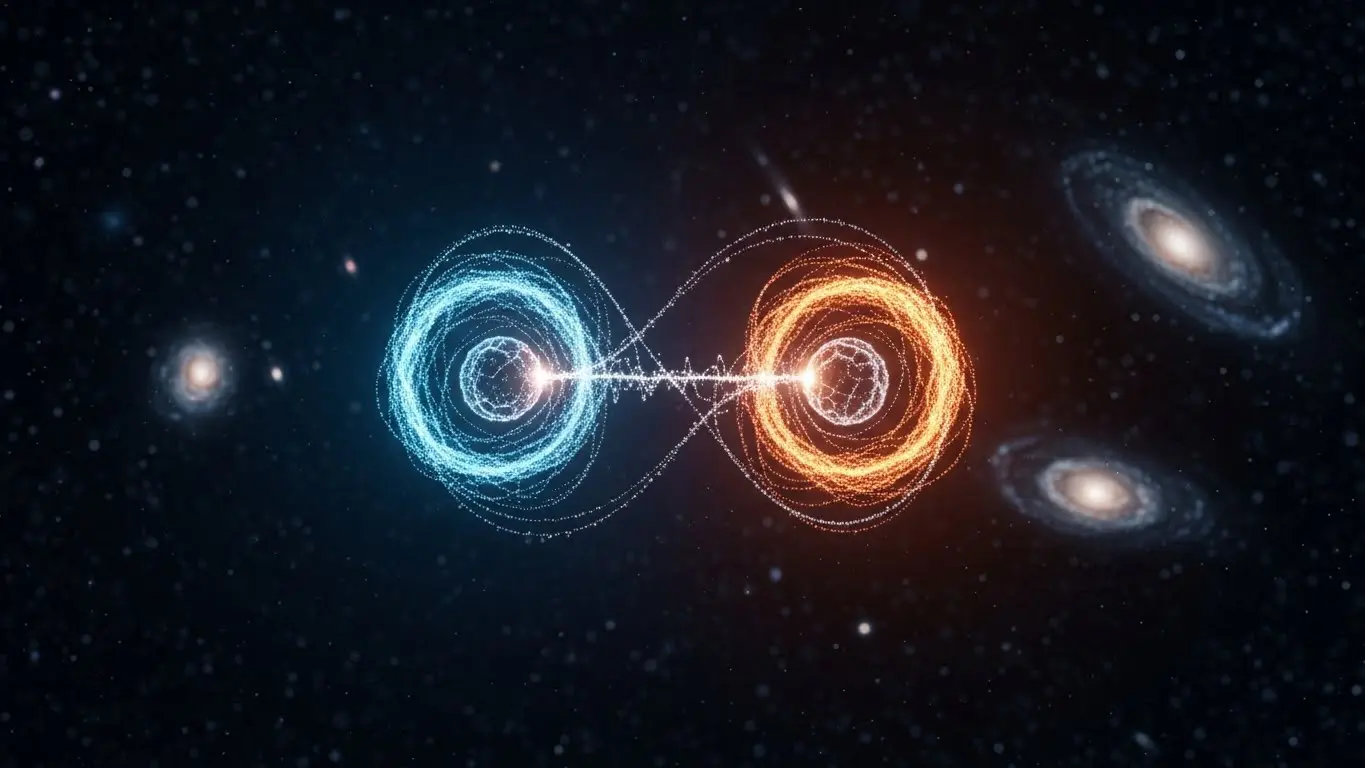
Albert Einstein’s skepticism of quantum entanglement, which he famously dismissed as “spooky action at a distance,” stemmed from his belief in a deterministic, local universe. He, along with Boris Podolsky and Nathan Rosen, argued in their 1935 EPR paradox paper that quantum mechanics must be incomplete, as it allowed particles to instantaneously influence one another across vast distances. However, decades of experimental and theoretical advances have conclusively shown that entanglement is not “spooky” in the sense of violating causality or enabling faster-than-light communication, but rather a fundamental feature of quantum reality. Modern physics now understands entanglement as a non-classical correlation between particles that defies classical intuition but adheres to strict physical laws. This article explores the principles of quantum entanglement, why Einstein’s objections were based on a misinterpretation of quantum theory, and how entanglement is now harnessed in cutting-edge technologies. By examining the mechanisms, challenges, and applications of entanglement, we uncover why it is no longer “spooky” but a cornerstone of quantum science.
The Fundamental Principles Behind Quantum Entanglement
Quantum entanglement arises from the superposition principle and the tensor product structure of quantum states. When two or more particles interact, their combined state cannot always be described independently, even if they are separated by arbitrary distances. This interdependence is encapsulated in the concept of entangled states, such as the Bell states, where the quantum state of one particle is inextricably linked to another. For example, two entangled photons in a singlet state will exhibit correlated polarization measurements, regardless of the distance between them. The key principle here is non-separability: the system’s total state cannot be factored into individual states of its components. This challenges classical notions of locality and realism, as entangled particles do not possess definite properties until measured. However, entanglement does not allow for faster-than-light communication, as the outcomes of measurements are random and cannot be controlled to transmit information. Instead, it reveals the intrinsic probabilistic nature of quantum mechanics, a framework Einstein famously resisted.
How Quantum Entanglement Works Mechanically
The mechanism of entanglement begins with the preparation of a quantum system in a superposition state. For instance, a pair of entangled photons can be generated via spontaneous parametric down-conversion (SPDC), where a nonlinear crystal splits a single photon into two entangled photons. These photons share a correlated quantum state, such as opposite polarizations. When one photon is measured, the act of measurement collapses the entangled state, instantaneously determining the state of the other photon. This correlation persists regardless of the distance between the particles, a phenomenon known as nonlocality. Crucially, no information is transmitted faster than light, as the measurement outcomes are random and cannot be predicted or controlled. The entanglement is preserved as long as the particles remain isolated from environmental interactions that cause decoherence. Experiments such as the Bell test, which measure correlations between entangled particles, have confirmed that these outcomes cannot be explained by classical hidden variables. Instead, they validate the quantum mechanical prediction that entangled systems exhibit stronger correlations than any local theory allows.
Bell’s Theorem and the Disproof of Local Hidden Variables
Einstein’s skepticism was rooted in the idea of local hidden variables—undiscovered parameters that would determine the outcomes of quantum measurements in a deterministic, local manner. However, John Bell’s 1964 theorem mathematically demonstrated that no local hidden variable theory could reproduce all predictions of quantum mechanics. Bell derived an inequality that sets an upper limit on the correlations between measurements of entangled particles if local hidden variables exist. Experiments, such as those by Alain Aspect in the 1980s and more recently by the NIST team in 2015, have repeatedly violated Bell’s inequality, confirming that quantum correlations exceed classical limits. These violations prove that entanglement cannot be explained by pre-existing properties or local influences. Instead, the outcomes depend on the quantum state of the entire system, even when particles are separated by large distances. This does not imply faster-than-light communication but rather that quantum mechanics operates under fundamentally non-classical principles. Einstein’s insistence on locality and realism was incompatible with these results, which have now been empirically validated to high precision.
The NIST Experiments and the Validation of Entanglement
In 2015, a groundbreaking experiment by the National Institute of Standards and Technology (NIST) provided one of the most definitive confirmations of quantum entanglement. The team generated entangled photon pairs and performed a loophole-free Bell test, ensuring that all potential classical explanations for the observed correlations were ruled out. By using fast-switching measurement bases and ensuring that the photons were spacelike separated (i.e., no information could travel between them at light speed), the experiment conclusively demonstrated that entangled particles exhibit nonlocal correlations. The measured violation of Bell’s inequality exceeded the classical limit by over 15 standard deviations, leaving no room for doubt. This experiment, along with others, has cemented entanglement as a real and measurable phenomenon. It also addressed a key criticism of earlier Bell tests, which had loopholes such as detection inefficiencies. The NIST work showed that entanglement is not an artifact of experimental limitations but a fundamental property of quantum systems.
The Role of Quantum Error Correction in Maintaining Entanglement
One of the most significant challenges in harnessing entanglement is decoherence, the loss of quantum coherence due to interactions with the environment. Decoherence disrupts entangled states by causing them to collapse into classical mixtures, effectively destroying the nonlocal correlations. To combat this, quantum error correction (QEC) has emerged as a critical tool. QEC encodes quantum information into redundant states across multiple qubits, allowing errors to be detected and corrected without directly measuring the qubits—a process that would collapse their state. For example, the surface code, a leading QEC method, uses a two-dimensional lattice of qubits to detect and correct errors caused by decoherence or noise. By continuously monitoring ancillary qubits, the code identifies error syndromes and applies corrections to preserve the entangled state. While QEC requires significant overhead in terms of qubit count and control precision, it is essential for building scalable quantum systems. Without error correction, entanglement would be too fragile to use in practical applications like quantum computing or communication.
Challenges in Decoherence and Scalability
Despite advances in error correction, decoherence remains a major obstacle. Even the best cryogenic systems, which isolate qubits at temperatures near absolute zero, cannot completely eliminate environmental noise. For superconducting qubits, decoherence times are typically in the range of microseconds to milliseconds, depending on materials and design. Ion trap qubits, which have longer coherence times (up to seconds), face challenges in scaling to large numbers of qubits due to the complexity of trapping and controlling many ions. Another issue is entanglement distribution—maintaining high-fidelity entanglement across large distances. Quantum networks require entanglement to be shared between nodes, but losses in fiber optics and the lack of efficient quantum repeaters limit current systems to a few hundred kilometers. Additionally, gate fidelity—the accuracy of quantum operations—must exceed 99.9% to ensure reliable computation. While current gate fidelities in leading quantum processors are approaching this threshold, achieving fault tolerance with QEC requires even higher precision. These challenges highlight the difficulty of transitioning from small-scale demonstrations to large-scale, error-corrected quantum systems.
Current Performance Benchmarks and Metrics
As of 2025, quantum systems are achieving impressive benchmarks in qubit count, coherence times, and gate fidelities. Superconducting qubits, such as those used in IBM’s 127-qubit Eagle and Google’s 72-qubit Bristlecone processors, have coherence times ranging from 100 microseconds to 1 millisecond, depending on the qubit architecture. Ion trap systems, like those developed by Honeywell and IonQ, demonstrate coherence times exceeding 10 seconds, but face limitations in scalability, with current devices hosting up to 32 qubits. Gate fidelities for single-qubit operations have surpassed 99.99%, while two-qubit gates are approaching 99.5% in the best systems. Error correction requires two-qubit gate fidelities above 99.9%, a target that is now within reach for leading platforms. Entanglement generation rates are also improving, with recent experiments demonstrating the creation of entangled photon pairs at rates exceeding 10^6 pairs per second. These metrics indicate that quantum systems are nearing the threshold for practical applications, though challenges in scalability and error correction remain.
Key Players and Innovations in Quantum Entanglement Research
The development of quantum technologies is driven by a mix of academic, governmental, and corporate efforts. Companies like IBM, Google, and Rigetti are advancing superconducting qubit architectures, while startups such as IonQ and Quantinuum specialize in trapped-ion systems. Academic institutions, including the University of Innsbruck and MIT, have pioneered techniques for high-fidelity quantum gates and error correction. Government agencies like the U.S. National Quantum Initiative and the European Quantum Flagship are funding large-scale projects to build quantum networks and improve entanglement distribution. Innovations such as photonic quantum computing, which uses entangled photons for low-decoherence operations, and hybrid systems that combine different qubit types, are also gaining traction. These efforts are accelerating the transition from theoretical concepts to real-world applications, making entanglement a cornerstone of quantum information science.
Applications of Quantum Entanglement in Modern Technology
Entanglement is the foundation of emerging quantum technologies, including quantum computing, quantum communication, and quantum sensing. In quantum computing, entangled qubits enable parallel processing of information through quantum algorithms like Shor’s algorithm for factoring large numbers and Grover’s algorithm for database searches. Quantum communication leverages entanglement for secure key distribution in quantum key distribution (QKD) protocols, such as BB84 and E91, which use the no-cloning theorem to detect eavesdropping. Quantum networks, which aim to connect quantum computers and sensors, rely on entanglement to enable distributed quantum computation and ultra-precise measurements. For example, entangled atomic clocks could improve GPS accuracy, while entangled photon pairs could enhance imaging and sensing in low-light conditions. These applications demonstrate that entanglement is not merely a theoretical curiosity but a practical resource for advancing technology beyond classical limits.
The Future of Quantum Entanglement and Its Implications
As quantum technologies mature, the role of entanglement will expand beyond specialized research to mainstream applications. The development of quantum repeaters, which use entanglement swapping and purification to extend the range of quantum networks, could enable global quantum internet infrastructure. In computing, fault-tolerant quantum computers with millions of error-corrected qubits may solve problems intractable for classical systems, such as simulating complex molecules for drug discovery. Additionally, advances in quantum sensing, which exploit entanglement to surpass classical precision limits, could revolutionize fields like metrology, medical imaging, and gravitational wave detection. While challenges remain in scalability, error correction, and materials science, the theoretical and experimental progress in entanglement research suggests that Einstein’s “spooky” phenomenon is not a flaw in quantum mechanics but a gateway to transformative technologies.
Conclusion: Embracing the Quantum Paradigm
Einstein’s resistance to quantum entanglement was rooted in his belief in a deterministic, local universe—a paradigm that quantum mechanics has since shown to be incomplete. Modern experiments have conclusively demonstrated that entanglement is a real, measurable feature of nature, governed by well-defined physical laws. Far from being “spooky,” entanglement is now understood as a resource for building technologies that transcend classical capabilities. From secure communication to ultra-precise sensing, entanglement is reshaping our understanding of reality and enabling breakthroughs once thought impossible. As quantum science continues to evolve, it is clear that Einstein’s skepticism was not a testament to the flaws of quantum theory but a reflection of the limitations of 20th-century physics. Today, entanglement stands as a cornerstone of the quantum revolution, proving that the universe is far more intricate—and less “spooky”—than Einstein imagined.