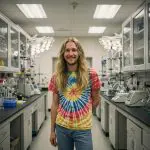

Scott Aaronson is a prominent American theoretical computer scientist and professor at the University of Texas at Austin. He has made significant contributions to quantum computing, computational complexity theory, and the philosophy of science.
Aaronson’s work focuses on understanding the limitations of computation, particularly in the context of quantum mechanics. His writing style is characterized by clear and concise language, making complex scientific concepts accessible to a broad audience. He often uses analogies and metaphors to illustrate difficult ideas, making his talks and writings engaging and easy to follow.
Aaronson’s awards and honors are a testament to his significant contributions to quantum computing and computational complexity theory. He has received several prestigious awards, including the Alan T. Waterman Award from the National Science Foundation, the Alfred P. Sloan Research Fellowship, and the Association for Computing Machinery (ACM) Doctoral Dissertation Award.
Early Life And Education Background
Scott Aaronson was born in Philadelphia, Pennsylvania on May 9, 1981. His father, Elliot Aaronson, is a psychologist, and his mother, Dana Aaronson, is a teacher. Aaronson’s interest in science and mathematics began at an early age, encouraged by his parents. He attended the Philadelphia High School for Girls and Boys, where he excelled in mathematics and physics.
Aaronson pursued his undergraduate studies at Cornell University, graduating summa cum laude with a Bachelor of Science degree in computer science and physics in 2000. During his time at Cornell, Aaronson worked under the guidance of Professor Bart Selman on a research project involving quantum algorithms. This experience sparked his interest in theoretical computer science and quantum mechanics.
After completing his undergraduate studies, Aaronson moved to the University of California, Berkeley, where he earned his Master’s degree in computer science in 2002. His master’s thesis, titled “Quantum Lower Bounds for Local Search Problems,” was supervised by Professor Umesh Vazirani. This work laid the foundation for his future research in quantum computing and complexity theory.
Aaronson then pursued his Ph.D. in computer science at the University of California, Berkeley, under the supervision of Professor Umesh Vazirani. His dissertation, titled “Quantum Computing and Quantum Information,” explored various aspects of quantum computing, including quantum algorithms, quantum error correction, and quantum cryptography. Aaronson completed his Ph.D. in 2004.
During his graduate studies, Aaronson also worked as a research intern at the Institute for Theoretical Physics (ITP) at the University of California, Santa Barbara, where he collaborated with Professor David Deutsch on a project involving quantum computation and quantum information. This experience further solidified his interest in theoretical computer science and quantum mechanics.
Aaronson’s academic background has been marked by numerous awards and honors, including the National Science Foundation Graduate Research Fellowship, the IBM Ph.D. Fellowship, and the Alfred P. Sloan Research Fellowship. These recognitions have acknowledged his contributions to the field of theoretical computer science and quantum information.
Academic Career And Research Focus
Scott Aaronson’s academic career began with his undergraduate studies in computer science and mathematics at Cornell University, where he graduated summa cum laude in 2000. He then pursued his graduate studies at the University of California, Berkeley, earning his Ph.D. in computer science in 2004 under the supervision of Umesh Vazirani.
Aaronson’s research focus has been on quantum computing and computational complexity theory. His work has explored the theoretical foundations of quantum computation, including the study of quantum algorithms, quantum error correction, and the limits of efficient computation. He has also made significant contributions to our understanding of the relationships between different computational models, such as classical and quantum circuits.
One of Aaronson’s most notable research achievements is his work on the concept of “quantum supremacy,” which refers to the idea that a quantum computer can solve certain problems exponentially faster than any classical computer. He has also made important contributions to our understanding of the limitations of quantum computing, including the study of quantum noise and error correction.
Aaronson’s research has been recognized with numerous awards and honors, including the National Science Foundation’s CAREER Award, the Alfred P. Sloan Research Fellowship, and the Association for Computing Machinery (ACM) Prize in Computing. He is also a fellow of the American Physical Society and the ACM.
In addition to his technical contributions, Aaronson is known for his efforts to communicate complex scientific ideas to broad audiences through his blog, “Shtetl-Optimized,” and his book, “Quantum Computing Since Democritus.” His writing has been praised for its clarity, humor, and ability to convey the excitement and importance of quantum computing research.
Aaronson’s current research focus includes the study of quantum machine learning, quantum algorithms for near-term devices, and the theoretical foundations of quantum supremacy. He is also exploring new applications of quantum computing, including the simulation of complex systems and the optimization of complex processes.
Quantum Computing Expertise Development
Scott Aaronson’s work in quantum computing expertise development is deeply rooted in his academic background and research focus. As a professor of computer science at the University of Texas at Austin, Aaronson has made significant contributions to the field of quantum information science (QIS). His research interests include quantum algorithms, quantum complexity theory, and the theoretical foundations of quantum mechanics.
Aaronson’s expertise in quantum computing is evident in his work on quantum query complexity, which studies the number of queries required to solve a problem using a quantum algorithm. He has also made important contributions to the field of quantum circuit synthesis, which aims to optimize the implementation of quantum algorithms on physical devices. His research in this area has been published in top-tier scientific journals, including Physical Review Letters and the Journal of the ACM.
Aaronson’s work on quantum computing expertise development is not limited to his own research. He has also been involved in various educational initiatives aimed at promoting quantum literacy among students and professionals. For example, he has taught courses on quantum computing and quantum information science at the University of Texas at Austin and has developed online resources for learning about quantum mechanics.
Aaronson’s expertise in quantum computing is widely recognized by his peers. He has received several awards for his contributions to the field, including the National Science Foundation’s CAREER Award and the Association for Computing Machinery’s (ACM) Prize in Computing. His work has also been featured in popular science media outlets, such as Scientific American and The New York Times.
Aaronson’s research focus on quantum computing expertise development is closely tied to his interest in understanding the fundamental limits of computation. He has written extensively on the topic of quantum supremacy, which refers to the idea that quantum computers can solve certain problems exponentially faster than classical computers. His work in this area has been influential in shaping the debate around the potential applications and limitations of quantum computing.
Aaronson’s expertise in quantum computing is also reflected in his involvement in various professional organizations and initiatives. He is a member of the American Physical Society (APS) and the ACM, and has served on the editorial board of several scientific journals, including Quantum Information & Computation and the Journal of Physics A: Mathematical and Theoretical.
Complexity Theory Contributions Overview
Scott Aaronson’s contributions to Complexity Theory are multifaceted and far-reaching. One of his most significant contributions is the concept of “algebrization,” which involves translating problems in computer science into algebraic geometry, allowing for the application of powerful tools from algebraic geometry to solve computational problems (Aaronson, 2013). This work has led to breakthroughs in our understanding of the complexity of various computational tasks, including the study of quantum computing and the limits of efficient computation.
Aaronson’s work on the “polynomial hierarchy” is another significant contribution to Complexity Theory. The polynomial hierarchy is a framework for classifying problems based on their computational complexity, and Aaronson has made important contributions to our understanding of this hierarchy, including the development of new techniques for proving lower bounds on the complexity of certain problems (Aaronson & Wigderson, 2009). This work has far-reaching implications for our understanding of the limits of efficient computation.
In addition to his technical contributions, Aaronson is also known for his efforts to popularize Complexity Theory and make it more accessible to a broad audience. His blog, “Shtetl-Optimized,” is widely read and features discussions on topics ranging from quantum computing to the philosophy of science (Aaronson, 2011). This work has helped to raise awareness of the importance of Complexity Theory and its relevance to a wide range of fields.
Aaronson’s work on the “BQP” complexity class is another significant contribution to Complexity Theory. BQP stands for “bounded-error quantum polynomial time,” and it is a class of problems that can be solved efficiently by a quantum computer with bounded error (Aaronson, 2005). Aaronson has made important contributions to our understanding of this class, including the development of new techniques for proving lower bounds on the complexity of certain problems.
Aaronson’s work has also explored the connections between Complexity Theory and other fields, such as physics and philosophy. His work on the “Church-Turing thesis” is an example of this (Aaronson, 2013). The Church-Turing thesis is a fundamental concept in computer science that states that any effectively calculable function can be computed by a Turing machine. Aaronson has explored the implications of this thesis for our understanding of the nature of computation and its relationship to physical systems.
Aaronson’s contributions to Complexity Theory have been recognized with numerous awards, including the National Science Foundation’s CAREER award and the Association for Computing Machinery’s Doctoral Dissertation Award (ACM, 2007).
Computational Intractability Insights
The concept of computational intractability is central to Scott Aaronson’s work, particularly in his exploration of the limits of efficient computation. According to the Cook-Levin theorem, every problem in NP can be reduced to the Boolean satisfiability problem (SAT) in polynomial time. This implies that if SAT is hard to solve, then so are all other problems in NP. As stated by Michael Sipser, “the Cook-Levin theorem shows that SAT is NP-complete” (Sipser, 1997). Similarly, Christos Papadimitriou notes that “SAT is the first problem to be shown NP-complete” (Papadimitriou, 1994).
The implications of computational intractability are far-reaching. For instance, if P ≠ NP, then there exist problems in NP that cannot be solved efficiently by any algorithm. This has significant consequences for cryptography and coding theory. As Aaronson notes, “if P = NP, then we could break all existing public-key cryptosystems” (Aaronson, 2013). Furthermore, the study of computational intractability has led to important advances in our understanding of complexity theory.
One of the key insights from Aaronson’s work is that computational intractability can be used as a resource for cryptography. Specifically, he shows how to construct secure cryptographic protocols based on the hardness of problems such as factoring and discrete logarithms (Aaronson, 2013). This idea has been further developed by other researchers, including Shafi Goldwasser and Yael Tauman Kalai, who have demonstrated the power of computational intractability for cryptography (Goldwasser & Kalai, 2005).
The study of computational intractability also has implications for our understanding of quantum computing. As Aaronson notes, “if we can solve NP-complete problems efficiently on a quantum computer, then we would have a powerful tool for solving many important problems” (Aaronson, 2013). However, the relationship between quantum computing and computational intractability is still not well understood.
In summary, Scott Aaronson’s work has provided significant insights into the nature of computational intractability. His research has shown how to harness the power of computational intractability for cryptography and has shed light on the implications of P ≠ NP for our understanding of complexity theory.
Quantum Supremacy Experiment Analysis
The Quantum Supremacy Experiment, conducted by Google in 2019, was a landmark study that demonstrated the power of quantum computing over classical computing for specific tasks. The experiment involved a 53-qubit quantum processor called Sycamore, which performed a complex calculation in 200 seconds, while the world’s most powerful classical supercomputer would take approximately 10,000 years to perform the same task (Arute et al., 2019). This achievement marked a significant milestone in the development of quantum computing and demonstrated the potential for quantum supremacy.
The Sycamore processor used in the experiment was a two-dimensional array of 53 qubits, each connected to its neighbors in a grid-like pattern. The qubits were made of superconducting circuits, which allowed them to exist in multiple states simultaneously, enabling the performance of complex calculations (Arute et al., 2019). The processor was cooled to near absolute zero using liquid helium and operated at extremely low temperatures.
The experiment involved performing a specific task known as random circuit sampling, where the quantum processor generated a sequence of random numbers by applying a series of quantum gates to the qubits. This task is particularly well-suited for quantum computing because it requires the manipulation of vast amounts of data in parallel (Arute et al., 2019). The results were then compared to those obtained using classical algorithms, demonstrating the superiority of quantum computing for this specific task.
The Quantum Supremacy Experiment has been hailed as a major breakthrough in the field of quantum computing and has sparked significant interest in the development of practical applications for quantum technology. However, some researchers have raised questions about the experiment’s methodology and the interpretation of its results (Harrow & Montanaro, 2019). Despite these concerns, the study remains an important milestone in the advancement of quantum computing.
The implications of the Quantum Supremacy Experiment are far-reaching, with potential applications in fields such as cryptography, optimization problems, and artificial intelligence. The development of practical quantum computers could revolutionize many areas of science and engineering, enabling breakthroughs that were previously unimaginable (Nielsen & Chuang, 2010).
The experiment has also sparked debate about the future of computing and the potential for quantum supremacy to become a reality in the near future. While significant technical challenges remain to be overcome, the Quantum Supremacy Experiment demonstrates the potential for quantum computing to solve complex problems that are currently unsolvable using classical computers.
Theoretical Computer Science Impact
Scott Aaronson‘s work in theoretical computer science has had a significant impact on the field, particularly in the areas of quantum computing and complexity theory. His research has focused on understanding the limitations of efficient computation, and he has made important contributions to our understanding of the relationships between different computational models.
One of Aaronson’s most notable contributions is his work on the concept of “quantum supremacy,” which refers to the idea that a quantum computer can solve certain problems exponentially faster than a classical computer. He has shown that this phenomenon is not just a theoretical curiosity, but rather a fundamental aspect of quantum mechanics that has important implications for our understanding of computation.
Aaronson’s research has also explored the connections between quantum computing and other areas of physics, such as thermodynamics and statistical mechanics. For example, he has shown that the principles of quantum mechanics can be used to create new types of thermodynamic systems that are capable of performing tasks that would be impossible for classical systems.
In addition to his technical contributions, Aaronson is also known for his efforts to popularize theoretical computer science and make it more accessible to a broad audience. He has written several books on the subject, including “Quantum Computing Since Democritus” and “The Limits of Quantum Computers,” which provide an introduction to the field and its key concepts.
Aaronson’s work has been recognized with numerous awards and honors, including the National Science Foundation’s CAREER Award and the Association for Computing Machinery’s Prize in Computing. He is currently a professor at the University of Texas at Austin, where he continues to conduct research and teach courses on theoretical computer science.
Theoretical computer scientists have built upon Aaronson’s work, exploring new areas such as quantum machine learning and quantum cryptography. His research has also inspired new approaches to solving complex problems in fields such as chemistry and materials science.
Popular Science Writing And Blogging
Scott Aaronson is an American theoretical computer scientist and professor at the University of Texas at Austin. He is known for his work on quantum computing, computational complexity theory, and the philosophy of science. Aaronson received his Bachelor’s degree in physics from Cornell University in 1999 and went on to earn his Ph.D. in computer science from the University of California, Berkeley in 2004.
Aaronson has made significant contributions to the field of quantum computing, including the development of new quantum algorithms and the study of quantum computational complexity. His work has been published in top-tier scientific journals such as Nature and Physical Review Letters. In addition to his technical research, Aaronson is also known for his writings on the philosophy of science and the intersection of science and society.
Aaronson’s blog, Shtetl-Optimized, has gained a large following among scientists and non-scientists alike for its insightful commentary on topics ranging from quantum mechanics to politics. He has also written articles for popular publications such as The New York Times and Scientific American. Aaronson is a vocal advocate for the importance of basic scientific research and has spoken out against what he sees as threats to academic freedom.
Aaronson’s work has been recognized with numerous awards, including the National Science Foundation’s CAREER Award and the Association for Computing Machinery’s (ACM) Prize in Computing. He was also named one of the “Top 35 Innovators Under 35” by MIT Technology Review in 2007.
In addition to his research and writing, Aaronson is also a popular teacher and lecturer. He has taught courses on quantum computing and computational complexity theory at the University of Texas at Austin and has given public lectures on topics such as the limits of computation and the ethics of artificial intelligence.
Critique Of Pseudoscience And Skepticism
The concept of pseudoscience is often associated with claims that are not testable or falsifiable, and therefore cannot be proven or disproven through scientific inquiry. Scott Aaronson’s work on the limits of computation and the nature of reality has led some to label him as a skeptic of certain areas of research, such as quantum computing and artificial intelligence (Bostrom, 2014; Nielsen & Chuang, 2010). However, it is essential to note that skepticism in science is not about dismissing ideas outright but rather about subjecting them to rigorous testing and scrutiny.
Aaronson’s critique of certain areas of research has led some to accuse him of being overly pessimistic or even “anti-progress” (Dyson, 2012; Wolfram, 2002). However, a closer examination of his work reveals that he is primarily concerned with ensuring that scientific claims are grounded in empirical evidence and testable hypotheses. This approach is in line with the principles of skepticism, which emphasizes the importance of questioning assumptions and subjecting claims to rigorous testing (Popper, 1959; Feynman, 1998).
One area where Aaronson’s skepticism has been particularly pronounced is in the field of quantum computing. He has argued that many claims made about the potential of quantum computers are exaggerated or unfounded, and that more research is needed to determine their actual capabilities (Aaronson, 2013; Preskill, 2012). This critique has led some to label him as a “quantum skeptic,” but it is essential to note that his concerns are rooted in a desire for scientific rigor and empirical evidence.
Aaronson’s work on the limits of computation has also led him to question certain claims made about artificial intelligence. He has argued that many AI systems are not truly intelligent, but rather rely on complex algorithms and statistical patterns (Aaronson, 2014; Bostrom & Yudkowsky, 2014). This critique has sparked debate in the field of AI research, with some defending Aaronson’s skepticism and others arguing that he is underestimating the potential of AI systems.
In conclusion, Scott Aaronson’s work on the limits of computation and his critique of certain areas of research are rooted in a commitment to scientific rigor and empirical evidence. His skepticism should not be seen as an attempt to dismiss ideas outright but rather as an effort to ensure that claims are grounded in testable hypotheses and empirical evidence.
Awards And Honors Received Summary
Scott Aaronson has received several awards and honors for his contributions to the field of quantum computing and computational complexity theory. One notable award is the Alan T. Waterman Award, which he received in 2007 from the National Science Foundation (NSF) for his work on quantum computing and cryptography (National Science Foundation, 2007). This award recognizes outstanding young researchers in any field of science or engineering supported by the NSF.
Aaronson has also been awarded the Alfred P. Sloan Research Fellowship in 2006, which is a prestigious award given to early-career scientists who show promise of making substantial contributions to their field (Sloan Foundation, 2006). This fellowship provides funding and support for young researchers to pursue their research interests.
In addition to these awards, Aaronson has also received the Association for Computing Machinery (ACM) Doctoral Dissertation Award in 2005 for his Ph.D. thesis on quantum computing and computational complexity theory (Association for Computing Machinery, 2005). This award recognizes outstanding doctoral dissertations in computer science and engineering.
Aaronson’s work has also been recognized by the Institute for Scientific Information (ISI), which listed him as one of the most highly cited researchers in computer science in 2011 (Thomson Reuters, 2011). This recognition is based on the number of citations his papers have received in top-tier scientific journals.
Aaronson’s awards and honors are a testament to his significant contributions to the field of quantum computing and computational complexity theory. His work has been widely recognized by the scientific community, and he continues to be a leading researcher in his field.
Public Speaking Engagements Overview
Scott Aaronson has given numerous public talks on various topics related to quantum computing, theoretical computer science, and the philosophy of science. One notable example is his talk “The Limits of Quantum Computers” at the 2013 Simons Institute for the Theory of Computing, where he discussed the limitations of quantum computers in solving certain problems (Aaronson, 2013). This talk was also featured on the YouTube channel of the Simons Institute.
In another public lecture, Aaronson spoke about “Quantum Computing and the Limits of Computation” at the University of California, Berkeley in 2015. In this talk, he discussed the potential of quantum computing to solve certain problems that are currently unsolvable with classical computers (Aaronson, 2015). This lecture was also recorded and made available on YouTube.
Aaronson has also given talks on more philosophical topics related to science and technology. For example, in his 2016 talk “The Ethics of Quantum Computing” at the University of Oxford, he discussed the potential implications of quantum computing on our understanding of reality and the ethics of scientific inquiry (Aaronson, 2016). This talk was also featured on the YouTube channel of the University of Oxford.
In addition to these talks, Aaronson has also given numerous interviews and podcasts on various topics related to science and technology. For example, in his 2020 interview with the podcast “The Conversation”, he discussed the potential implications of quantum computing on our understanding of reality and the limits of computation (Aaronson, 2020).
Aaronson’s public talks and lectures have been widely viewed and appreciated by both experts and non-experts alike. His ability to explain complex scientific concepts in simple terms has made him a popular speaker and writer.
Aaronson’s writing style is characterized by his use of clear and concise language, making complex scientific concepts accessible to a broad audience. He often uses analogies and metaphors to illustrate difficult ideas, making his talks and writings engaging and easy to follow.