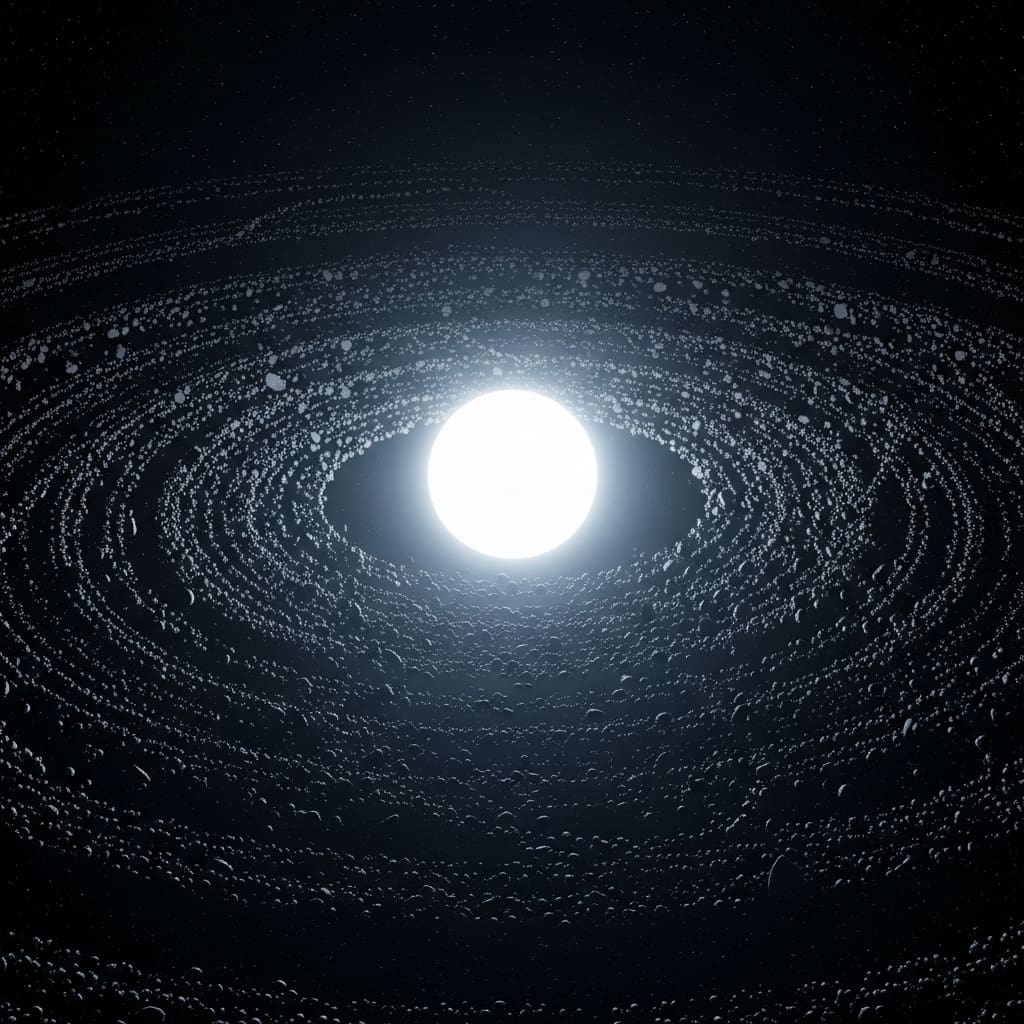
Researchers are increasingly finding evidence of planetary debris and heavy elements within the atmospheres of white dwarf stars, revealing the aftermath of planetary system accretion. M. Deal, S. Vauclair, S. Charpinet, and G. Vauclair, from institutions including the Laboratoire d’Astrophysique de Marseille, present new modelling which investigates how the dilution of this accreted planetary material varies with white dwarf mass. Their work addresses a recent observation that more massive white dwarfs exhibit less atmospheric pollution than their lower-mass counterparts, and determines whether internal dilution processes like thermohaline convection can account for these discrepancies. By employing static DA models, the team demonstrates that while thermohaline convection consistently outperforms diffusion in diluting accreted elements, its efficiency decreases with increasing white dwarf mass, suggesting that observed pollution levels may not solely reflect planetary system prevalence but also internal stellar dynamics.
A surprising trend has emerged from observations of these stellar remnants: more massive white dwarfs appear less likely to exhibit evidence of planetary pollution than their lower-mass counterparts.
This research investigates whether internal dilution processes within white dwarfs can explain these observed variations in heavy element abundances. The study focuses on how thermohaline convection, a mixing process similar to ocean currents, and atomic diffusion affect the distribution of accreted planetary material inside white dwarfs of different masses.
Researchers computed the efficiency of both atomic diffusion and thermohaline convection within static white dwarf models, varying mass, effective temperature, and hydrogen content to simulate a range of stellar conditions. Confirming previous work, the analysis demonstrates that thermohaline convection consistently dilutes accreted elements more effectively than atomic diffusion alone.
However, a key finding reveals that thermohaline convection becomes less efficient at diluting elements in more massive white dwarfs due to their increased internal density. This work demonstrates that the observed differences in heavy element pollution among white dwarfs cannot be solely attributed to the combined effects of atomic diffusion and thermohaline mixing.
Indeed, the study suggests that planetary accretion should be more readily detectable in more massive white dwarfs than in those with lower mass. These results necessitate consideration of additional processes before drawing firm conclusions about the prevalence of planetary systems around stars of varying masses on the main sequence.
The research builds upon recent analyses of hundreds of white dwarfs, including a statistical study revealing that approximately 44% of less massive white dwarfs ( 0.8 solar masses). By incorporating thermohaline convection into their models, scientists are refining our understanding of how planetary debris is processed within these stellar remnants and challenging previous interpretations based solely on atomic diffusion. The research focused on understanding how internal dilution processes affect the observed abundance of heavy elements in white dwarf atmospheres.
Models were constructed to simulate the behaviour of accreted material within the white dwarf interiors, allowing for a detailed examination of dilution mechanisms. However, a key finding was that thermohaline convection becomes less efficient at diluting elements in more massive white dwarfs due to their increased internal density.
This work utilized static models, meaning that the models did not account for rotation or magnetic fields, to simplify the complexity of the calculations. The study varied white dwarf masses to determine the impact of gravitational compression on thermohaline mixing efficiency. By comparing the dilution rates in different mass ranges, the research aimed to determine whether observed variations in heavy element pollution could be explained solely by internal dilution processes. The results indicated that the observed mass-dependent pollution patterns cannot be fully explained by diffusion and thermohaline mixing alone, suggesting that accretion rates also play a significant role.
Thermohaline convection and atomic diffusion efficiencies influence accreted element abundances in white dwarfs
Researchers confirmed thermohaline convection consistently dilutes accreted elements more effectively than atomic diffusion, aligning with previous literature. The study demonstrated that differences in observed heavy element pollution across white dwarfs of varying masses cannot be solely explained by dilution from atomic diffusion and thermohaline mixing.
Indeed, planetary system accretion is predicted to be more readily detectable in massive white dwarfs than in those with lower masses. This finding suggests that observed variations in pollution levels are not simply a consequence of internal dilution processes. Analyses of over 250 hot white dwarfs, with effective temperatures between 13,000 K and 30,000 K, revealed that approximately 44 per cent of those with masses below 0.7 M⊙ exhibit signs of pollution, whereas only around 11 per cent of those exceeding 0.8 M⊙ show similar evidence.
This metallic trend, observed in relation to white dwarf mass, indicates a potential difference in planetary formation processes dependent on the initial stellar mass. The research highlights the need to consider additional processes before drawing conclusions about the prevalence of planetary systems based on the mass of the host star on the main sequence.
Dilution efficiency is mass dependent due to convective suppression
Observations of white dwarfs frequently reveal debris disks and heavy element signatures, indicating the ongoing accretion of planetary material. The findings confirm that thermohaline convection consistently dilutes accreted elements more effectively than diffusion, a result consistent with previous studies.
However, the efficiency of thermohaline convection decreases in more massive white dwarfs due to their higher internal density. Importantly, the observed differences in heavy element pollution among white dwarfs of varying masses cannot be solely explained by these dilution processes. In fact, the study suggests that planetary accretion should be more readily detectable in more massive white dwarfs than in those with lower mass.
The authors acknowledge that other processes must be considered when interpreting the relationship between stellar mass and the prevalence of planetary systems. Future research should focus on incorporating these additional factors to refine our understanding of planetary system evolution around white dwarfs and to accurately assess the composition of accreted planetary material. These results highlight the complexity of interpreting observed pollution levels and emphasise the need for comprehensive modelling of internal stellar processes.
🗞 Dilution of accreted planetary matter in hot DA white dwarfs according to their mass
🧠 ArXiv: https://arxiv.org/abs/2602.06738