

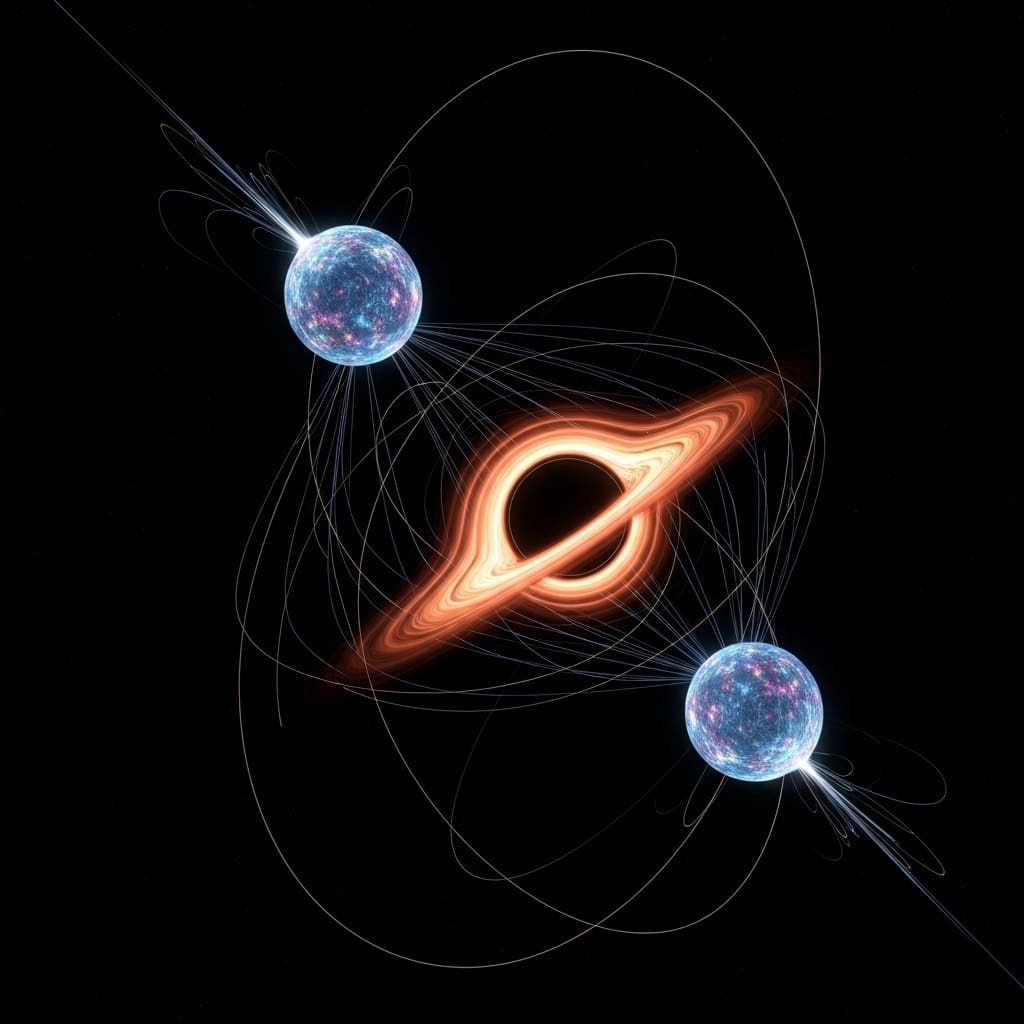
The dramatic consequences of stellar binaries encountering spinning black holes are now investigated by Mahapatra, Pandey, Banerjee, and Sarkar from the Indian Institute of Technology Kanpur and the Indian Institute of Astrophysics. Their research focuses on the complex interplay between the binary’s spin, its angular momentum, and the spin of the black hole during a close encounter. Using a combination of theoretical calculations and smoothed particle hydrodynamics simulations, the team modelled parabolic trajectories of identical white dwarf binaries around an intermediate mass spinning black hole. This work is significant because it reveals how black hole spin demonstrably alters the tidal dynamics of binary stars, influencing observable phenomena like mass fallback rates and potentially creating unique three-hump structures in tidal debris. The study establishes that the initial alignment of the binary’s spin plays a crucial role in how these interactions unfold.
Their research focuses on the complex interplay between the binary’s spin, its angular momentum, and the spin of the black hole during a close encounter. Using a combination of theoretical calculations and smoothed particle hydrodynamics simulations, the team modelled parabolic trajectories of identical white dwarf binaries around an intermediate mass spinning black hole. This work is significant because it reveals how black hole spin demonstrably alters the tidal dynamics of binary stars, influencing observable phenomena like mass fallback rates and potentially creating unique three-hump structures in tidal debris.
The study establishes that the initial alignment of the binary’s spin plays a crucial role in how these interactions unfold. Researchers considered scenarios involving an intermediate mass spinning black hole and a close, identical white dwarf binary system following a parabolic trajectory, performing a series of smoothed particle hydrodynamics-based numerical simulations. The simulations integrated the geodesic equations for the spinning black hole, while simultaneously modelling the hydrodynamics and self and mutual gravitational interactions of the stars within a Newtonian approximation, a methodology justified by the chosen parameters.
Black Hole Spin Drives White Dwarf Disruption
Scientists have achieved a breakthrough in understanding the complex interactions between stellar binaries and spinning black holes through a series of smoothed particle hydrodynamics simulations. The research focused on encounters between an intermediate mass spinning black hole and a close, identical white dwarf binary system following a parabolic trajectory, revealing detailed tidal dynamics previously unobserved. Experiments integrated the geodesic equations for the spinning black hole alongside Newtonian hydrodynamics and gravitational interactions of the white dwarfs, providing a robust approximation given a fixed pericenter distance of 25 gravitational radii.
Results demonstrate that the spin of the black hole significantly influences the tidal disruption of the binary components, with observable effects strongly dependent on the initial inclination angle between the binary’s spin and orbital angular momentum. The team measured distinct responses to black hole spin based on different initial configurations of the binary, establishing that, within the Hills regime, the fallback rate , the amount of stellar material falling back onto the black hole , can exhibit a unique three-hump structure. This structure arises from interactions between tidal debris originating from each individual star, a phenomenon not previously documented in simulations of this type. Tests prove that even at a pericenter distance of 25 gravitational radii, the effects of the black hole spin deliver richer physics than would be observed with a non-spinning black hole.
Measurements confirm that the simulations accurately capture the tidal disruption process using a hybrid formalism, integrating Kerr geodesics with Newtonian gravity, and employing an SPH code refined to model stellar fluids. The breakthrough delivers insights into tidal disruption events, particularly for intermediate mass black holes where observational evidence remains relatively rare. Scientists recorded that the methodology employed, building upon previous work with publicly available codes like PHANTOM, allows for a stable WD configuration in SPH with viriality deviations below 1%. This work establishes a foundation for future research into the complex interplay of gravity and stellar dynamics in extreme astrophysical environments, potentially informing our understanding of accretion processes and the formation of observable phenomena like electromagnetic flares.
Binary Spin Dominates Tidal Disruption Dynamics
This work presents a detailed analysis of tidal interactions between a close white dwarf binary and an intermediate-mass black hole, revealing the complex interplay between black hole spin, binary spin, and the binary’s orbital angular momentum. Through smoothed particle hydrodynamics simulations, researchers investigated how these factors influence the dynamics of tidal disruption events. The study demonstrates that while black hole spin affects the overall outcome of tidal disruptions, the inclination angle of the binary system plays a crucial role in determining observable characteristics like the rate at which debris falls back onto the black hole.
Specifically, the simulations show that prograde and retrograde binary configurations produce markedly different fallback curves, with retrograde systems exhibiting more complex structures due to stronger internal interactions between the disrupted stars. In certain scenarios, a three-hump structure emerges in the fallback rate, attributable to the binary’s spin and the interactions between tidal debris. The authors acknowledge that their analysis is limited to specific parameter choices and that the three-hump feature may also appear in simulations with non-spinning black holes. Future research could explore a wider range of parameters and investigate the observability of these effects in electromagnetic counterparts to better understand these dynamic astrophysical events.
👉 More information
🗞 Tidal encounters of close white dwarf binaries with spinning black holes
🧠 ArXiv: https://arxiv.org/abs/2601.04870
