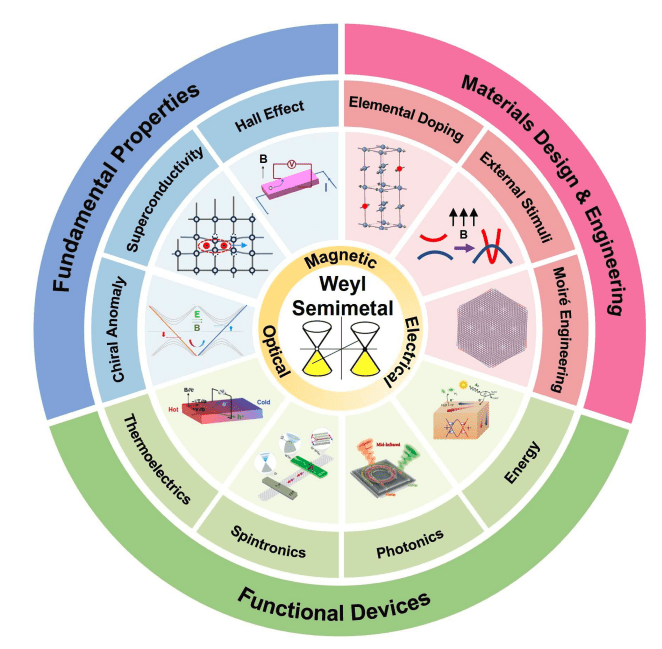
A recent comprehensive review on Weyl semimetals, published April 1, 2025, explores their unique electronic properties and potential applications in electronics, photonics, and spintronics, offering insights into current advancements and future challenges.
Weyl semimetals, known for their unique electronic and topological properties, are promising candidates for advanced applications in electronics, photonics, and spintronics. A comprehensive review covers theoretical foundations, synthesis, engineering strategies, and emerging device applications. Recent advancements enhance functional versatility, while critical challenges remain for practical implementation. The review discusses future directions and potential expansions of applications, offering a balanced perspective on progress and obstacles.
The Rise of Metasurfaces: Engineering Light at Will
One of the most exciting developments in condensed matter physics is the emergence of metasurfaces—ultra-thin materials engineered to manipulate light in unprecedented ways. These surfaces, often just a few atoms thick, can bend, focus, or even trap light, enabling applications ranging from high-resolution imaging to energy-efficient optical devices.
Researchers have demonstrated that metasurfaces made from chalcogenide glasses—a class of materials containing sulfur or selenium—can operate across an ultra-wide spectral range, from visible to mid-infrared light. This versatility opens the door for next-generation sensors and detectors, capable of operating in environments where traditional technologies fall short.
Quantum Materials: Unlocking New States of Matter
Quantum materials exhibit exotic properties due to quantum mechanical effects and are another frontier in condensed matter physics. These materials challenge our understanding of how electrons behave at the atomic scale and hold promise for revolutionizing electronics and computing.
Recent studies have identified new topological states of matter, where electrons move in ways that defy classical intuition. For instance, researchers have observed quantum spin liquids, a state where electrons remain in a quantum superposition even at absolute zero. Such discoveries could pave the way for fault-tolerant quantum computers, capable of solving problems beyond the reach of classical machines.
The intersection of condensed matter physics with photonics is also yielding transformative results. Advances in plasmonics—controlling light at the nanoscale—are enabling ultra-compact optical devices that could revolutionize telecommunications and data storage.
In quantum communication, researchers are leveraging the unique properties of condensed matter systems to develop secure communication networks. By encoding information in quantum states of light, scientists can create systems resistant to eavesdropping, ensuring unparalleled security for data transmission.
Despite these advancements, challenges remain. Manufacturing quantum materials at scale remains a hurdle, as does maintaining coherence in quantum systems. However, the potential rewards are immense. From ultra-efficient solar cells to room-temperature superconductors, the possibilities are vast.
As condensed matter physics continues to evolve, it is poised to play a pivotal role in shaping the future of technology and science. By unlocking the secrets of matter at the atomic level, researchers are advancing our understanding of the universe and paving the way for a new era of innovation.
In conclusion, condensed matter physics remains a dynamic and rapidly evolving field, with breakthroughs that promise to transform industries and redefine what is possible in technology. As scientists delve deeper into the quantum realm, the future looks brighter—and more intriguing—than ever before.
👉 More information
🗞 Weyl Semimetals: from Principles, Materials to Applications
🧠 DOI: https://doi.org/10.48550/arXiv.2504.01300