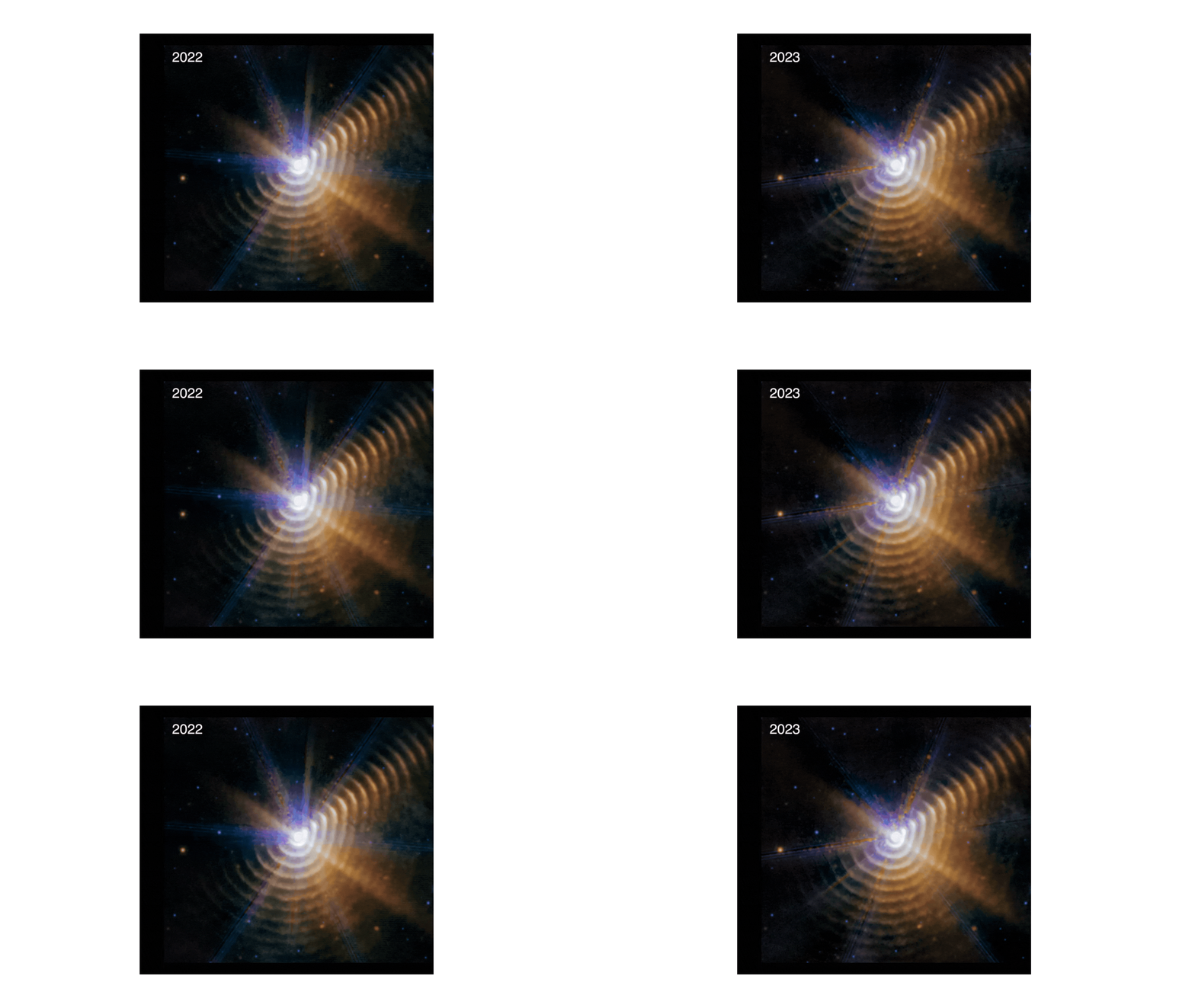
Astronomers have long sought to unravel the mystery of how carbon, a fundamental element for life, is dispersed throughout the universe. Now, NASA’s James Webb Space Telescope has provided unprecedented insight into this process by capturing the formation and expansion of carbon-rich dust shells in the Wolf-Rayet 140 star system. Located in our own Milky Way galaxy, this binary system consists of two massive stars that orbit each other in a tight, elongated path, generating stellar winds that collide and compress to form dust. Webb’s mid-infrared images reveal 17 distinct dust shells expanding at regular intervals into the surrounding space, offering a unique glimpse into the dynamic process of carbon-rich dust creation and dispersal.
Unveiling the Secrets of Carbon-Rich Dust Formation in Wolf-Rayet 140
Astronomers have long been fascinated by the distribution of elements like carbon, essential for life, across the universe. The James Webb Space Telescope has now provided unprecedented insights into the formation and expansion of carbon-rich dust shells in the Wolf-Rayet 140 star system.
Wolf-Rayet 140 is a binary system consisting of two massive stars that follow a tight, elongated orbit. As they swing past each other, their stellar winds collide, compressing material and forming carbon-rich dust. The Webb telescope has captured 17 dust shells shining in mid-infrared light, expanding at regular intervals into the surrounding space.
The observations reveal that these dust shells are moving outward at consistent velocities, with every shell racing away from the stars at more than 1,600 miles per second (2,600 kilometers per second), almost 1% the speed of light. This rapid expansion is a remarkable phenomenon, especially considering that events in space typically unfold over millions or billions of years.
The Dynamics of Dust Formation and Expansion
The Webb telescope’s mid-infrared images have detected shells that have persisted for more than 130 years. The researchers speculate that the stars will ultimately generate tens of thousands of dust shells over hundreds of thousands of years. The telescope’s data also show that the dust formation process is not uniform, with some dust “piling up” to form amorphous, delicate clouds as large as our entire solar system.
Each individual dust particle is incredibly small, measuring only one-hundredth the width of a human hair. Despite their varying distribution, all of the dust moves at the same speed and is carbon-rich. This uniformity suggests that the dust particles are formed through a consistent process, which is crucial for understanding the origins of carbon in our universe.
The Fate of Wolf-Rayet 140 and Its Dust Shells
The Wolf-Rayet star in this system is nearing the end of its life, with two possible scenarios unfolding in the future. It may explode as a supernova, potentially blasting away some or all of the dust shells, or collapse into a black hole, leaving the dust shells intact. Researchers are hoping for the latter scenario, as it would allow the carbon-rich dust to survive and provide valuable insights into the origins of dust in our universe.
Implications for Our Understanding of Carbon and Planet Formation
The discovery of carbon-rich dust formation in Wolf-Rayet 140 has significant implications for our understanding of planet formation and the distribution of elements in our universe. Carbon is essential for the formation of rocky planets and solar systems like ours, making it a crucial component in the search for life beyond Earth.
These findings have been published in The Astrophysical Journal Letters and were presented at the 245th meeting of the American Astronomical Society. As the James Webb Space Telescope continues to explore the mysteries of our universe, it is likely to uncover more secrets about the origins of carbon and its role in shaping the cosmos.
External Link: Click Here For More