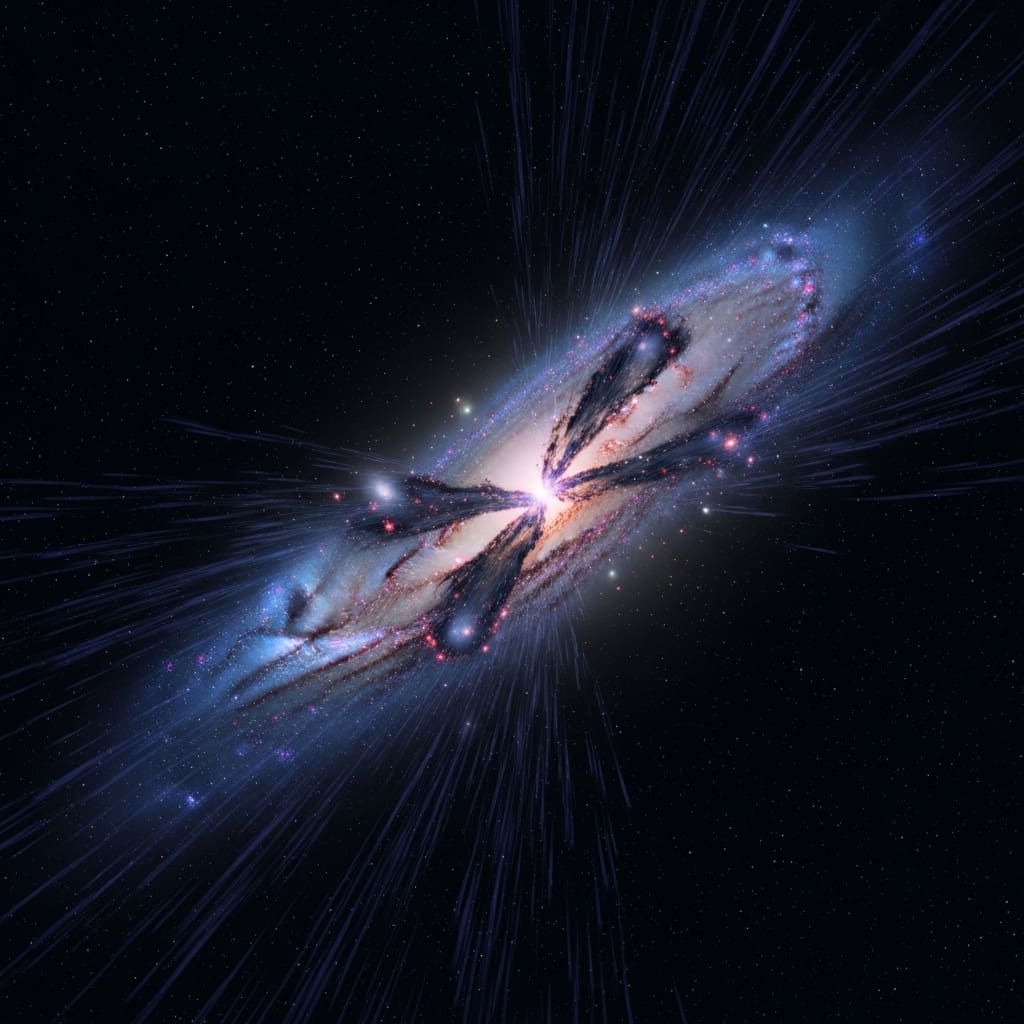
Scientists investigate the role of ultra-fast outflows in regulating galactic evolution using new observations from the James Webb Space Telescope. Jerome Seebeck, Kylie Yui Dan, and Sylvain Veilleux, all from the Department of Astronomy at the University of Maryland, alongside David Rupke et al., report findings from a study of two ultraluminous infrared galaxies, F11119+3257 and F05189-2524, both exhibiting previously detected high-velocity outflows. Their mid-infrared spectroscopic data reveal remarkably similar, high-velocity outflows of approximately 4000km/s in ionized neon, providing crucial insights into the mechanisms driving large-scale winds from active galactic nuclei and their impact on star formation and black hole growth. This research confirms earlier suggestions that momentum conservation governs these outflows, despite the warm ionized gas contributing little to the overall momentum budget.
The research focuses on understanding how these galactic winds suppress star formation and ultimately shape the development of galaxies.
Observations of these two nearby ultraluminous infrared galaxies reveal remarkably similar mid-infrared characteristics, most notably the presence of this exceptionally fast-moving gas. In F05189-2524, a slightly slower, biconical outflow extending up to approximately 2 kiloparsecs was also identified in the same neon emission lines.
Detailed analysis indicates a deficit of rotational molecular hydrogen lines near the central quasar in both galaxies, suggesting AGN-driven radiative feedback, yet no clear evidence of molecular gas being directly carried away by the outflow was found. Energetic analysis of the warm ionized gas demonstrates that it contributes minimally, ranging from 0.1 to 5 percent, to the overall momentum outflow rate.
This finding reinforces conclusions from previous studies, confirming that the energetics of these sources align with a momentum-conserving outflow model. The detection of such a high-velocity gas outflow, around 4000 kilometers per second, underscores the immense power of these galactic winds and their potential to significantly impact the evolution of galaxies. These galaxies were selected due to previously detected nuclear X-ray signatures of ultra-fast outflows and kiloparsec-scale outflow phenomena.
Observations utilized all three MIRI grating settings, Short, Medium, and Long, to cover the full wavelength range of 4.9 to 27.9μm, enabling a comprehensive spectral analysis. A four-point extended dither pattern was implemented during data acquisition to minimise background contamination and mitigate undersampling effects.
The spectral resolution of the MIRI instrument ranges from 8Å in the first channel to 60Å in the fourth, corresponding to velocities of 30 to 85km/s across the entire MIRI wavelength range. Data reduction employed JWST pipeline version 1.15.1 and calibration reference data system version 12.0.2, utilising the publicly available MIRI pipeline sample notebook with a pixel-by-pixel background subtraction step activated.
This reduction process notably improved the signal-to-noise ratio in the fully reduced data cubes. Remaining fringing artefacts were addressed during post-processing, specifically those observed at the edges of the MIRI detector in certain sub-bands. The resulting data facilitated the detection of a high-velocity 4000km/s gas outflow in highly ionized neon emission lines from both galaxies, a key finding demonstrating the power of active galactic nuclei to drive galactic winds. This observation provides compelling evidence that supermassive black holes can instigate powerful winds which regulate the growth of their host galaxies.
Detailed analysis of mid-infrared emissions revealed this outflow in highly ionized neon, specifically observed through neon emission lines. In F05189-2524, a slightly slower biconical outflow extending up to kiloparsec scale was also identified in the same neon emission lines. Luminosity distances of 172.4 Mpc were calculated for F05189-2524, establishing a physical scale of 1′′ equating to 0.848 kpc.
The study further indicates a deficit of rotational molecular hydrogen lines within 1 kpc of the central quasar in both galaxies, suggesting AGN-driven radiative feedback. The energetic analysis demonstrates that warm ionized gas contributes minimally to the momentum outflow rate, aligning with previous literature suggesting a momentum-conserving outflow.
Observations utilising the MIRI instrument’s Medium-Resolution Spectrometer captured the full wavelength range of 4.9 to 27.9μm, with a spectral resolution ranging from 8Å to 60Å. Data reduction employed JWST v1.15.1 and CRDS v12.0.2, incorporating a 2D pixel-by-pixel background subtraction to enhance signal-to-noise ratios.
These findings are crucial for understanding galactic evolution and the role of active galactic nuclei in suppressing star formation. The detection of a 4000km/s outflow demonstrates the substantial power of these galactic winds and their capacity to influence the development of galaxies. These outflows, detected in highly ionized neon emissions, reach speeds of approximately 4000 kilometres per second. A biconical outflow extending up to two kiloparsecs was also observed in F05189-2524, exhibiting a slightly slower velocity than the primary outflow.
These findings support the theory that supermassive black holes actively regulate galaxy growth through powerful winds, a process known as galactic feedback. Analysis indicates that the warm ionized gas contributes minimally to the overall momentum of these outflows, aligning with existing literature suggesting a momentum-conserving outflow mechanism.
The observed deficit of rotational molecular hydrogen near the galactic nuclei further suggests that active galactic nuclei drive radiative feedback, suppressing star formation. These galaxies, representative of a class of infrared-bright objects known as ultraluminous infrared galaxies, provide a local analogue for understanding similar processes in more distant and less-resolved galaxies.
The authors acknowledge that while these observations confirm the presence of energetic outflows, further research is needed to fully understand the entrainment of molecular gas within these winds. Future studies could focus on higher-resolution observations to map the distribution and kinematics of gas at various phases, providing a more complete picture of the feedback mechanisms at play. These results contribute to a growing body of evidence demonstrating the significant role of active galactic nuclei in shaping the evolution of their host galaxies.
👉 More information
🗞 JWST Discovery of High-Velocity Mid-Infrared Ionized Outflows in Ultraluminous Infrared Galaxies F11119+3257 and F05189-2524
🧠 ArXiv: https://arxiv.org/abs/2602.03836