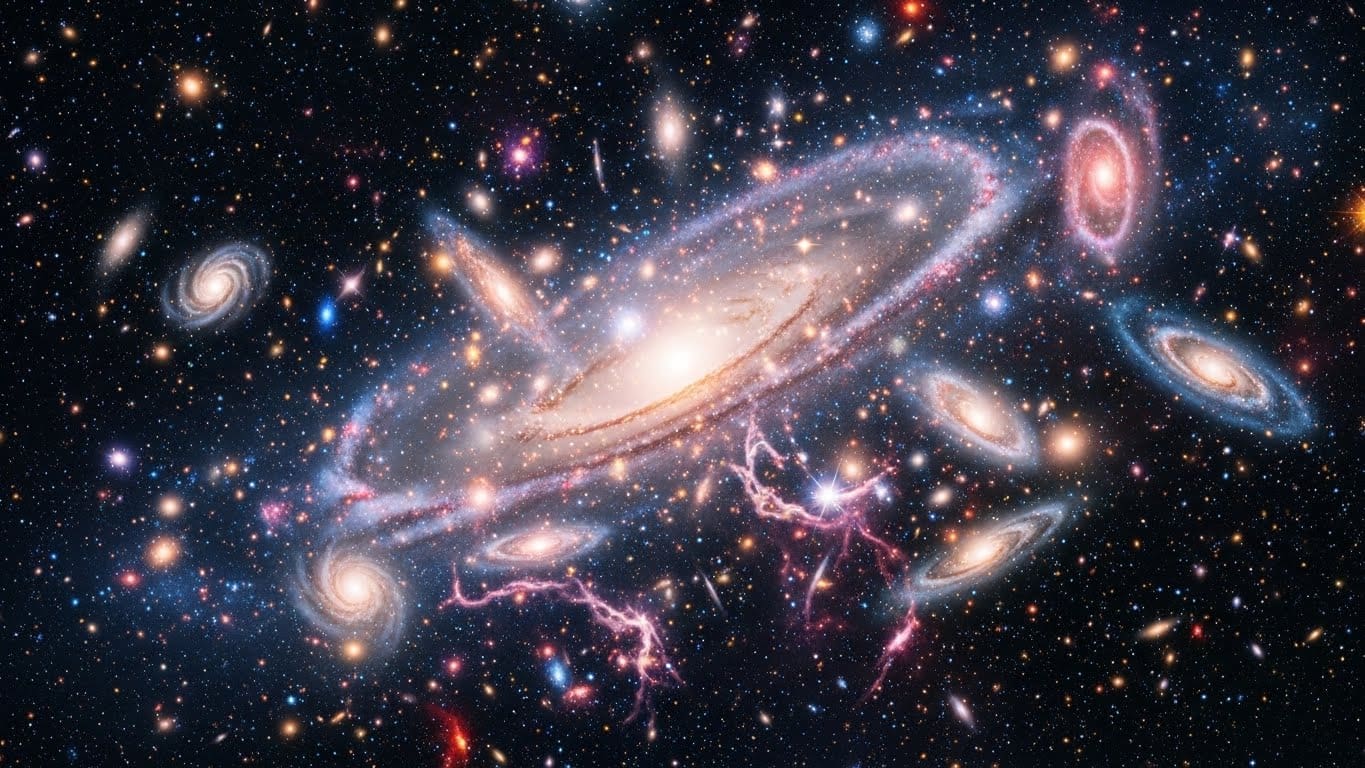
New data from late 2025 suggests that dark energy might be losing its strength. If the ‘cosmological constant’ isn’t constant, the fate of the universe, and the Big Freeze, just changed. For decades, the accelerating expansion of the universe has been attributed to a mysterious force dubbed “dark energy, ” a pervasive energy density seemingly inherent to space itself. This explanation, elegantly encapsulated in the concept of the cosmological constant, has become a cornerstone of modern cosmology. However, recent observations, primarily from the Dark Energy Survey (DES) and increasingly refined data from the upcoming Large Synoptic Survey Telescope (LSST), are challenging this long-held assumption.
These findings hint at a universe where dark energy isn’t a constant, but rather an evolving entity, potentially weakening over cosmic time.
The implications of a decaying dark energy are profound. If the expansion rate slows, the ultimate fate of the universe shifts dramatically. The widely predicted “Big Freeze, ” where the universe expands forever into a cold, dark emptiness, might be averted. Instead, we could be heading towards a “Big Crunch, ” a reversal of the expansion leading to a fiery collapse, or a more nuanced scenario where the universe eventually reaches a stable, albeit vastly expanded, state. Understanding the nature of dark energy, and whether its influence is waning, is therefore not merely an academic exercise; it’s a quest to determine the ultimate destiny of everything.
The data arriving in late 2025, while preliminary, has ignited a flurry of theoretical work, forcing cosmologists to revisit fundamental assumptions about the universe and the forces that govern it.
The challenge lies in the subtlety of the observed changes. The effects are not immediately apparent, requiring meticulous analysis of vast datasets and increasingly precise measurements of cosmic distances and expansion rates. This is where projects like DES and LSST, with their unprecedented ability to map the distribution of galaxies and supernovae across billions of light-years, become crucial. The initial signals are faint, buried within the noise of observational uncertainties, but the accumulating evidence is becoming increasingly difficult to ignore. The next few years promise to be a pivotal period in cosmology, as scientists race to confirm or refute these groundbreaking findings and unravel the mystery of a potentially fading dark energy.
The Ghost in the Machine: Defining Dark Energy
Dark energy constitutes approximately 68% of the total energy density of the universe, dwarfing the contributions of ordinary matter (5%) and dark matter (27%). Its existence was first inferred from observations of distant Type Ia supernovae in the late 1990s, which appeared fainter than expected, indicating that the expansion of the universe was accelerating. This acceleration couldn’t be explained by gravity alone, necessitating the introduction of a repulsive force, dark energy. The simplest explanation is the cosmological constant, often denoted by the Greek letter Λ (Lambda), representing a constant energy density permeating all of space. In Einstein’s field equations of general relativity, Λ acts as a repulsive pressure, counteracting gravity and driving the accelerated expansion.
However, the observed value of Λ is incredibly small, roughly 120 orders of magnitude smaller than predicted by quantum field theory, a discrepancy known as the cosmological constant problem.
Echoes from the Early Universe: How We Measure Expansion
Determining the expansion history of the universe is a complex undertaking. Cosmologists employ a variety of techniques, each with its own strengths and limitations. One primary method involves measuring the distances to distant objects, such as Type Ia supernovae, which serve as “standard candles” due to their consistent intrinsic brightness. By comparing the observed brightness of these supernovae to their known luminosity, astronomers can calculate their distances and, consequently, the expansion rate at different epochs. Another crucial technique relies on the cosmic microwave background (CMB), the afterglow of the Big Bang. The CMB contains subtle temperature fluctuations that encode information about the early universe, including its geometry and expansion rate.
Analyzing these fluctuations allows cosmologists to constrain the parameters of the cosmological model and test the validity of the cosmological constant. Baryon Acoustic Oscillations (BAO), ripples in the distribution of matter caused by sound waves in the early universe, also provide a standard ruler for measuring cosmic distances.
The LSST Revolution: A New Era of Cosmic Mapping
The Large Synoptic Survey Telescope (LSST), now operational, is poised to revolutionize our understanding of dark energy. Its 8.4-meter telescope and 3.2-gigapixel camera will survey the entire visible sky every few nights, creating a vast database of astronomical objects. This unprecedented dataset will enable astronomers to measure the distances to billions of galaxies and supernovae with unprecedented precision. LSST will also map the distribution of dark matter through gravitational lensing, the bending of light by massive objects. By analyzing the distortions in the images of distant galaxies, astronomers can infer the distribution of dark matter and its influence on the expansion of the universe.
The sheer volume and quality of data from LSST will significantly reduce the uncertainties in our measurements of dark energy and provide a more definitive answer to the question of whether it is truly constant.
Beyond Lambda-CDM: Alternative Models Emerge
The potential weakening of dark energy has spurred a surge in theoretical research exploring alternative models beyond the standard Lambda-CDM (ΛCDM) cosmology. Quintessence, a dynamic form of dark energy represented by a scalar field, is one prominent contender. Unlike the cosmological constant, quintessence can evolve over time, potentially explaining the observed changes in the expansion rate. Another intriguing possibility is modified gravity, which proposes that general relativity itself may need to be modified at large scales. These models attempt to explain the accelerated expansion without invoking dark energy altogether, attributing it instead to a modification of the laws of gravity.
Phantom energy, a more exotic form of dark energy with an equation of state parameter less than -1, is also being investigated, although it predicts a catastrophic “Big Rip” scenario where the universe is torn apart in the distant future.
The Equation of State: A Key Diagnostic
A crucial parameter for characterizing dark energy is its equation of state, denoted by w, which represents the ratio of pressure to energy density. For the cosmological constant, w = -1. A value of w different from -1 would indicate that dark energy is not a constant but rather a dynamic entity. Current observations constrain w to be very close to -1, but with significant uncertainties. The LSST and other upcoming surveys aim to measure w with much greater precision, potentially revealing a deviation from -1 and confirming the weakening of dark energy. Determining the time evolution of w is even more crucial, as it would provide insights into the underlying physics of dark energy and help distinguish between different theoretical models.
The Role of Dark Matter: A Complicated Relationship
Dark matter, another mysterious component of the universe, plays a crucial role in the formation of galaxies and large-scale structures. While dark matter doesn’t directly contribute to the accelerated expansion, its distribution and evolution are intimately linked to the behavior of dark energy. The growth of structures in the universe is influenced by both dark matter and dark energy, and any changes in the dark energy density will affect the rate at which structures form. Therefore, understanding the interplay between dark matter and dark energy is essential for accurately interpreting the observational data and unraveling the mystery of the universe’s expansion.
Recent research suggests that the distribution of dark matter may be more complex than previously thought, with evidence for substructures and voids that could affect the measurements of dark energy.
Cosmic Shear and Weak Lensing: Mapping the Invisible
Cosmic shear, the distortion of the shapes of distant galaxies due to the gravitational lensing effect of intervening matter, provides a powerful probe of dark energy and dark matter. By measuring the subtle distortions in the images of millions of galaxies, astronomers can map the distribution of dark matter and reconstruct the geometry of the universe. Weak lensing, a related technique, measures the average alignment of galaxy shapes, providing a statistical measure of the gravitational lensing effect. These techniques are particularly sensitive to the growth of structures in the universe and can help constrain the parameters of dark energy and dark matter. The LSST is expected to provide an unprecedentedly large and accurate dataset for cosmic shear and weak lensing studies.
The Hubble Tension: A Growing Discrepancy
The Hubble tension refers to the significant discrepancy between the value of the Hubble constant (H_0), the current expansion rate of the universe, measured using different methods. Local measurements, based on observations of Cepheid variable stars and Type Ia supernovae, yield a higher value of H_0 than measurements derived from the CMB. This discrepancy cannot be easily explained by systematic errors and may indicate the need for new physics beyond the standard cosmological model. Some proposed solutions involve modifications to dark energy or the introduction of new particles or interactions in the early universe. Resolving the Hubble tension is a major challenge for modern cosmology and could provide crucial insights into the nature of dark energy.
The Quantum Vacuum and the Cosmological Constant Problem
The cosmological constant problem remains one of the most perplexing mysteries in physics. Quantum field theory predicts that the vacuum of space should be filled with virtual particles that contribute to the energy density of the universe. However, the predicted value of this vacuum energy is vastly larger than the observed value of the cosmological constant, by a factor of approximately 120 orders of magnitude. This discrepancy suggests that our understanding of quantum gravity or the nature of the vacuum is incomplete.
Various attempts have been made to explain the cosmological constant problem, including the anthropic principle, which argues that the observed value is simply the one that allows for the existence of observers, and the concept of a multiverse, where different universes have different values of the cosmological constant.
The Future of Cosmology: Precision and Discovery
The next decade promises to be a golden age for cosmology. The LSST, along with other upcoming surveys such as the Euclid space telescope and the Roman Space Telescope, will provide an unprecedented wealth of data that will revolutionize our understanding of dark energy, dark matter, and the evolution of the universe. These surveys will not only improve the precision of our measurements but also enable us to probe new aspects of cosmology, such as the nature of dark matter interactions and the properties of the early universe. The combination of observational data and theoretical modeling will lead to a more complete and accurate picture of the cosmos.
A Universe in Transition: The Fading of the Dark
If the data continues to support the weakening of dark energy, it will necessitate a fundamental shift in our understanding of the universe. The cosmological constant, once considered a simple and elegant explanation, will be relegated to the realm of approximations. We will be forced to confront the possibility that dark energy is not a constant force, but a dynamic entity that evolves over cosmic time. This realization will open up new avenues of research, prompting us to explore more complex and nuanced models of the universe. The future of cosmology is uncertain, but one thing is clear: the quest to understand dark energy is far from over, and the next few years promise to be filled with exciting discoveries and profound insights into the nature of reality.