Research demonstrates a quantifiable link between coherence and wave-particle duality using a duality ellipse equality, unifying visibility and predictability. Extending this to quantum imaging with undetected photons reveals an imaging duality ellipse connecting duality to object transmittance, enabling characterisation via duality measurements despite experimental imperfections.
The fundamental nature of reality, oscillating between wave-like and particle-like behaviour, remains a cornerstone of quantum mechanics. Researchers are continually refining our understanding of this duality and its implications for technologies reliant on quantum coherence – the ability of a quantum system to exist in multiple states simultaneously. A new theoretical framework, detailed in the article ‘Wave-particle duality ellipse and application in single-photon imaging’, provides a mathematical relationship linking wave and particle characteristics to the degree of coherence in two-path interference systems, and extends this to imaging scenarios utilising undetected photons. This work, conducted by Pawan Khatiwada and Xiao-Feng Qian from the Stevens Institute of Technology, establishes a quantifiable connection between an object’s properties and its wave-particle duality, potentially offering a method for object characterisation independent of traditional imaging techniques.
Quantifying Wave-Particle Duality Reveals New Imaging Potential
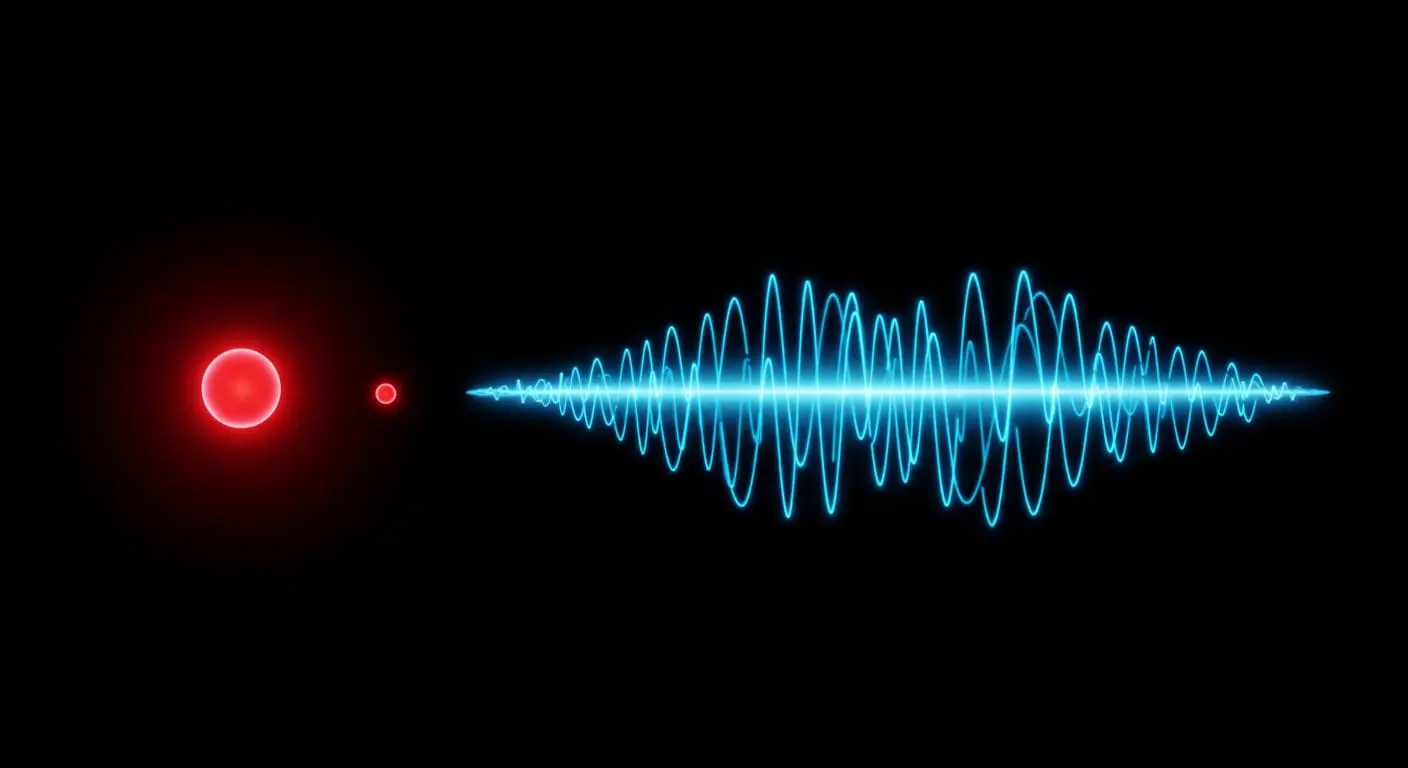
Recent research details a systematic framework for quantifying the relationship between quantum coherence and wave-particle duality in two-path interference experiments, with implications for advanced imaging techniques. The work establishes a rigorous connection between the visibility of interference patterns – a measure of wave-like behaviour – and the predictability of which path a photon takes – indicative of particle-like behaviour – with the degree of quantum coherence present in the system.
Researchers extended this analysis to quantum imaging with undetected photons (QIUP). QIUP relies on correlated, entangled photons; one photon interacts with the object, while its entangled partner is detected, allowing image formation without directly illuminating the object. The study reveals a direct link between wave-particle duality and an object’s transmittance profile – how much light passes through it – visualised through a newly defined ‘imaging duality ellipse’.
This ellipse mathematically encapsulates the trade-off between wave-like visibility and particle-like predictability. Crucially, the research demonstrates that object characterisation is possible solely through measurements of this duality, offering a degree of resilience against common experimental imperfections such as decoherence – the loss of quantum coherence due to environmental interactions – and misalignment of optical components.
The work builds upon established principles of quantum optics. Quantum coherence describes the fixed phase relationship between quantum states, essential for interference. Entanglement, a key quantum phenomenon, links the fates of two or more particles, even when separated by large distances. These principles underpin investigations into quantum ghost imaging (creating images without directly detecting photons that interacted with the object), quantum illumination (enhancing detection in noisy environments), and the use of squeezed light and entangled photons to improve signal-to-noise ratios.
Maintaining quantum coherence is paramount for optimal imaging performance. Decoherence diminishes the ability to exploit wave-particle duality, reducing imaging fidelity. The researchers provide a toolkit for optimising coherence-driven technologies, with potential applications spanning high-resolution microscopy, remote sensing, and secure communication systems.
This work represents a step towards a deeper understanding of fundamental quantum phenomena and their application in advanced imaging modalities, offering a new framework for characterising objects through the lens of wave-particle duality.
👉 More information
🗞 Wave-particle duality ellipse and application in single-photon imaging
🧠 DOI: https://doi.org/10.48550/arXiv.2505.21443