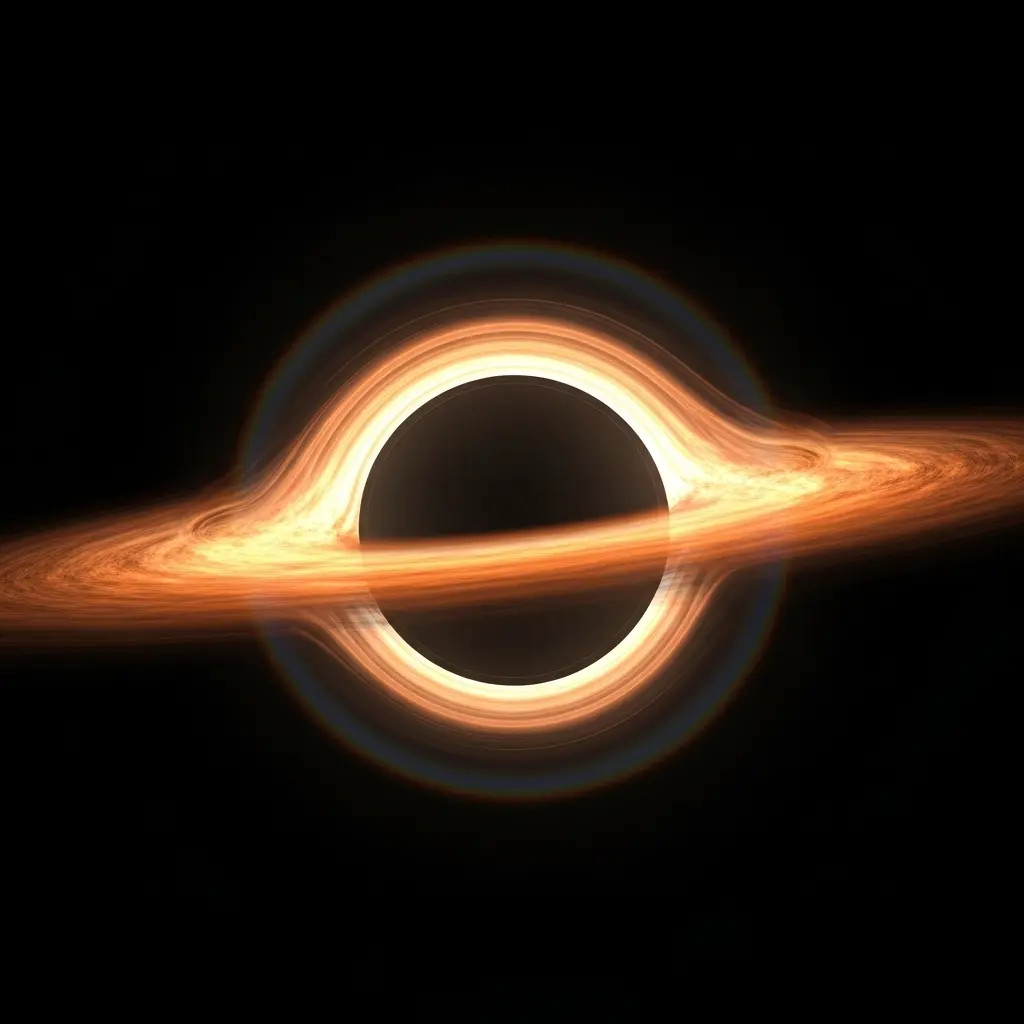
Scientists are investigating the unusual tidal disruption event AT2024tvd to understand the behaviour of wandering supermassive black holes. M. Guolo, A. Mummery and S. van Velzen from Leiden University, working with M. Nicholl, S. Gezari, Y. Yao, K. C. Chambers, T. de Boer, M. E. Huber, C.-C. Lin from University of Hawaii and C.-C. Chen from National Taiwan University, and colleagues, have analysed the event’s spectral energy distribution to reveal the properties of the black hole responsible. Their modelling, combining X-ray and optical data, suggests this is not an intermediate-mass black hole, but a supermassive black hole displaced from a galactic centre, exhibiting an extreme mass ratio relative to any remaining host galaxy. This research is significant because it provides evidence supporting cosmological simulations which predict that wandering black holes at small distances from galactic centres are unlikely to be surrounded by detectable stellar populations, offering new insights into the dynamics of these enigmatic objects.
These events occur when a black hole’s immense gravitational field tears apart a star, producing a luminous flare of energy known as a tidal disruption event (TDE). This research provides compelling evidence that displaced, or wandering, black holes are capable of disrupting stars and generating observable TDEs, offering critical insights into the evolution of galaxies and the black holes they host. Crucially, the analysis revealed no evidence of an associated star cluster or dwarf galaxy, indicating that the black hole is truly isolated rather than embedded within a larger galactic structure. The absence of a detectable host galaxy supports the interpretation that wandering black holes are not merely intermediate-mass black holes residing in ultra-compact dwarf galaxies, but instead fully fledged supermassive black holes that have been ejected from galactic centers.
This conclusion is consistent with predictions from cosmological simulations, which suggest that surviving wandering black holes often lack a detectable stellar overdensity. As astronomers continue to uncover TDEs in environments where traditional black hole–host galaxy scaling relations fail, the ability to measure black hole masses directly from TDE observations—independent of host galaxy properties—becomes increasingly important. A multi-wavelength observational approach was essential for capturing the full spectral energy distribution and accurately modeling the physical processes governing the event. Detailed host-light subtraction was applied to the imaging data to isolate the transient emission from any underlying galactic light, involving careful modeling of the parent galaxy’s surface brightness profile and removal of its contribution from the observed images.
The resulting data were used to construct a multi-wavelength light curve, tracing the temporal evolution of the event’s brightness. To interpret these observations, a fully relativistic, compact accretion disk model incorporating self-consistent inner-disk Comptonization was employed to reproduce the observed spectral energy distribution. This model accounts for the complex physics of accretion disks, including general relativistic effects and the production of high-energy photons. By fitting the model to the data, key physical parameters—most notably the black hole mass and accretion disk properties—were inferred.
Bayesian statistical methods were used throughout the analysis, providing a robust framework for parameter estimation and uncertainty quantification. Posterior distributions were characterized by their median values, with uncertainties defined as 68% credible intervals, ensuring the reliability and stability of the inferred parameters. The resulting mass estimate places the object firmly in the supermassive black hole regime, distinguishing it from intermediate-mass black holes previously identified in off-nuclear TDEs. Furthermore, the study establishes an unusually high black hole–to–host mass ratio, exceeding 3% (M•/M_gal > 3%), for a wandering black hole.
Detailed modeling of the spectral energy distribution finds no evidence for an accompanying star cluster or dwarf galaxy down to a mass limit of log₁₀(M_gal/M_⊙) ≤ 7.6. The inferred accretion disk parameters are consistent with established tidal disruption event scaling relations, including the relation L_disk,bol / L_Edd ∝ T⁴, further supporting the physical interpretation of the event and reinforcing the conclusion that the source is an isolated, supermassive wandering black hole.
🗞 The Wandering Supermassive Black Hole Powering the off-nuclear TDE AT2024tvd
🧠 ArXiv: https://arxiv.org/abs/2602.12272