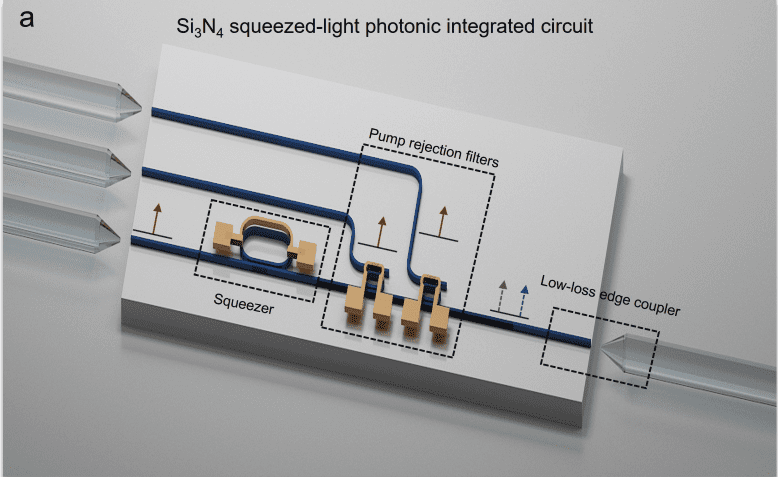
The pursuit of more efficient and powerful information processing drives innovation in photonics, and recent work focuses on harnessing the unique properties of squeezed light. Shuai Liu, Kailu Zhou, Yuheng Zhang, and colleagues at the University of Michigan have now demonstrated a significant advance in this field, successfully fabricating squeezed-light chips across an entire four-inch wafer. This achievement overcomes a major hurdle in scaling up quantum technologies, as squeezed light is notoriously sensitive to imperfections in device manufacturing. By integrating ultralow-loss microresonators and carefully designed optical filters onto a silicon nitride platform, the team generates strong, reproducible squeezed-light states with minimal variation across the wafer, paving the way for scalable quantum processors, multiplexed entanglement sources, and enhanced sensing capabilities.
Squeezed light, a non-classical state of light with reduced noise, holds immense potential for advancements in precision measurement, quantum communication, and quantum computing. This work addresses a critical need for compact and efficient sources of squeezed light, paving the way for more practical quantum technologies. The team successfully fabricated eight functional devices on a four-inch wafer, each demonstrating remarkably consistent levels of squeezing, ranging from 2.9 to 3. 1 decibels, with an average of 2. 96 ±0. 2 dB. The fabrication process involved creating intricate photonic circuits incorporating ultralow-loss microresonators, cascaded pump-rejection filters, and low-loss edge couplers on a silicon nitride-on-insulator wafer.
Silicon nitride was chosen for its low optical loss and compatibility with standard manufacturing techniques. Researchers carefully engineered a racetrack microring resonator with optimized dimensions to balance low scattering loss with strong coupling and minimal dispersion. To effectively suppress unwanted light, they employed two cascaded add-drop microring filters designed near a critical-coupling regime, ensuring robust performance despite potential variations during fabrication. Precise control over the resonance frequencies was achieved through thermo-optic tuning, facilitated by deep thermal isolation trenches surrounding the filters.
Generated squeezed light was efficiently coupled into optical fibers using inverse-tapered waveguides, maximizing light collection. Detailed optical characterization confirmed the high performance of the fabricated chips, with measured linewidths demonstrating high escape efficiencies and quality factors. The team utilized a stable pump laser and a phase-coherent local oscillator to precisely measure the squeezing levels, confirming the wafer-scale reproducibility of the fabrication process and establishing a foundation for scalable quantum photonic technologies.
Wafer-Scale Squeezed Light with High Uniformity
Scientists have demonstrated wafer-scale fabrication and generation of squeezed light on a silicon nitride platform, fully compatible with standard manufacturing processes. This work establishes a reproducible method for creating non-classical light sources, essential for advancements in quantum technologies. Experiments reveal consistent generation of two-mode squeezed vacuum states across a four-inch wafer, yielding 2. 9 to 3. 1 decibels of directly measured quadrature squeezing with a remarkably low variation of less than 0.
2 dB between devices. This uniformity is crucial for building large-scale quantum systems. The achievement stems from a novel integration of key components onto a single chip, including ultralow-loss microresonators with a quality factor exceeding 10 7 , high-extinction pump-rejection filters providing over 30 dB of attenuation, and low-loss edge couplers achieving over 75% chip-to-fiber coupling efficiency. These components work in concert to minimize signal loss and maintain stable operation, converting squeezed-light generation from a single-device demonstration into a scalable, manufacturable resource.
The team designed strongly overcoupled microresonators with escape efficiencies exceeding 91% near 1560nm, maximizing the interaction between light and the chip’s quantum components. Measurements confirm that this integrated approach overcomes a critical hurdle in quantum photonics, delivering greater than 3 dB of measured squeezing, a threshold recognized as essential for achieving quantum advantages in applications like quantum teleportation and entanglement swapping. This level of performance marks a transition from simple noise reduction to the creation of genuinely useful non-classical resources for quantum-enhanced tasks. By combining advanced fabrication techniques with careful component design, the research team has established a new benchmark for wafer-scale non-classical light generation, paving the way for high-volume manufacturing of quantum processing circuits and enabling a range of applications in quantum sensing, communication, and computation.
Wafer-Scale Squeezed Light Generation Demonstrated
Scientists have achieved reproducible, wafer-scale generation of squeezed light using a silicon nitride photonic integrated circuit. Across an entire four-inch wafer, eight fabricated devices consistently yielded 2. 9 to 3. 1 decibels of quadrature squeezing, demonstrating excellent uniformity in performance. This advance stems from the co-integration of ultralow-loss microresonators, high-extinction pump rejection filters, and low-loss edge couplers on a single chip.
The team’s results align with theoretical models based on independently measured device parameters, validating the design and fabrication process. Currently, the observed squeezing is limited by off-chip detection efficiencies of approximately 60 percent, suggesting a clear path toward further improvement by minimizing losses in external components and interfaces. Beyond strong squeezing, the silicon nitride platform offers functionalities not readily available in traditional setups, including reconfigurable interferometers and the potential for co-integrating modulators and detectors. Researchers acknowledge that current squeezing levels are constrained by off-chip components, and future work will focus on improving these efficiencies. The team envisions the development of fully integrated, continuous-variable quantum processors on a single chip, bridging the gap between laboratory demonstrations and scalable quantum technologies. This work establishes a foundation for advancements in quantum sensing, communication, and computation.
👉 More information
🗞 Wafer-Scale Squeezed-Light Chips
🧠 ArXiv: https://arxiv.org/abs/2509.10445