Superconducting nanowire single photon detectors are becoming increasingly vital components in diverse fields, from quantum computing to long-distance communication, and understanding their behaviour is paramount to advancing these technologies. Daien He, Leif Bauer, Sathwik Bharadwaj, and colleagues at Purdue University’s Elmore Family School of Electrical and Computer Engineering present a new theory explaining how these detectors function, offering a single framework to define both their ability to detect photons, known as system detection efficiency, and the rate of false detections, or dark counts. This research successfully predicts the consistent, high-efficiency performance observed in detectors made from niobium nitride and tungsten silicide, and importantly, accurately forecasts how temperature affects dark count rates and the precision of timing measurements. By providing a unified and validated model, this work promises to accelerate the design and optimisation of next-generation single photon detectors.
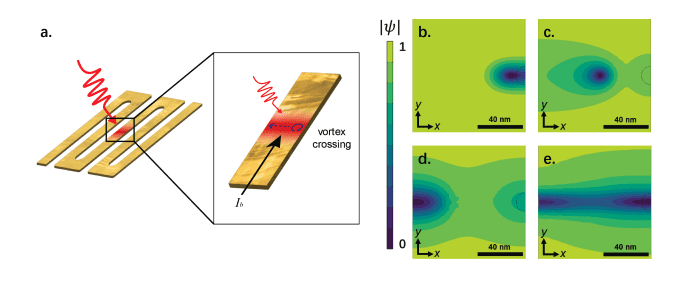
The research focuses on vortex crossing, where a photon’s absorption triggers the movement of a magnetic disturbance across the nanowire, registering the photon’s arrival. This theory provides a unified definition of system detection efficiency and dark count rates, offering a comprehensive understanding of detector performance.
Superconducting Nanowire Detector Physics and Performance
This research deeply investigates the fundamental physics governing SNSPDs, critical components for quantum information science, astronomy, and biomedical imaging. The goal is to optimize detector performance, specifically detection efficiency, timing resolution, and dark count rate, by understanding the underlying physical mechanisms. The research explores key areas including the detection mechanism and vortex dynamics, timing jitter and speed, and dark counts and noise. A significant focus is on how magnetic vortices form and move within the superconducting nanowire when a photon is absorbed, as the creation and motion of these vortices are believed to be the primary mechanism for generating a detectable signal.
Researchers also investigate how energy is dissipated during vortex motion and the role of thermal energy in triggering vortex movement, addressing limitations of existing models for vortex behavior and the influence of nanowire geometry on detector performance. Understanding the factors limiting the detector’s ability to precisely measure the time of a photon’s arrival is also crucial, with the research exploring the role of microwave resonances and electromagnetic effects. Designs using nanowire delay lines to improve timing resolution are investigated, alongside the sources of spurious signals, known as dark counts, and how they limit detector sensitivity, considering thermally activated events and the contribution of magnetic vortices. The research employs theoretical frameworks like Ginzburg-Landau theory and Kramers rate theory to model the superconducting behavior of the nanowire and simulate vortex dynamics.
Computational methods, including molecular dynamics and finite element analysis, are used to simulate the detector’s response to photons, and experimental characterization, through measurements of detector performance, validates the theoretical models and simulations. This comprehensive approach, combining theory, simulation, and experiment, represents a significant advancement in SNSPD research. This research represents a significant effort to push the boundaries of SNSPD technology. By gaining a deeper understanding of the fundamental physics governing these detectors, researchers can improve detector performance, develop new applications, and advance superconducting materials science. Future work will likely focus on materials optimization, nanowire geometry optimization, and integration with quantum circuits.
Vortex Crossing Explains Detector Efficiency and Noise
Researchers have developed a comprehensive theory explaining how SNSPDs function, offering a unified understanding of their detection efficiency and the rate of false detections, known as dark counts. This theory centers on vortex crossing, where a photon’s absorption triggers the movement of a magnetic disturbance across the nanowire, registering the photon’s arrival. The model accurately predicts the plateau region of detection efficiency observed in both niobium nitride and tungsten silicide-based SNSPDs. Crucially, the theory also predicts how temperature affects the rate of dark counts and the precision with which the detector can time the arrival of a photon.
The. By accurately quantifying this barrier, the researchers can predict the probability of vortex crossing and, consequently, the detector’s overall performance, with the calculated energy barriers closely aligning with those predicted by established theory, validating the model’s accuracy. This work goes beyond simply explaining current detector performance; it provides a framework for designing the next generation of SNSPDs. By understanding the factors that govern vortex crossing, researchers can optimize materials and device geometries to maximize detection efficiency and minimize dark counts. Furthermore, the team’s approach is versatile, offering a platform for improving a wide range of superconducting detectors.
Vortex Crossings Explain SNSPD Performance Metrics
This research presents a new theoretical understanding of how SNSPDs function, offering a unified explanation for their detection efficiency and dark count rates. The developed vortex crossing theory accurately predicts the performance of SNSPDs made from both niobium nitride and tungsten silicide, and also predicts the temperature dependence of unwanted dark counts and the intrinsic timing jitter. The strength of this work lies in its ability to quantitatively describe several key performance metrics of SNSPDs, providing a valuable tool for designing and optimizing future detectors. While the model demonstrates strong agreement with existing experimental results, the authors acknowledge that further refinement may be necessary to fully capture all aspects of SNSPD behavior, with future research directions potentially focusing on extending the model to account for variations in device geometry and material properties, potentially leading to even more accurate predictions and improved detector designs.
👉 More information
🗞 Unified Theory of Dark Count Rate and System Detection Efficiency for NbN, WSi Based Superconducting Single Photon Detectors
🧠 ArXiv: https://arxiv.org/abs/2508.10816