
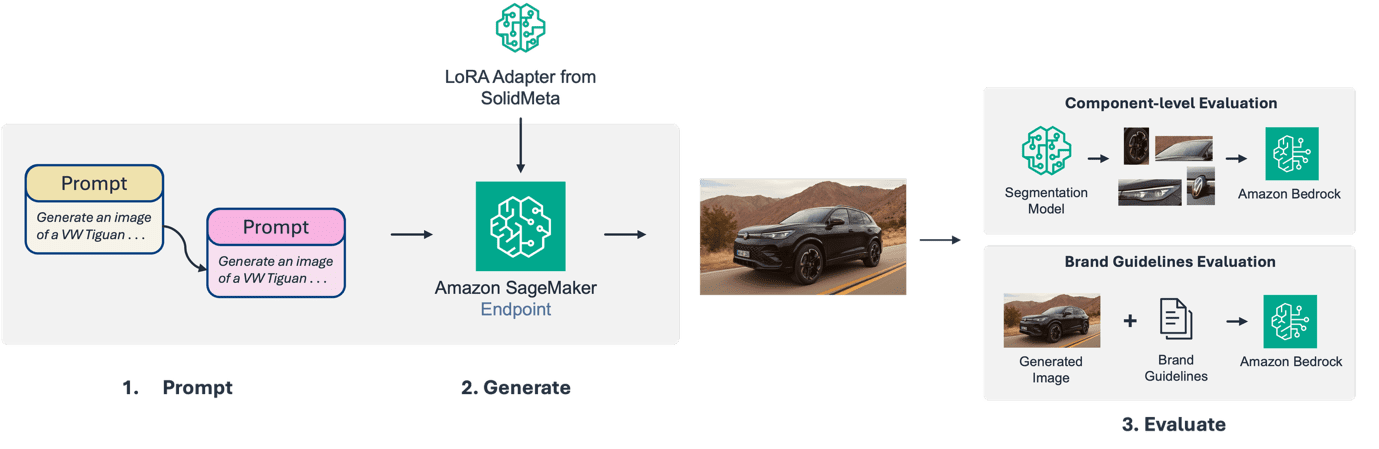
Volkswagen Group is leveraging generative artificial intelligence to rapidly produce compliant marketing assets for its ten diverse brands, including Volkswagen, Porsche, and Ducati. Facing the challenge of creating thousands of images annually while upholding exacting brand standards, the automotive manufacturer partnered with the AWS Generative AI Innovation Center to build a solution capable of generating photorealistic vehicle images at scale. A single vehicle launch traditionally demands months of production work and six-figure photo shoot costs; Volkswagen now aims to generate images in minutes instead of weeks. Volkswagen Group team members explained that the challenge extended beyond technical accuracy, noting that each brand possesses a unique visual language requiring systematic validation. This new pipeline focuses on both high-quality image generation and consistent brand alignment across its portfolio, which delivered 6.6 million vehicles in the first nine months of 2025.
Volkswagen Group Marketing Challenges: Scale and Brand Precision
The sheer volume of marketing assets required annually presents logistical and creative hurdles, traditionally demanding months of production work for a single vehicle launch and potentially costing six figures for on-location photoshoots involving physical prototypes and complex setups. However, the most significant bottleneck wasn’t production time or expense, but ensuring each asset adhered to the specific visual guidelines of each brand before public release. The base models lacked specific details regarding features such as grille textures, headlight geometry, and wheel spoke patterns, failing to accurately represent specific model years. The models also had no knowledge of unreleased vehicles, limiting their utility for future marketing campaigns. To overcome these limitations, Volkswagen implemented a solution involving fine-tuning foundation models on proprietary visual assets, utilizing DreamBooth techniques with data from digital twins in NVIDIA Omniverse.
This involved deploying the Flux.1-Dev diffusion model enhanced with a LoRA adapter on an Amazon SageMaker AI endpoint, allowing for specialization in VW design language while preserving general image generation capabilities. Automated prompt optimization, leveraging Amazon Nova Lite, further refined the process by expanding user inputs with brand-appropriate details and technical specifications, ensuring consistency in style and tone. The result was the ability to generate renderings of both current and unreleased models with speed and precision. A new challenge quickly emerged, however: how to validate these images at scale.
Fine-tuning Flux.1-Dev with DreamBooth and NVIDIA Omniverse
The pursuit of scalable, brand-consistent imagery for marketing is driving innovation in generative artificial intelligence, particularly within the automotive sector. Volkswagen Group’s experience demonstrates a shift from simply generating photorealistic images to ensuring those images adhere to the nuanced visual language of ten distinct brands, a challenge that previously demanded extensive and costly physical production. Initial experiments with base diffusion models revealed two critical gaps. First, while these models could produce impressive automotive imagery, they lacked decades of Volkswagen design language. The smallest features matter: the exact texture of a grille mesh, the precise geometry of headlight housings, the specific wheel spoke patterns for each model line. The models would generate a Volkswagen, but with generic wheels and grille patterns that didn’t match an actual model year. Second, base models had no knowledge of unreleased vehicles, severely limiting their utility for forward-looking marketing campaigns. The solution required fine-tuning foundation models on Volkswagen’s proprietary visual assets. Working with SolidMeta, the team used DreamBooth fine-tuning techniques leveraging digital twins within NVIDIA Omniverse. This process, illustrated for the Volkswagen Tiguan, involves training the model with images paired with a unique identifier, teaching it the specifics of a particular vehicle before broadening its capabilities with generic car images to prevent overfitting. This allowed for specialization in Volkswagen’s design language, extending down to minute details like grille textures and trim options, while preserving the base model’s broader image generation abilities. The team deployed the Flux.1-Dev diffusion model enhanced with a LoRA adapter on an Amazon SageMaker AI endpoint.
This approach allowed them to specialize the model’s understanding of the VW design language, down to grille textures and specific trim options, while maintaining the base model’s general image generation capabilities. The architecture used the managed infrastructure of Amazon SageMaker AI for both training and inference, configured for asynchronous processing on ml.g5.2xlarge GPU instances to handle the computational demands. Even a fine-tuned model required careful prompting to achieve brand alignment. Volkswagen discovered that effective prompts necessitated specialized vocabulary and style modifiers beyond the reach of most marketing team members. To bridge this gap, an automated prompt optimization system using Amazon Nova Lite was implemented. “Nova Lite helps enhance the user’s input prompt, expanding it with brand-appropriate details, technical specifications, and stylistic elements drawn from VW’s marketing guidelines,” transforming simple requests into comprehensive descriptions that guided the diffusion model. This resulted in images with accurate component details and consistent styling.
The challenge extended beyond technical accuracy. Each of the Group’s ten brands has its own visual language: the understated elegance of Bentley demands different staging than the performance-focused aesthetic of Porsche or the accessible modernity of ŠKODA.
Amazon SageMaker Deployment for Asynchronous Image Generation
Volkswagen Group’s push to leverage generative artificial intelligence for marketing asset creation necessitated a robust and scalable deployment strategy, ultimately centering on Amazon SageMaker for asynchronous image generation. Traditional methods, involving costly on-location photoshoots potentially exceeding six figures per model, proved unsustainable given the demand for hundreds of variations per vehicle launch. The base models lacked details such as “the exact texture of a grille mesh, the precise geometry of headlight housings, the specific wheel spoke patterns for each model line.” The models had no knowledge of unreleased vehicles, hindering forward-looking marketing efforts. This approach allowed for precise control over vehicle specifications and environmental conditions during training. However, model refinement alone wasn’t sufficient; effective prompting proved equally crucial. The team discovered that generating brand-compliant imagery required specialized vocabulary and stylistic modifiers beyond the capabilities of typical marketing team members.
Beyond generating visually appealing images, Volkswagen needed a system to validate their accuracy at scale, moving beyond simple metrics like PSNR and SSIM which proved inadequate for isolating and evaluating specific vehicle components.
A single vehicle launch might require hundreds of variations-different angles, environments, lighting conditions, and regional adaptations-each traditionally requiring months of production work.
Amazon Nova Lite Optimizes Prompts for Brand Compliance
While the potential for faster production times and reduced costs was clear, potentially saving six figures per photoshoot, the validation process initially presented a bottleneck. To address this, Volkswagen collaborated with the AWS Generative AI Innovation Center, resulting in a pipeline that not only generates photorealistic vehicle images but also ensures alignment with each brand’s unique visual identity. A key component of this solution was the implementation of Amazon Nova Lite, an automated prompt optimization system designed to translate broad marketing requests into detailed instructions for the generative AI model. The development team explained that a marketing team member might input “silver VW in a forest,” but generating brand compliance-aligned imagery required far more specificity: lighting conditions, camera angles, environmental details, and precise descriptions of vehicle features. The resulting images not only showcased correct wheel designs but also maintained proper vehicle proportions unique to each Volkswagen brand.
However, generating high-quality images was only half the battle; ensuring they met Volkswagen’s exacting standards at scale required an automated quality control system. Images that looked obviously wrong to experts might score well on traditional metrics. Instead, they developed a system combining computer vision segmentation with vision-language models, evaluating vehicles component by component, mirroring the approach of a human brand expert.
By combining our domain expertise with AWS, we built a generative AI platform that makes our marketing faster, smarter, and safer.
Sebastian Angersbach, Head of IT Strategy & Innovation, Volkswagen Group Services
Automated Validation Beyond PSNR/SSIM Metrics
Conventional image quality metrics like PSNR and SSIM proved surprisingly inadequate when Volkswagen Group sought to automate validation of marketing assets generated by artificial intelligence; these established methods evaluate entire images, including backgrounds, hindering the ability to pinpoint inaccuracies in specific vehicle components. The limitations became clear as the automotive manufacturer scaled its generative AI pipeline, realizing that acceptable numerical scores often failed to align with human perception of quality, with images appearing obviously flawed to experts nonetheless receiving high marks. To overcome these shortcomings, the company adopted a component-level evaluation system, mirroring the way human experts assess automotive design. This approach leverages computer vision segmentation to deconstruct both reference photographs and AI-generated images into individual parts, wheels, grilles, headlights, and so on, allowing for focused analysis.
The team utilized the open-source Florence-2 model hosted on an Amazon SageMaker AI endpoint to identify these components, specifying exactly which elements to detect rather than relying on generic object detection. A large language model-aided verification step, using Amazon Nova Lite, further ensures the accuracy of the segmentation process, confirming each extracted segment matches its intended label, addressing potential errors. The segmented components are then presented side-by-side for evaluation by a vision-language model, which applies component-specific criteria. These criteria cover details such as spoke design and rim profile for wheels, texture and logo positioning for grilles, and housing and internal structure for headlights. This granular approach allows the system to identify even subtle discrepancies, such as an incorrect grille pattern or the wrong wheel design, details that are critical to maintaining brand consistency across Volkswagen Group’s ten distinct brands.
This kind of subtle inconsistency could undermine the authenticity that Volkswagen works so hard to maintain, yet could go unnoticed in a manual review of hundreds of images.