

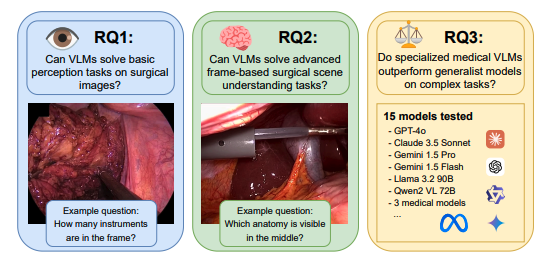
Vision Language Models (VLMs) demonstrate competence in basic surgical perception tasks like object identification, achieving performance comparable to general image analysis. However, performance declines with tasks requiring medical expertise. Surprisingly, specialised medical VLMs currently underperform relative to generalist models in complex surgical environments, indicating a need for focused development.
The increasing application of artificial intelligence in medical settings demands rigorous evaluation of its capabilities, particularly in complex visual domains like laparoscopic surgery. Researchers are now assessing the potential of large vision-language models (VLMs) – AI systems trained to interpret both images and text – to assist in surgical procedures. A comprehensive study, detailed in a new publication, benchmarks the performance of these models on a newly curated dataset of surgical imagery, probing their ability to perform tasks ranging from simple object identification to complex scene understanding. This work, led by Leon Mayer, Tim Rädsch, Dominik Michael, Lucas Luttner, Amine Yamlahia, Evangelia Christodoulou, Patrick Godau, Marcel Knopp, Annika Reinke, Fiona Kolbinger, and Lena Maier-Hein from the German Cancer Research Center (DKFZ) Heidelberg, alongside Fiona Kolbinger from Purdue University, is titled ‘Challenging Vision-Language Models with Surgical Data: A New Dataset and Broad Benchmarking Study’.
Vision-Language Models Assessed for Laparoscopic Surgical Image Interpretation
A comprehensive evaluation of current Vision-Language Models (VLMs) reveals their capabilities and limitations when applied to laparoscopic surgical imagery. The study systematically assessed performance across a spectrum of tasks, ranging from basic object recognition to complex scene understanding, utilising multiple surgical datasets and extensive human annotation for reference. The central question addressed was whether VLMs can effectively interpret the visual information present in surgical videos and images.
Results indicate VLMs successfully complete fundamental surgical perception tasks, such as instrument counting and localisation, achieving performance levels comparable to those observed in general image analysis. However, performance diminishes considerably when tasks require specific medical knowledge or nuanced understanding of the surgical environment. This suggests a limitation in the models’ ability to integrate contextual understanding crucial for accurate surgical interpretation. While VLMs demonstrate a degree of general visual competence, they currently lack the specialised reasoning capabilities necessary for complex surgical interpretation.
Counterintuitively, VLMs specifically designed for medical applications currently underperform compared to generalist models across both basic and advanced surgical tasks. Researchers suggest the complexity of surgical environments – characterised by dynamic scenes, instrument occlusion (where instruments obscure each other), and subtle anatomical variations – presents a significant challenge. This highlights the need for tailored approaches to developing medical VLMs that address the unique characteristics of surgical imagery and workflows.
The findings underscore the need for continued development in medical visual AI, focusing on enhancing VLMs’ ability to integrate medical knowledge, reason about surgical procedures, and adapt to the unique characteristics of laparoscopic imagery. Future work should prioritise training methodologies that specifically address the challenges posed by surgical video. Researchers are investigating the creation of datasets that capture the variability of surgical procedures, incorporating temporal information, and focusing on tasks that require complex reasoning about surgical actions and anatomical structures. This work aims to provide valuable insights for building the next generation of endoscopic AI systems and identifies key areas for improvement in medical image understanding, paving the way for more effective and reliable surgical tools.
👉 More information
🗞 Challenging Vision-Language Models with Surgical Data: A New Dataset and Broad Benchmarking Study
🧠 DOI: https://doi.org/10.48550/arXiv.2506.06232


