

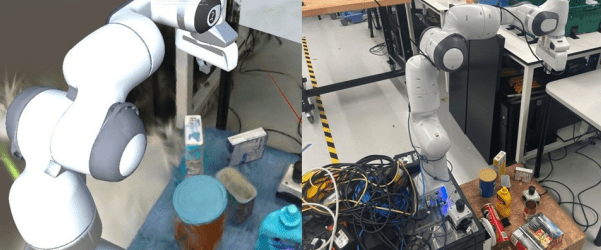
On April 21, 2025, researchers Takuya Boehringer, Jonathan Embley-Riches, Karim Hammoud, Valerio Modugno, and Dimitrios Kanoulas published Immersive Teleoperation Framework for Locomanipulation Tasks, detailing a novel VR-based system that enhances teleoperation efficiency. Their framework employs Gaussian splatting to create an intuitive virtual environment, resulting in 66% faster task completion and 93% user preference, as demonstrated through rigorous testing.
Recent advancements in VR-based teleoperation systems have improved precision and immersion compared to traditional methods. A novel framework integrates Gaussian splatting for a manipulator on a mobile platform, abstracting scenes into VR environments for intuitive interactions. User studies show 66% faster task completion with a 43% time reduction, and 93% preferred the interface, citing improvements in precision, responsiveness, and situational awareness. Real-world experiments validate its effectiveness across diverse applications.
Teleoperation—the remote control of robots—is a critical area of research, particularly for tasks requiring precision and adaptability in dynamic environments. While progress has been made, challenges remain in creating accurate and responsive 3D models that enable effective complex manipulations. Recent advancements in computer vision and rendering techniques are addressing these limitations, offering new possibilities for real-time interaction with robotic systems.
This article explores a novel approach to teleoperation that leverages Gaussian splatting, a method originally developed for radiance field rendering, to generate high-fidelity 3D models of environments in real time. By integrating this technique into teleoperation frameworks, researchers have demonstrated improved accuracy and efficiency compared to traditional methods like structure-from-motion (SfM).
Gaussian Splatting for Real-Time Rendering
Gaussian splatting is a rendering technique that represents 3D scenes as collections of small, overlapping spheres (or splat points) with associated color and depth information. Unlike conventional SfM methods, which rely on reconstructing surfaces from multiple viewpoints, Gaussian splatting directly maps visual data into a continuous 3D space. This approach allows for faster rendering and more accurate representations of complex environments.
In the context of teleoperation, this innovation enables robots to generate detailed 3D models of their surroundings as they operate in real time. These models are continuously updated based on sensor data, providing operators with an immersive and responsive view of the environment. This capability is particularly valuable for tasks requiring precise manipulation, such as assembly or repair operations in industrial settings.
Benefits Over Traditional Methods
Traditional teleoperation systems often rely on SfM to reconstruct 3D models from camera feeds. While effective, this method can be computationally intensive and slow to update, especially in dynamic environments where objects are moving or changing positions. Gaussian splatting addresses these limitations by reducing the computational overhead associated with surface reconstruction.
The benefits of Gaussian splatting over traditional methods include faster rendering times, improved accuracy in complex environments, and reduced computational requirements. These advantages make it particularly suitable for real-time applications where operators need immediate feedback to perform precise tasks.
To evaluate the effectiveness of Gaussian splatting in teleoperation, researchers conducted user studies comparing it to traditional SfM methods. Participants were asked to perform a series of tasks requiring precise manipulation in dynamic environments.
The results demonstrated that operators using Gaussian splatting completed tasks more efficiently and with higher accuracy compared to those using SfM. The immersive and responsive nature of the 3D models generated by Gaussian splatting was particularly beneficial in complex scenarios, where traditional methods often struggled to provide adequate feedback.
Limitations and Future Directions
While Gaussian splatting offers significant advantages over traditional methods, it is not without limitations. One challenge is its reliance on high-quality sensor data, which can be difficult to obtain in certain environments. Additionally, while the computational requirements are lower than those of SfM, they still pose a challenge for resource-constrained systems.
Future research directions include improving the robustness of Gaussian splatting in challenging environments and developing more efficient algorithms to reduce computational overhead further. Researchers also aim to explore applications beyond industrial settings, such as medical robotics and autonomous vehicles, where precise manipulation and real-time feedback are critical.
Gaussian splatting represents an advancement in teleoperation technology, offering faster rendering times, improved accuracy, and reduced computational requirements compared to traditional methods. Its ability to generate immersive and responsive 3D models makes it particularly suitable for complex tasks in dynamic environments.
As researchers continue to refine this approach, Gaussian splatting has the potential to revolutionize how humans interact with robots in a wide range of applications. By addressing longstanding challenges in 3D model generation, this technology not only enhances the capabilities of teleoperation systems but also opens new possibilities for collaboration between humans and machines.
The future of teleoperation is bright, and Gaussian splatting is at the forefront of this exciting evolution.
👉 More information
🗞 Immersive Teleoperation Framework for Locomanipulation Tasks
🧠 DOI: https://doi.org/10.48550/arXiv.2504.15229


