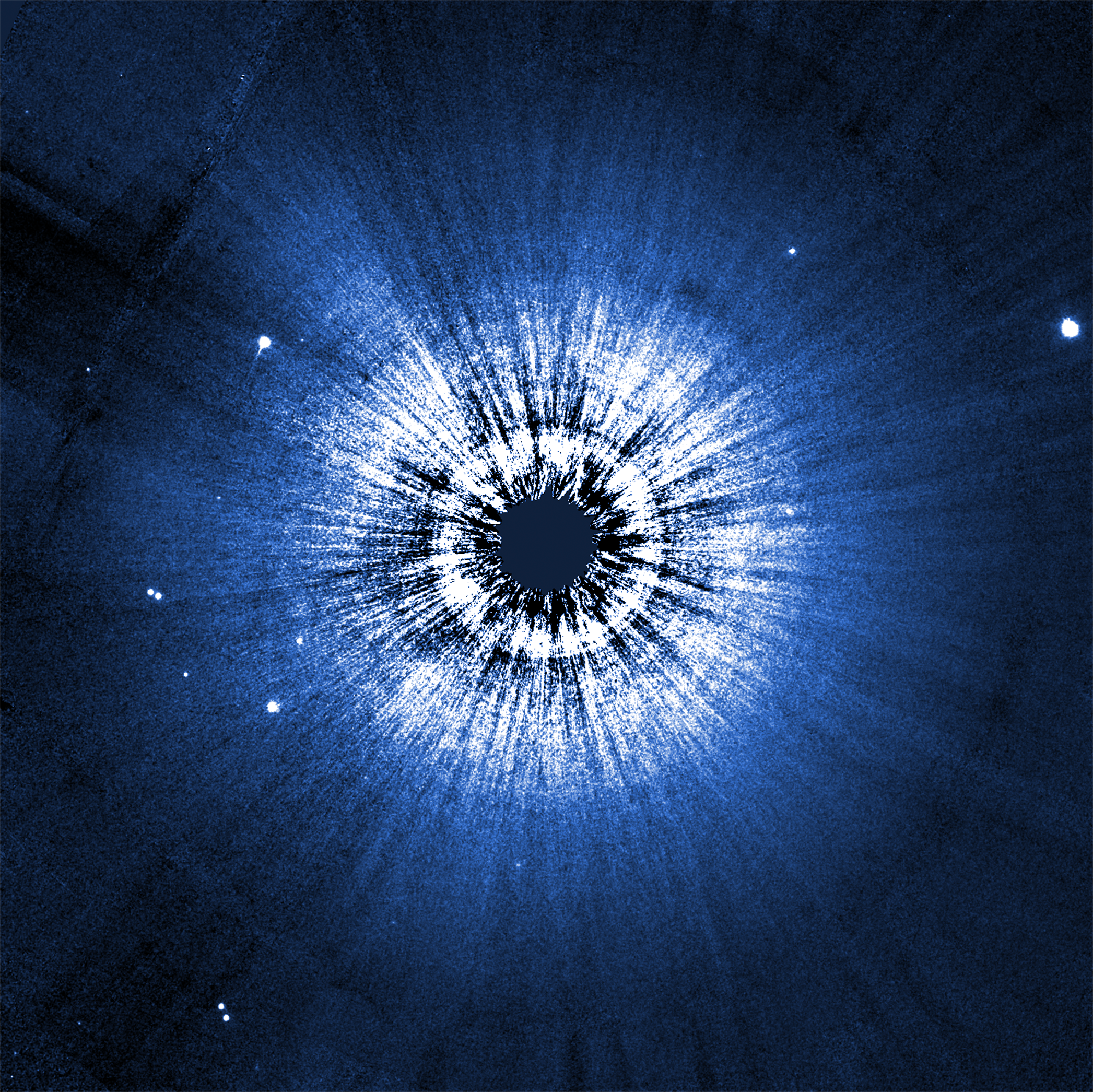
Astronomers have made a groundbreaking discovery about the star Vega, using the James Webb Space Telescope to capture a stunning image of its circumstellar disk. The disk, a smooth and fuzzy halo around the star, is replenished by minor bodies ejecting dust at a rate of about 10 tons per second.
This dust is then shaped by planets, providing a strategy for detecting exoplanets without directly observing them. According to Dr. Scott Wolff of the University of Arizona, Vega’s system architecture is markedly different from our own solar system, with no giant planets like Jupiter and Saturn to keep the dust in check.
The research team, including Dr. George Rieke and Dr. Kate Su, used Webb’s Mid-Infrared Instrument to acquire the image, which reveals a perfectly circular disk with a black circle at its center blocking light from the star. The discovery sheds new light on planetary formation and has implications for our understanding of the universe. NASA, ESA, CSA, STScI, and Lockheed Martin Space are among the organizations involved in this research.
The James Webb Space Telescope has captured a stunning image of the circumstellar disk around Vega, a bright star in the northern sky. The orange-colored, smooth, and fuzzy halo is a marvel of celestial architecture, with an inner white disk, a darker lane, and a perfectly circular shape. But what makes this image truly remarkable is the insight it provides into the formation and evolution of planetary systems.
Vega’s disk is thought to be a site
Vega’s disk is thought to be a site of ongoing planet formation, migration, and destruction, similar to those found around newly forming stars in the 1990s Hubble observations. However, Vega’s system stands out for its unusual architecture, which differs significantly from our own solar system. The lack of giant planets like Jupiter and Saturn allows the dust to spread more freely, creating a unique environment that is still puzzling scientists.
The Webb image significantly improved over previous observations by NASA’s Spitzer Space Telescope, submillimeter telescopes, and ESA’s Herschel Space Telescope. The new data provides unprecedented detail, revealing secrets about the Vega system that were previously unknown.
One of the most intriguing questions raised by this discovery is why Vega’s system differs from that of Fomalhaut, a nearby star with similar distance, age, and temperature. Fomalhaut’s circumstellar architecture features three nested debris belts, suggesting the presence of shepherding planets that constrict the dust into rings. However, no planets have been directly detected around Fomalhaut yet.
The comparison between Vega and Fomalhaut raises fundamental questions about planetary formation and the star’s role in shaping its circumstellar environment. As team member George Rieke of the University of Arizona notes, “What’s puzzling is that the same physics is at work in both [Vega and Fomalhaut].”
The study of Vega’s disk also provides a
The study of Vega’s disk also provides a strategy for detecting planets around other stars indirectly, by observing the effects they have on the dust. This approach could lead to new discoveries and a deeper understanding of planetary formation and evolution.
The James Webb Space Telescope is poised to continue making groundbreaking discoveries, probing the mysteries of our universe and our place within it. The Hubble Space Telescope, which has been operating for over three decades, will also continue to contribute to our understanding of the cosmos, shaping our fundamental knowledge of the universe.
Two papers from the Arizona team, led by Wolff et al. and Su et al., will be published in The Astrophysical Journal, providing further insights into the Vega system and its implications for our understanding of planetary formation and evolution.
External Link: Click Here For More