Researchers are developing new theoretical tools to understand complex behaviours in systems that both gain and lose energy, such as superconducting materials. Pasquale Filice from the University of Pisa, Marco Schirò from the Collège de France, and Giacomo Mazza from the University of Pisa, present time-dependent variational principles that model these ‘open’ quantum systems, including those governed by complex interactions and energy dissipation. Their work investigates how these systems evolve over time, particularly focusing on the behaviour of superconductors with both particle losses and external driving forces. The team demonstrates that approaching a specific mathematical limit, where energy loss dominates, dramatically alters the system’s evolution, shifting from predictable power-law decay to exponential behaviour and revealing a surprising ‘freezing’ of particle depletion. Furthermore, they find that strong dissipation can trap the system in an unusual state resembling negative temperature, bypassing typical high-temperature steady states, and they explain these findings through the conservation of a key property related to the system’s quantum nature.
These systems, which interact with their environment, often exhibit complex dynamics not captured by standard quantum mechanics. The researchers developed time-dependent variational principles to model these non-unitary dynamics, allowing them to describe how systems evolve even when traditional rules are broken. These principles formulate equations of motion for the system’s quantum state, bypassing the need for complex calculations typically used to describe open systems.
The team demonstrated the applicability of this method to driven-dissipative superconductors, focusing on the evolution of the superconducting order parameter and the emergence of new, non-equilibrium states. Calculations reveal that the time-dependent variational principle accurately captures the effects of both external forces and dissipation, providing a robust framework for investigating complex quantum phenomena. Furthermore, the method offers a computationally efficient alternative to traditional approaches, enabling the study of larger systems and longer timescales.
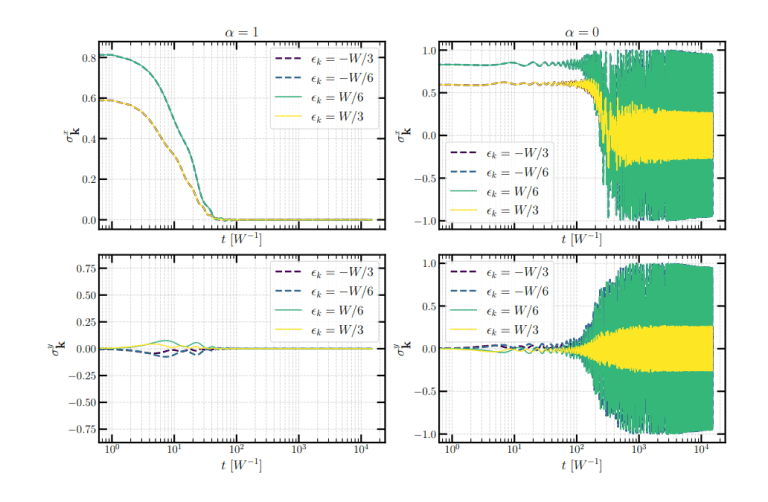
Researchers explored the behaviour of superconductors experiencing both energy loss and external driving, comparing the results to calculations using standard quantum mechanics. They investigated scenarios ranging from complete descriptions of energy loss to limits where quantum jumps are disregarded. Results demonstrate that disregarding quantum jumps significantly alters the system’s behaviour, leading to a sharp modification of how the system reaches a stable state.
Rigorous Derivations and Mathematical Justifications
Accompanying the main research, detailed appendices provide the rigorous mathematical derivations supporting the presented results. These appendices ensure the reproducibility, completeness, and validity of the findings, demonstrating that the authors have considered all relevant terms and approximations. The work relies on key concepts including open quantum systems, the Lindblad master equation, quantum operators, and correlation functions. The authors employ advanced mathematical techniques, including the Bogoliubov-de Gennes equations and mean-field theory, to simplify the complex many-body problem. They also utilize particle-hole symmetry to further streamline calculations. The core of the mathematical work lies in the derivation of the equations of motion for key observables, such as particle number and the superconducting order parameter, starting with the Lindblad master equation and applying quantum operator algebra and commutation relations.
Slowing Dissipation Via Quantum Jump Control
This research introduces new theoretical tools to investigate the behaviour of open quantum systems, specifically focusing on how systems evolve when not subject to standard quantum rules. Scientists developed time-dependent variational principles to model non-unitary dynamics, encompassing scenarios from standard dissipation to extreme limits where quantum jumps are disregarded entirely. These principles account for state normalization within hybrid quantum evolution and simplify to established methods in specific cases. Applying these principles to driven-dissipative BCS superconductors, the team explored the impact of varying the importance of quantum jumps on system dynamics.
Results demonstrate that reducing the influence of quantum jumps effectively slows down dissipation, while completely neglecting them causes dramatic shifts in behaviour. In systems experiencing particle depletion, the conservation of a quantity termed ‘pseudospin length’ suppresses particle loss, altering the decay of density. For driven-dissipative systems, this conservation hinders order parameter decay, leading to a slow, power-law decline instead of exponential decay. Importantly, the research reveals that these non-unitary dynamics can lead to steady states unattainable with standard quantum jumps included.
The authors acknowledge that their models represent a specific approach to understanding open quantum systems and that further investigation is needed to explore the full range of possible behaviours. Future work could focus on applying these principles to more complex systems and exploring the implications of these findings for quantum technologies. The research highlights the crucial role of quantum jumps in shaping non-unitary dynamics and demonstrates how neglecting them can lead to qualitatively different outcomes.
🗞 Time-dependent Variational Principles for Hybrid Non-Unitary Dynamics: Application to Driven-Dissipative Superconductors
🧠 ArXiv: https://arxiv.org/abs/2510.12737