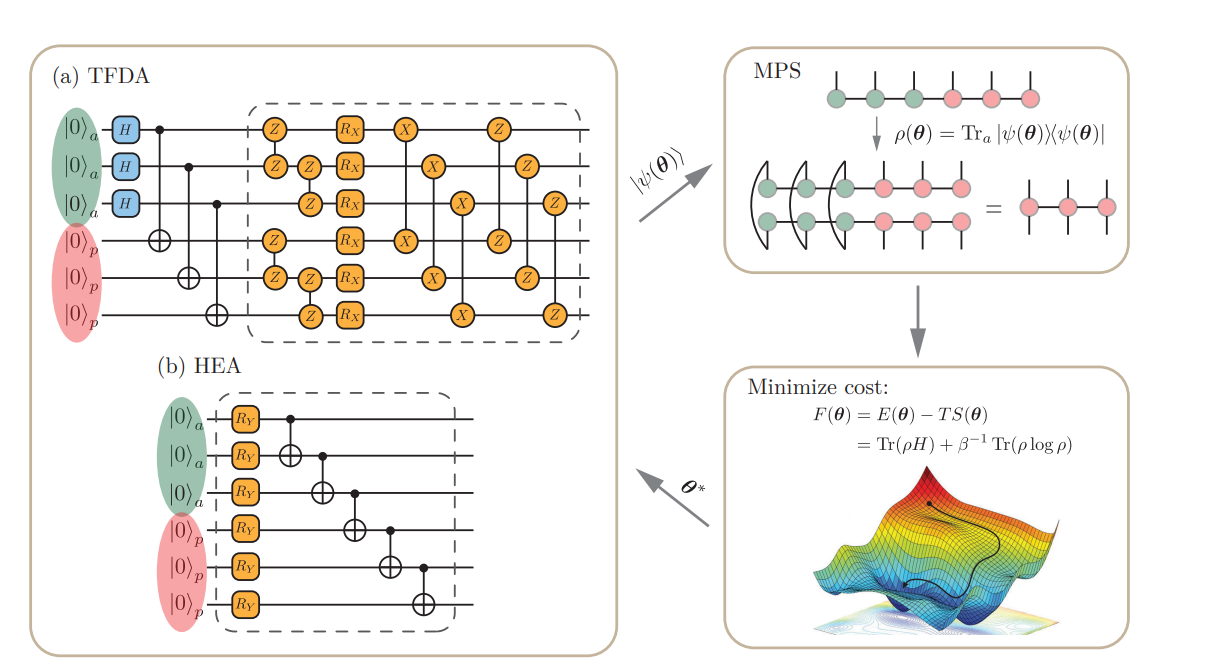
The accurate preparation of thermal states is fundamental to many computational tasks, including simulating complex materials and optimising challenging problems, and researchers continually seek more efficient methods to achieve this. Rui-Hao Li, Semeon Valgushev from National Tsing Hua University and Iowa State University, and Khadijeh Najafi from IBM Quantum and MIT-IBM Watson AI Lab, present a new variational framework that significantly advances this field. Their approach combines matrix product states with digital quantum processors to efficiently calculate key thermodynamic properties and accurately approximate thermal states in both one and two-dimensional systems, even with substantial numbers of interacting components. Through extensive simulations and a demonstration on a 156-qubit IBM Heron processor, the team showcases the ability to prepare high-quality thermal states and reduce errors in crucial measurements by over 50%, representing a substantial step towards practical thermal simulations on near-term quantum hardware.
Variational Quantum Algorithms and Applications
This collection of papers comprehensively covers the rapidly evolving field of variational quantum algorithms, quantum state preparation, and quantum machine learning. The research highlights key themes including the development of variational quantum algorithms, efficient methods for preparing and characterizing quantum states, and the application of quantum circuits to machine learning problems. A significant focus lies on addressing challenges such as the barren plateau problem and improving the resilience of algorithms to noise and errors. Researchers are increasingly combining tensor networks, a classical technique for representing quantum states, with variational quantum algorithms to enhance performance and scalability.
This work represents a substantial advancement in our ability to harness quantum computers for complex scientific simulations and optimization tasks. Among the foundational works, the Quantum Approximate Optimization Algorithm and the Variational Quantum Eigensolver stand out as pivotal contributions. Carleo and Troyer pioneered the use of artificial neural networks to represent quantum wavefunctions, laying the groundwork for neural quantum states. Classic works by White and Schollwock on Density Matrix Renormalization Group provide essential foundations for many tensor network approaches. Furthermore, foundational papers by Cramer and colleagues on efficient quantum state tomography and Martyn and Swingle’s work on representing thermal states using tensor networks have significantly advanced the field.
Current research emphasizes combining the strengths of both tensor networks and variational quantum algorithms. Scientists are developing hybrid algorithms that seamlessly integrate these techniques to overcome limitations inherent in each approach. Addressing the barren plateau problem remains a critical challenge, driving ongoing research into better circuit architectures, optimization algorithms, and initialization strategies. Error mitigation and fault tolerance are also crucial areas of investigation, as quantum hardware continues to improve. Ultimately, the goal is to develop scalable algorithms capable of tackling larger and more complex quantum systems, with applications ranging from materials science and chemistry to optimization and machine learning.
Variational Gibbs State Preparation via Tensor Networks
Scientists have developed a novel variational framework that efficiently prepares Gibbs states, crucial for simulating many-body systems at finite temperatures. This work combines matrix product states, a classical technique for compactly representing quantum states, with quantum circuit simulation to accurately approximate thermal states in both one and two dimensions. The team demonstrated the ability to prepare high-quality Gibbs states for systems containing up to 30 sites in one dimension and 6×6 sites in two dimensions, utilizing up to 42 qubits in their simulations. Researchers successfully prepared the approximate Gibbs state of a 30-site transverse-field Ising model on a 156-qubit IBM Heron processor, employing quantum circuits with 34 qubits and approximately 100 two-qubit gates. By integrating error mitigation techniques, the team reduced relative errors in energy and susceptibility measurements by over 50% compared to unmitigated results, significantly improving measurement accuracy. This work leverages matrix product states, a classical technique for compactly representing quantum states, combined with quantum circuit simulation to accurately approximate thermal states in both one and two dimensions. The team demonstrated the ability to prepare high-quality Gibbs states for systems containing up to 30 sites in one dimension and 6×6 sites in two dimensions, utilizing up to 42 qubits in their simulations. Researchers successfully prepared the approximate Gibbs state of a 30-site transverse-field Ising model on a 156-qubit IBM Heron processor.
By integrating error mitigation techniques, they reduced relative errors in energy and susceptibility measurements by over 50% compared to unmitigated results. The framework’s performance was extensively benchmarked against analytical results and Monte Carlo simulations, confirming its accuracy for key observables. This research unifies tensor-network compression with quantum circuit simulation, offering a promising pathway to enhance the fidelity, efficiency, and scalability of Gibbs state preparation and learning.
Efficient Gibbs State Preparation via Variational Methods
This research presents a new variational framework that efficiently prepares Gibbs states, crucial for simulating many-body systems and thermal sampling. By combining matrix product states with a hardware-efficient ansatz, the team accurately approximates thermal states in both one and two-dimensional systems, achieving simulations with up to 30 sites in one dimension and 6×6 sites in two dimensions, utilizing up to 42 qubits. Extensive benchmarking against analytical results and Monte Carlo simulations confirms the method’s accuracy for key observables like energy density, susceptibility, specific heat, and two-point correlations. Researchers successfully prepared the Gibbs state of a 30-site transverse-field Ising model on an IBM Heron processor, significantly improving measurement accuracy, with over a 50% reduction in relative error achieved through the application of zero-noise extrapolation as an error mitigation technique. While the hardware-efficient ansatz excels at low temperatures and requires shallower quantum circuits, its performance diminishes at intermediate temperatures. Future work will likely focus on improving the ansatz design and error mitigation techniques to enhance the quality of variational Gibbs state preparation across a wider range of temperatures and system sizes.
🗞 Variational Thermal State Preparation on Digital Quantum Processors Assisted by Matrix Product States
🧠 ArXiv: https://arxiv.org/abs/2510.23546