The quest to accurately simulate quantum systems drives innovation in computational methods, and recent work highlights the crucial role of symmetry in achieving efficient solutions. Ivana Miháliková of the Institute of Physics of Materials, Czech Academy of Sciences, alongside Joseph Carlson, Duff Neill, and Ionel Stetcu, all from Los Alamos National Laboratory, demonstrate how incorporating symmetries significantly improves the performance of Variational Quantum Eigensolver algorithms. Their research examines two distinct spin problems, one inspired by the complex dynamics of neutrino behavior in supernovae and the other a standard model of interacting spins on a lattice, revealing that preserving all inherent symmetries dramatically accelerates convergence towards accurate solutions. This achievement overcomes limitations of conventional methods, enabling nearly exact results in scenarios where standard algorithms fail, and promises to speed up quantum simulations for a wide range of scientific applications.
Symmetry Exploitation Improves Variational Quantum Algorithms
This research details advancements in variational quantum algorithms (VQAs), focusing on state preparation for simulating physical systems in areas like high-energy physics and condensed matter physics. Scientists demonstrate that enhancing VQA performance relies on effectively leveraging symmetries within the quantum system being modeled. A key challenge for VQAs is overcoming issues like barren plateaus and the need for complex trial wavefunctions, making efficient initial state preparation crucial for successful computation. The team emphasizes using symmetry projection techniques to prepare initial states possessing specific quantum numbers, such as total spin zero.
This significantly reduces the computational space the VQA optimizer needs to explore. Researchers explored various methods for implementing this projection on quantum computers, aiming for streamlined computational circuits, and applied these techniques to simulate neutrino scattering and spin models. This research demonstrates that strategically exploiting symmetries can significantly enhance the capabilities of variational quantum algorithms, paving the way for more efficient and accurate simulations of complex quantum systems. The focus on symmetry projection as a state preparation technique offers a practical approach to overcome limitations of current VQA methods.
Symmetry Exploitation Accelerates Quantum Algorithm Convergence
Scientists developed a novel approach to accelerate the convergence of variational quantum algorithms by explicitly incorporating symmetries present within quantum Hamiltonians. The study focused on two distinct spin problems: one inspired by neutrino flavor evolution and the standard Heisenberg spin Hamiltonian arranged on a lattice. Researchers demonstrated that maintaining these symmetries throughout the variational process dramatically improves convergence, achieving solutions where standard algorithms fail. The team engineered a methodology that leverages product-state ansatzes, carefully constructed to align with the symmetries of each Hamiltonian.
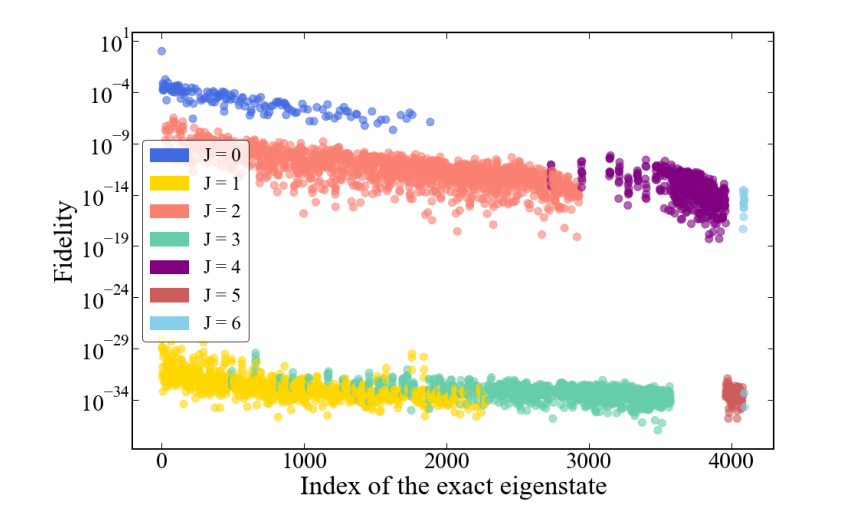
For the neutrino model, they utilized a product state representing a specific configuration anticipated in the classical limit, while the Heisenberg model employed the anti-ferromagnetic Néel state as the initial product state. Following this initial state preparation, scientists applied a restricted variational quantum algorithm designed to preserve the underlying symmetry, accelerating convergence compared to standard projection algorithms. Experiments employed a two-stage process, beginning with projection algorithms to improve the overlap of the initial product states with the desired symmetry. This was followed by the restricted variational quantum algorithm, further refining the solution while maintaining symmetry constraints. Researchers examined two spin models: one inspired by neutrino flavor evolution in supernovae and the standard Heisenberg spin Hamiltonian on a two-dimensional lattice. Both models share conservation of total spin as a fundamental symmetry, with the Heisenberg model additionally possessing translational and reflection symmetries. Experiments reveal that maintaining all symmetries dramatically improves the convergence of variational methods, allowing nearly exact solutions to be obtained in cases where standard unconstrained algorithms fail.
For the neutrino-inspired Hamiltonian, scientists utilized a product state where each spin aligns with its momentum, achieving a specific configuration detailed in previous work. The team constructed an initial product state for the Heisenberg model, the symmetrized Néel state, which yields a specific expectation value for nearest neighbor interactions. The researchers then applied a restricted variational quantum algorithm designed to preserve the underlying symmetries of the Hamiltonian. Results demonstrate that this approach significantly enhances the accuracy and efficiency of finding the ground state, particularly for systems where standard methods struggle. The team achieved a specific configuration for the Néel state, yielding a specific expectation value for nearest neighbor interactions, paving the way for more efficient quantum simulations of complex physical systems.
Symmetry Preservation Boosts Quantum Algorithm Efficiency
This research demonstrates the significant benefits of incorporating symmetries into variational quantum algorithms, specifically when seeking the ground or low-lying states of quantum systems. Investigations into two distinct spin problems, one modelling neutrino interactions and the other a standard Heisenberg model, reveal that enforcing symmetries dramatically improves the convergence of these algorithms. In both cases, the team achieved solutions where standard, unconstrained methods failed. The findings show that projecting onto states with the correct symmetries, and then maintaining these symmetries within the variational approach, substantially increases the efficiency of finding accurate solutions.
This symmetry preservation effectively expands the spectral gap and allows for the exploration of much smaller solution spaces. For example, in the Heisenberg model, a high-dimensional space was reduced to just nine states through symmetry projection, accompanied by a significant increase in the effective spectral gap. The team achieved high fidelity results, reaching specific values for the neutrino and Heisenberg models respectively, and exceeding 98% fidelity with full symmetry enforcement. The authors acknowledge that the variational solutions obtained remain approximate and could be further refined using techniques like quantum phase estimation. Future research directions include exploring strategies to reduce the complexity of quantum circuits, thereby mitigating the impact of noise, potentially leading to more powerful and efficient quantum algorithms for a range of important problems.