

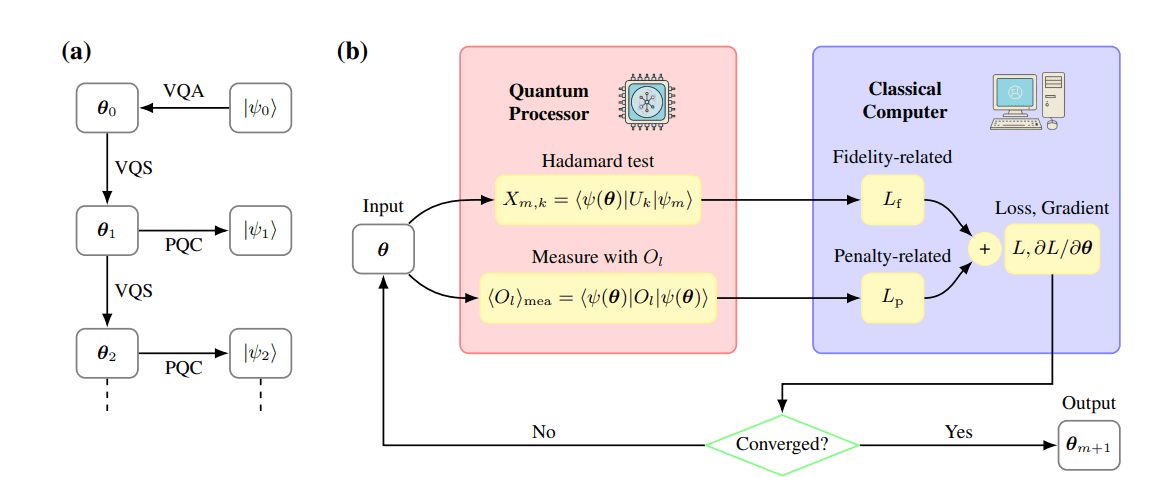
Open quantum systems exhibit fascinating behaviours, but simulating their evolution presents a significant challenge due to the complexity of their dynamics and the rapid growth in computational requirements. Huan-Yu Liu, Tai-Ping Sun, and Zhao-Yun Chen, working with colleagues at the University of Science and Technology of China and Origin Quantum Computing Technology, now demonstrate a new variational algorithm that overcomes these hurdles. Their method efficiently simulates the behaviour of these complex systems by transforming the problem into a series of manageable, unitary steps, and crucially, requires a circuit depth that does not increase with the length of the simulation. By implementing this approach on the Wukong superconducting processor, the team successfully models both a dissipative transverse Ising model and an interacting Hatano-Nelson model, showcasing the potential of near-term quantum devices to tackle previously intractable problems in physics and beyond.
Variational Simulation of Non-Unitary Quantum Dynamics
Scientists have developed a variational quantum simulation algorithm to model complex, non-unitary dynamics, a challenge for conventional quantum devices due to the exponential growth of computational requirements. This approach converts non-unitary processes into a weighted sum of unitary evolutions, making them tractable on near-term hardware. Crucially, the researchers engineered a simplified quantum circuit for evaluating the loss function, ensuring the circuit depth remains independent of the simulation time, a significant advancement for scalability. The method employs a hybrid quantum-classical loop, where a quantum processor performs calculations and a classical computer optimizes parameters until convergence is achieved, ultimately determining the system’s time evolution.
To demonstrate the algorithm’s capabilities, the team simulated the collective dynamics of a dissipative transverse Ising model and an interacting Hatano-Nelson model using the superconducting processor, Wukong. For the Ising model, they initialized a system of six spins and studied the evolution of average spin polarization under a complex magnetic field. Experiments were conducted with specific system parameters, and the parameterized quantum circuit was executed repeatedly, with each run sampled extensively, to determine the average spin polarization. The results, showing excellent agreement between experimental data and numerical simulations, demonstrate the reliability of the quantum simulation at the current noise level.
Further validating the approach, the researchers simulated the interacting Hatano-Nelson model, a system exhibiting exponentially localized eigenstates, using the same quantum processor. This model, chosen to demonstrate the scalability of the method for simulating many-body non-Hermitian systems, was optimized through leveraging inherent dynamic symmetry. The success of these simulations underlines the capability of noisy intermediate-scale quantum devices to explore dissipative dynamics and represents a step forward in harnessing their potential for solving outstanding physical problems. This work demonstrates the potential of noisy intermediate-scale quantum devices to tackle problems beyond the reach of classical computation, specifically in the study of dissipative dynamics.
Researchers acknowledge that the algorithm can be resource-intensive, particularly regarding qubit requirements and circuit depth, suggesting that approximating the loss function by focusing on diagonal terms offers a potential solution when resources are limited. Furthermore, improvements to simulation accuracy can be achieved through refined kernel functions and optimization of the time step used in the simulation. Future work may also benefit from careful selection of observables within the loss function to further mitigate fidelity decay during experiments. This research represents a significant step towards harnessing the power of quantum computing to explore complex physical systems and unlock new scientific discoveries.
👉 More information
🗞 Variational quantum simulation of many-body dissipative dynamics on a superconducting quantum processor
🧠 ArXiv: https://arxiv.org/abs/2510.20118

