Quantum simulations promise to revolutionise fields from materials science to drug discovery, yet current quantum computers struggle with the complexity of many-body systems. Hao Zhang and Ayush Asthana, alongside their colleagues, address this challenge with a new algorithm called the Cyclic Variational Quantum Eigensolver. This innovative approach systematically improves the accuracy of quantum calculations by intelligently building up the computational space, avoiding the limitations of traditional methods that often get trapped in unproductive calculations. The team demonstrates that their algorithm not only escapes these computational bottlenecks, known as barren plateaus, but also achieves a level of precision comparable to sophisticated chemical models, while requiring significantly fewer computational resources. This breakthrough paves the way for more efficient and scalable quantum simulations on near-term quantum hardware, bringing practical quantum chemistry closer to reality.
This method addresses the challenge of barren plateaus, a significant obstacle in variational quantum algorithms that hinders optimization and limits the scalability of quantum computations. CVQE employs a cyclical process of parameter updates, guided by a carefully designed cost function that promotes stable and efficient convergence towards the ground state. Specifically, the method uses a ‘staircase descent’ strategy, where parameters are adjusted sequentially, effectively navigating the complex energy landscape and avoiding regions where gradients vanish. Unitary Coupled Cluster, or UCC, serves as a powerful trial wavefunction, with ongoing work to make it more efficient for near-term quantum computers. Scientists also investigate methods for calculating excited state energies, crucial for spectroscopy and photochemistry, and are developing subspace-based methods and techniques to reduce leakage.
A major focus is on designing better trial wavefunctions, or ansätze, that are both accurate and implementable with a reasonable number of quantum gates, including adaptive and sparse ansätze, and Heat-Bath Configuration Interaction, or HB-CI. Improving optimization algorithms used to find the best parameters for VQE or UCC circuits is also critical, with research focused on avoiding local minima and utilizing techniques like natural gradient optimization and stochastic optimization. Current challenges include barren plateaus, where gradients vanish, and leakage, where the quantum state leaves the computational subspace. Reducing the depth and gate count of quantum circuits while maintaining accuracy, and dealing with the effects of noise in quantum computers, are also key areas of investigation.
Researchers employ techniques like the Bravyi-Kitaev Transformation to
Researchers employ techniques like the Bravyi-Kitaev Transformation to map electronic operators to qubit operators, and explore methods for minimizing the number of gates needed to represent quantum states. High-accuracy methods like Multireference Coupled Cluster and N-Electron Valence State Perturbation Theory are also being investigated. Beyond VQE and UCC, scientists are exploring quantum annealing for optimization problems, quantum neural networks, and variations like Cyclic Quantum Annealing. Software tools like PennyLane and PySCF are also being developed to facilitate quantum chemistry simulations.
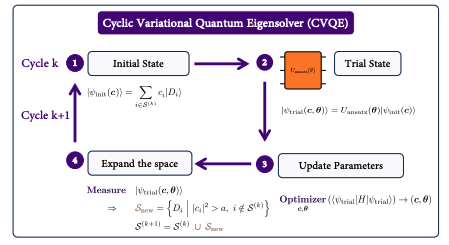
Current research emphasizes improving VQE and UCC, developing methods for excited state calculations, addressing barren plateaus and leakage, and benchmarking algorithms against classical methods. The development of user-friendly software tools is also a priority. Unlike traditional approaches that rely on fixed quantum circuits, CVQE systematically expands the computational space during the simulation process. This expansion occurs through a measurement-driven feedback cycle, where Slater determinants, representing possible electronic configurations, with high sampling probability are added to the reference state in each cycle. Crucially, the core entangling structure of the quantum circuit remains fixed, preserving efficiency and simplifying implementation.
This behavior demonstrates CVQE’s ability to escape barren plateaus, a common challenge in quantum computation where optimization stalls. Benchmarks conducted on molecular dissociation problems, including BeH2, H6, and N2, consistently demonstrate chemical accuracy across a range of correlation strengths. The results show CVQE reliably converges to accurate solutions using only a single layer of the UCCSD entangling circuit. Comparisons with established methods, including semistochastic heat-bath Configuration Interaction, demonstrate that CVQE achieves comparable accuracy with fewer computational determinants, highlighting a favorable accuracy-cost trade-off. The team also introduced a Cyclic Adamax optimizer, which accelerates parameter updates and amplifies the staircase descent pattern, further enhancing the efficiency and reliability of the method. This new framework achieves accurate ground-state energy calculations by iteratively expanding a reference superposition with the most probable Slater determinants, while consistently reusing a fixed entangling circuit. This adaptive growth of the reference space systematically improves the variational space, avoiding the need for manually designed or searched-for trial wavefunctions, and preserving the benefits of a pre-compiled quantum circuit. Results demonstrate that CVQE consistently achieves chemical accuracy across a range of molecular systems and correlation strengths, significantly outperforming fixed Unitary Coupled Cluster Singles and Doubles methods.
Notably, the method exhibits a distinctive “staircase” pattern
Notably, the method exhibits a distinctive “staircase” pattern during optimization, where sharp energy drops indicate efficient escape from optimization challenges known as barren plateaus. The team highlights the linear scalability of CVQE’s computational cost with the number of retained determinants, offering a tunable balance between accuracy and resource demands. While the fixed entangler offers advantages, the preparation of the reference superposition introduces some overhead, scaling linearly with the number of determinants. Future work may focus on further reducing this overhead by exploiting the specific structure of the low-energy subspace. The method’s ability to reuse a pre-optimized entangling circuit across diverse systems and applications positions CVQE as a promising, scalable paradigm for near-term quantum simulation.
🗞 Cyclic Variational Quantum Eigensolver: Escaping Barren Plateaus through Staircase Descent
🧠 ArXiv: https://arxiv.org/abs/2509.13096