Variational quantum algorithms represent a promising pathway towards practical quantum computation, offering potential advantages in fields ranging from optimisation to machine learning, but their susceptibility to noise remains a significant challenge. Connor van Rossum, Sally Shrapnel, and Riddhi Gupta, all from the University of Queensland, investigate how different types of noise impact the performance of these algorithms, revealing a surprising insight. Contrary to established error-mitigation techniques that aim to eliminate noise, the team demonstrates that preserving certain biases within the noise actually assists classical optimisers in finding superior solutions. Through analytical studies of a universal regression model and numerical experiments on a quantum eigensolver, they show that asymmetric noise introduces directional cues that can be exploited during optimisation, while standard noise-reduction strategies can suppress crucial signals and hinder performance. This research challenges conventional wisdom and suggests a new approach to harnessing, rather than eliminating, noise in variational quantum algorithms.
Barren Plateaus and Variational Quantum Algorithms
This body of work explores the core concepts, limitations, and potential solutions for variational quantum algorithms (VQAs) such as the variational quantum eigensolver (VQE) and quantum approximate optimization algorithm (QAOA). Investigations reveal a strong connection between noise and barren plateaus, suggesting that error mitigation strategies may offer a path towards improved performance. Deeper analyses of loss landscapes identify potential traps that hinder optimisation, while unified theories aim to provide a comprehensive understanding of these complex landscapes. Fourier analysis offers a powerful tool for understanding and potentially mitigating barren plateaus by analysing the underlying structure of quantum circuits.
Researchers are developing quantum circuit architecture search techniques and hardware-efficient ansatze specifically designed to avoid barren plateaus, highlighting the interconnectedness of expressibility, circuit design, and trainability in achieving successful VQA performance. Quantum error mitigation (QEM) is a critical area for near-term quantum computing, aiming to reduce the impact of noise without the need for full-fledged quantum error correction. This research underscores the importance of understanding the limitations of QEM and developing strategies to overcome them.
Data Re-uploading Circuits Assess VQA Noise Impacts
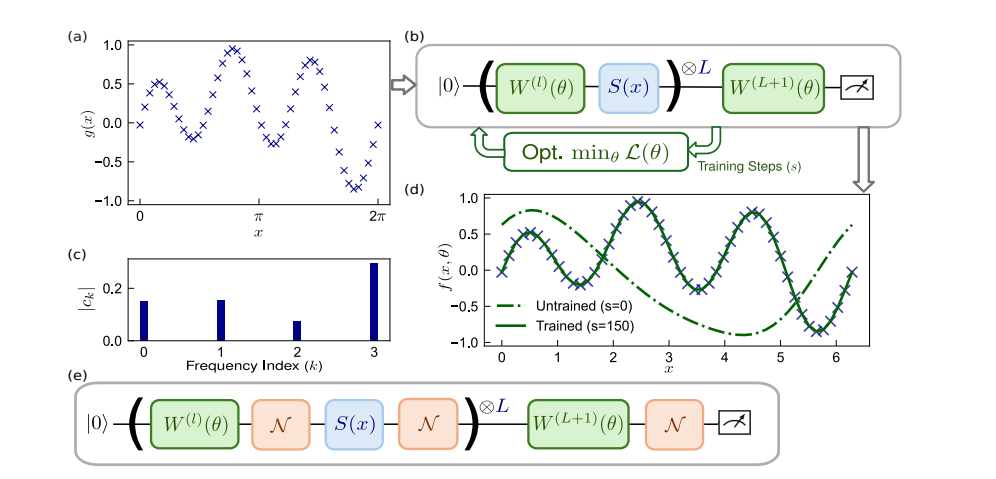
Researchers developed a novel methodology to investigate the impact of noise on variational quantum algorithms (VQAs), challenging conventional error-mitigation strategies. The study pioneered the use of data re-uploading circuits, specifically designed to achieve zero loss under ideal conditions, as reliable testbeds for analysing noise effects on expressivity and trainability. These circuits, structured to learn truncated Fourier series, enable precise characterisation of how different noise types influence performance. The team constructed circuits consisting of layers that encode data and trainable unitaries, controlling Fourier coefficients to achieve a zero-loss solution in the absence of noise.
To systematically assess noise impacts, scientists introduced various noise channels, including amplitude damping, Pauli channels, and Clifford twirling, into the quantum circuits. They then quantified expressivity by measuring the expected range of model outputs and trainability by examining the distribution of loss gradient magnitudes. A key innovation involved comparing the performance of circuits exposed to biased noise, such as amplitude damping, with those subjected to uniform Pauli or Clifford-twirled noise. Researchers discovered that biased noise enabled optimisers to navigate parameter space more effectively, leading to improved performance, while twirling degraded performance by removing exploitable noise biases. This work reveals that, contrary to expectations, symmetrising noise through twirling can hinder optimisation in VQAs, suggesting that preserving noise biases may, in fact, enhance performance.
Biased Noise Aids Variational Quantum Optimisation
Scientists have achieved a surprising result concerning noise in variational quantum algorithms (VQAs), demonstrating that commonly used error-mitigation techniques can actually hinder performance. Contrary to expectations, the research shows that twirling, a standard method for symmetrizing noise, degrades the ability of VQAs to find optimal solutions. Instead, preserving biased or non-unital noise can assist classical optimisers in achieving better results. Through analytical study of a universal regression model, researchers showed that uniform Pauli channels suppress gradient magnitudes and reduce expressivity, making optimisation more difficult.
Conversely, asymmetric noise, such as amplitude damping, introduces directional bias that can be exploited during the optimisation process. Numerical experiments using a variational quantum eigensolver for the transverse-field Ising model confirmed that non-unital noise yields lower-energy states compared to twirled noise, demonstrating a clear advantage in finding more accurate solutions. Further investigation using data re-uploading circuits revealed that expressivity is significantly impacted by noise type. The research demonstrates that a model’s ability to approximate target functions is directly tied to the circuit’s expressivity in both noise-free and noisy environments. Measurements of trainability showed that asymmetric noise facilitates more efficient optimisation, and that the structure of the loss landscape is crucial for successful training.
Biased Noise Aids Quantum Optimisation
Scientists have demonstrated that commonly used error-mitigation techniques can hinder performance in variational quantum algorithms (VQAs). The research shows that twirling, a standard method for symmetrizing noise, degrades the ability of VQAs to find optimal solutions, and that preserving biased or non-unital noise can assist classical optimisers in achieving better results. Through analytical study of a universal regression model, researchers showed that uniform Pauli channels suppress gradient magnitudes and reduce expressivity, making optimisation more difficult. Numerical experiments using a variational quantum eigensolver for the transverse-field Ising model confirmed that non-unital noise yields lower-energy states compared to twirled noise. The team also established that coherent errors are fully mitigated through re-parameterisation. The researchers anticipate that these findings will apply broadly to a range of VQAs.
🗞 Exploiting biased noise in variational quantum models
🧠 ArXiv: https://arxiv.org/abs/2510.24050