Classifying entangled quantum states presents a significant challenge for physicists, as it requires distinguishing between different arrangements of quantum connections within a system. Hamna Aslam and Frédéric Holweck, from the Laboratoire Interdisciplinaire Carnot de Bourgogne and the University of Technology of Belfort-Montbéliard, alongside their colleagues, now demonstrate a new method for identifying these complex arrangements. Their research introduces a hybrid approach combining classical and quantum computation to learn entanglement patterns, and they successfully apply this technique to build a classifier capable of distinguishing between four-qubit states. This achievement represents a step forward in our ability to characterise and harness the power of quantum entanglement, which is crucial for developing future quantum technologies.
Quantum entanglement has become a central focus in quantum information science due to its crucial role in applications like quantum cryptography, teleportation, and error correction. This research investigates classifying entanglement based on orbits, representing equivalence classes of quantum states connected by specific transformations, with finer distinctions requiring more complex classifications. Scientists demonstrate a novel approach using variational quantum circuits to learn these entanglement orbits and apply this technique to classify four-qubit states, contributing a new technique for analysing and categorising quantum entanglement, potentially advancing the development of more robust and efficient quantum technologies.
Learning Entanglement Orbits with Quantum Classifiers
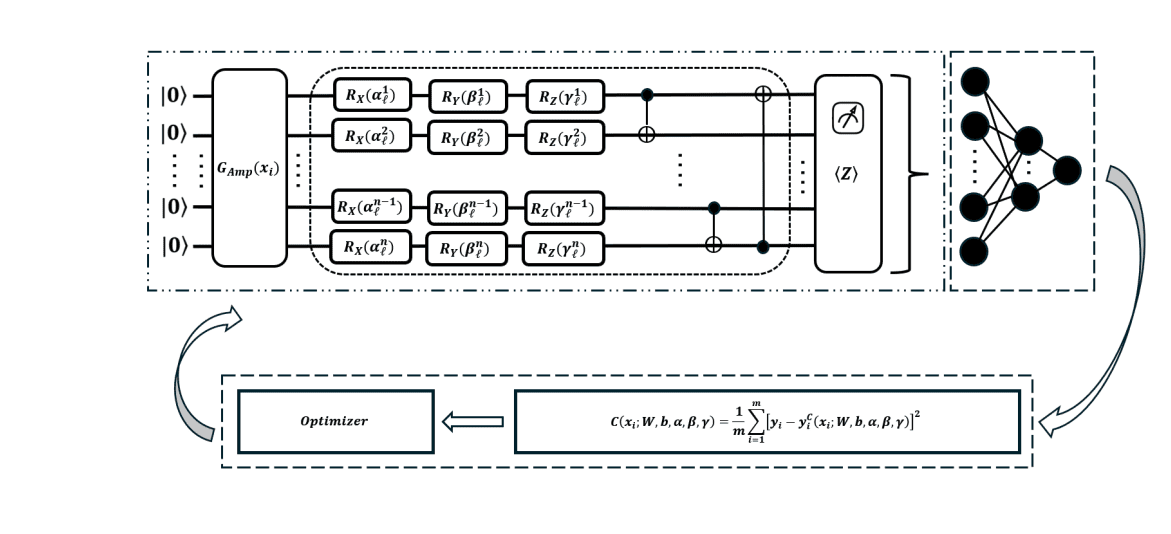
Scientists developed a variational quantum circuit approach to classify entanglement in multi-qubit systems, tackling a challenging problem in quantum information science. The study pioneers a method to learn entanglement orbits, representing equivalence classes of quantum states connected by local operations, and applies this to the specific case of four-qubit states. This work circumvents the need for extensive quantum state tomography or complex measurements, demanding resources that scale exponentially with the number of qubits. The team engineered a Variational Quantum Classifier (VQC) to function as a parametrized function, trained to predict labels based on input quantum states, encoding the state’s amplitude vector into the quantum circuit.
Repeated layers of rotation and entangling gates, represented by a parameter set, are then implemented, followed by measurement of an observable to extract the model’s predicted label. The success of the model is quantified by a cost function, minimized through iterative optimization on a classical computer to determine the optimal parameter set. This method achieves a polynomial scaling of resources with the number of qubits, a significant advantage over traditional approaches. The researchers implemented a hybrid VQC, designed to better capture the non-linear nature of entanglement orbits, surpassing the limitations of simpler VQC classifications. Experiments employed this hybrid VQC to learn various classification schemes for four-qubit graph states, successfully identifying states belonging to the same local connectivity and local unitary orbits, demonstrating the potential of VQCs to classify entanglement based on orbits.
Hybrid Quantum Circuit Classifies Entanglement Orbits
Scientists have developed a novel hybrid variational quantum circuit (VQC) that achieves high accuracy in classifying entanglement orbits of multipartite quantum states, a challenging problem in quantum information theory. This work demonstrates a method for learning these orbits by combining the power of quantum computation with classical neural network processing. The team successfully trained the hybrid VQC to distinguish between different entanglement classes of quantum states, significantly improving classification performance. Experiments reveal that the hybrid VQC, incorporating classical post-processing layers, achieves 100% classification accuracy for certain datasets, surpassing the performance of VQCs relying solely on quantum circuits, stemming from the ability of the classical neural network layers to provide non-linear decision boundaries.
The method involves encoding quantum state features into qubit amplitudes and then processing the resulting outputs with classical neural networks, allowing for a significant increase in trainable parameters without increasing the complexity of the quantum circuit itself. Measurements confirm that the hybrid VQC accurately classifies three-qubit states, achieving high training and test accuracies for various states, including fully separable, biseparable, and the W state. Further tests demonstrate the ability to distinguish between the local unitary orbit of a three-qubit GHZ state and other three-qubit states with high accuracy, delivering a powerful tool for classifying complex quantum states.
Four-Qubit Entanglement Classification via Hybrid Circuits
This research demonstrates a successful application of hybrid variational quantum circuits for classifying multipartite entangled states, specifically focusing on four-qubit systems. The team achieved high accuracy in identifying different equivalence classes of entanglement, correctly classifying all possible four-qubit graph states with over 98% accuracy and achieving over 90% accuracy when classifying states within a larger set of stabilizer states. Importantly, the method extends to learning local unitary orbits, distinguishing between equivalence classes with at least 88% accuracy, highlighting its robustness as classification schemes become more complex. The approach offers several advantages, including the ability to function without complete knowledge of the quantum system, a scaling of resources that is polynomial with the number of subsystems, and compatibility with current noisy intermediate-scale quantum (NISQ) hardware. Future research directions include scaling the method to larger systems, extending the classification to encompass the broader SLOCC classification of pure states, and investigating the impact of noise and decoherence on performance when implemented on actual quantum hardware, promising to further refine the practical classification of entangled states and broaden its applications within quantum information science.
👉 More information
🗞 A hybrid variational quantum circuit approach for stabilizer states classifiers
🧠 ArXiv: https://arxiv.org/abs/2511.09430