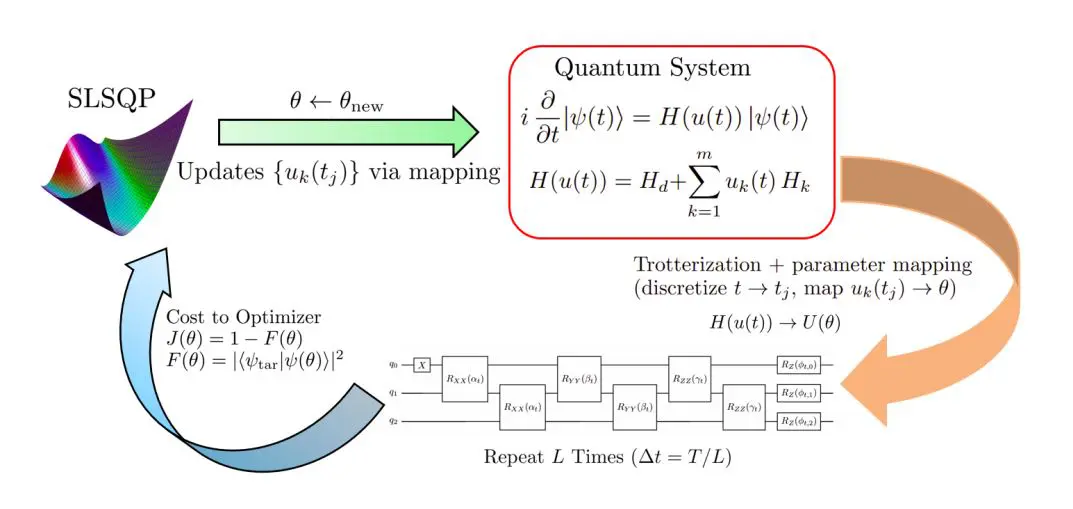
Quantum control of complex systems represents a significant challenge in realising the potential of quantum technologies, and researchers are now exploring new methods to achieve high-fidelity state transfer in spin chains. Nahid Binandeh Dehaghani, Rafal Wisniewski, and A. Pedro Aguiar, from Aalborg University and the University of Porto, have developed a novel hybrid variational framework that addresses this challenge by combining deterministic and trainable elements within a quantum circuit. Their approach discretises system dynamics and encodes control inputs using on-site rotations, allowing for optimisation via a Sequential Least Squares Quadratic Programming method. Simulations demonstrate that this technique achieves near-perfect state transfer, and importantly, reveals a crucial trade-off between expressivity and stability, paving the way for scalable control synthesis compatible with current and near-term quantum devices.
Variational Control Optimizes Spin-Chain State Transfer
This research investigates methods for achieving reliable and efficient quantum state transfer in spin chains, focusing on the challenges posed by current quantum hardware susceptible to noise and decoherence. Scientists explored different control strategies to move quantum information between qubits, employing a variational approach to optimize a parameterized quantum circuit. They compared local control, where each qubit’s control field is independently optimized, and global control, which uses a harmonic potential to create spatially correlated control fields. The continuous-time control problem was discretized using Trotterization, creating a practical quantum circuit for implementation.
The results demonstrate a clear trade-off between expressivity and stability. Local control achieves slightly higher fidelities in ideal conditions but is significantly more vulnerable to noise. Global control, however, demonstrates superior robustness under depolarizing noise, achieving substantially higher fidelities due to fewer parameters and correlated control fields that average out local errors. This work highlights the importance of considering noise resilience when designing quantum control strategies for near-term quantum devices, suggesting that simplicity and robustness are crucial for practical quantum control.
Hybrid Variational State Transfer in Spin Chains
This study pioneers a hybrid variational framework for achieving high-fidelity state transfer in spin chains, translating complex quantum dynamics into a form suitable for optimization on near-term quantum devices. Researchers discretized the system’s dynamics and compiled them into a parameterized quantum circuit, utilizing deterministic two-qubit blocks to represent the system’s natural evolution and trainable rotations to encode control inputs. This approach avoids computationally demanding methods, leveraging the expressivity of parameterized circuits to capture complex quantum dynamics. The team investigated a compact global scheme utilizing shared parameters and a local scheme employing site-wise angles.
To optimize the control parameters, scientists employed an algorithm minimizing the difference between the target and achieved states. Experiments on XXZ spin chains systematically compared the performance of the global and local control schemes. Results demonstrate that both parameterizations can achieve near-unit fidelities in the absence of noise. Under depolarizing noise, the global scheme exhibited improved robustness for comparable circuit depth and optimization effort, revealing a crucial expressivity-stability trade-off relevant to practical implementations. This work establishes a scalable route to synthesizing control protocols compatible with near-term quantum devices, paving the way for advanced quantum communication and computation.
Near-Unit Fidelity State Transfer in Spin Chains
Scientists have developed a hybrid variational framework for achieving high-fidelity state transfer in spin chains, a crucial process for quantum communication and computation. Researchers mapped complex quantum dynamics onto parameterized circuits, utilizing deterministic two-qubit blocks to represent the system’s natural evolution and trainable rotations to encode control inputs. The team investigated a compact global scheme employing shared parameters across circuit slices and a local scheme with site-specific angles. Simulations on XXZ spin chains demonstrate that both schemes can achieve near-unit fidelities in ideal conditions.
Specifically, the results show that both parameterizations are capable of reaching fidelities very close to 1, indicating highly accurate state transfer. Under realistic conditions, incorporating depolarizing noise, the global scheme exhibited improved robustness while maintaining comparable circuit depth and requiring similar numbers of optimization iterations. This reveals a fundamental trade-off between expressivity and stability in control design. The study quantified the computational cost of each scheme, demonstrating that the global scheme utilizes fewer parameters, crucial for implementation on near-term quantum devices with limited resources.
Global Control Boosts Robust State Transfer
This work presents a novel variational framework for achieving high-fidelity state transfer in spin chains, demonstrating a clear relationship between control parameterization, expressivity, and stability. Researchers developed two distinct approaches to quantum optimal control: a compact global scheme and a local scheme, both implemented using parameterized quantum circuits and optimized with an algorithm. Simulations reveal that while local control achieves marginally higher fidelities in ideal conditions, the global control scheme exhibits significantly improved robustness against depolarizing noise. Notably, the global parameterization maintains performance under noise with a comparable number of optimization iterations, indicating its inherent resilience rather than simply faster convergence.
The team quantified this advantage with a robustness ratio, demonstrating a substantial improvement in noise tolerance for the global control scheme. This combination of scalable parameterization, reduced calibration sensitivity, and enhanced noise resilience establishes global control as a promising strategy for near-term quantum applications. Future research will focus on extending this framework to larger systems, exploring diverse noise models, and ultimately validating these findings through experimental implementation, paving the way for more robust quantum technologies.
🗞 Trotterized Variational Quantum Control for Spin-Chain State Transfer
🧠 ArXiv: https://arxiv.org/abs/2511.09684