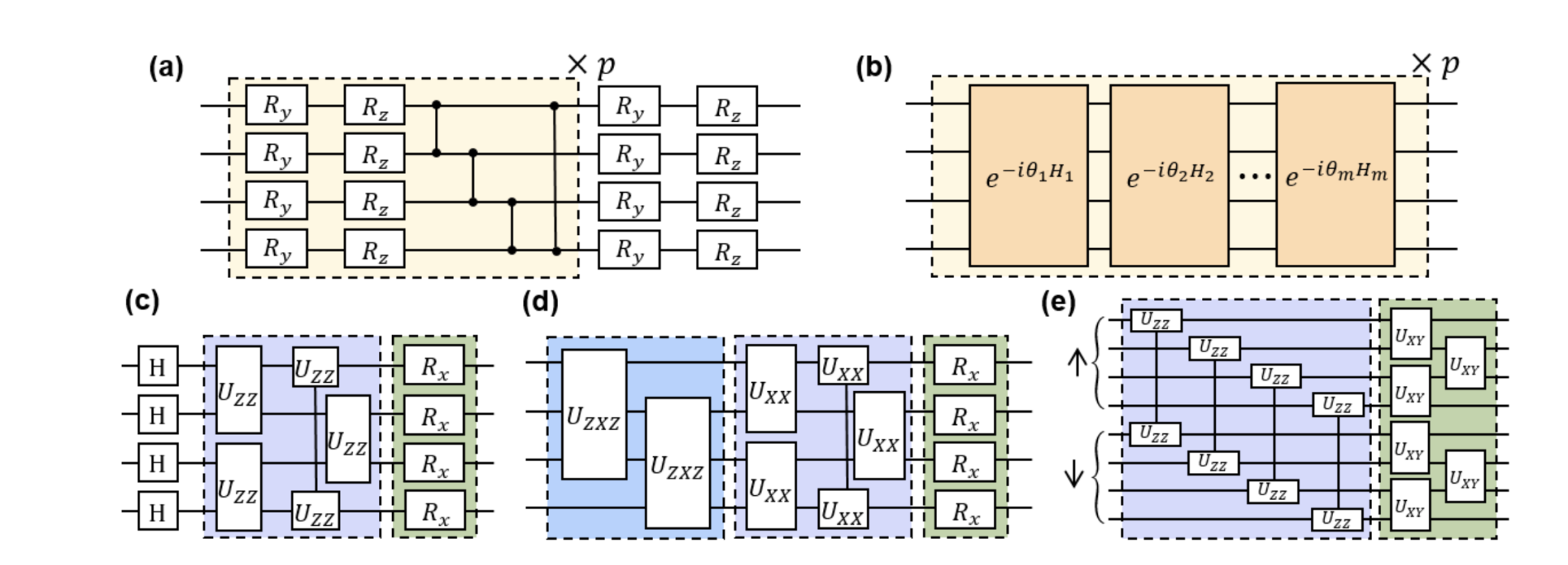
Variational quantum algorithms (VQAs) currently face a fundamental challenge, balancing the need for complex calculations with the limitations of current quantum hardware. Deeper circuits offer greater computational power but become increasingly susceptible to errors, while simpler circuits lack the necessary complexity for many problems. Now, Shaojun Wu, Shan Jin, Abolfazl Bayat, and Xiaoting Wang, all from the Institute of Fundamental and Frontier Sciences, University of Electronic Science and Technology of China, present a new framework that significantly improves VQA performance by carefully designing the initial input state. Their method systematically expands the range of states a quantum circuit can reach, boosting accuracy without increasing computational cost, and they mathematically prove this approach enhances the expressive capacity of any VQA. Demonstrating broad applicability, the team successfully applied this technique to complex models in physics, consistently achieving superior results compared to standard VQAs, and establishing input-state design as a crucial complement to existing circuit development.
Variational Quantum Eigensolver And Quantum Simulation
This body of research comprehensively explores Variational Quantum Eigensolver (VQE) and related quantum algorithms, quantum machine learning, and quantum simulation. The work reveals a vibrant and active field, with numerous studies focused on enhancing VQE’s performance and expanding its applications. A dominant theme involves improving the algorithm itself, with studies concentrating on enhancing performance, reducing circuit depth, and optimising the overall process. Significant attention is given to ansatz design, the selection of the quantum circuit structure crucial for VQE’s success. Researchers are actively investigating different circuit structures to improve the algorithm’s ability to represent complex quantum states.
Applications of VQE are widespread, particularly in quantum chemistry for calculating ground state energies of molecules, but also extend to materials science and solving problems in physics. Furthermore, studies address the practical challenges of running VQE on near-term quantum computers, focusing on reducing resource requirements and optimising circuit compilation. Beyond these core areas, the research investigates optimisation techniques, including classical and gradient-based methods, and evolutionary strategies to improve the efficiency of quantum algorithms. Theoretical foundations are also being strengthened through studies of expressibility, entanglement, error mitigation, and algorithm complexity. The sheer volume of research indicates a rapidly evolving field, with ongoing efforts to address key challenges and unlock the full potential of VQE and related algorithms. Current research highlights the importance of ansatz design, optimisation techniques, and error mitigation for scaling VQE to larger, more complex problems.
Reshaping Input States for Enhanced Variational Algorithms
Scientists have developed a novel approach to enhance variational quantum algorithms (VQAs) by focusing on the design of the input state, a previously under-explored area. Recognising the trade-off between circuit expressivity and trainability, the team engineered a method to systematically modify the set of reachable states without altering the quantum circuit itself. This work addresses a key challenge in VQAs, where deeper circuits offer greater expressivity but suffer from noise accumulation, while shallower circuits lack the capacity to represent complex states. The team pioneered a measurement-based encoder to prepare the input state as a superposition of candidate states, effectively reshaping the reachable set and providing a more favourable starting point for optimisation.
This technique involves constructing the input state as a linear combination of basis states, ensuring a broader range of initial conditions for the variational process. The researchers rigorously proved that this input-state design increases the expressive capacity of any given VQA ansatz, expanding the algorithm’s ability to approximate target quantum states. Experiments applied this method to ground-state preparation for the transverse-field Ising, cluster-Ising, and Fermi-Hubbard models, consistently achieving higher accuracy under the same gate budget compared to standard VQAs. The approach maintains the original circuit structure, making it broadly applicable to various ansatz families. By focusing on input-state design, the team demonstrates a powerful complement to circuit design, paving the way for VQAs that are both expressive and trainable on near-term quantum computers.
Input State Optimisation Boosts VQA Performance
Scientists have developed a new method to enhance the performance of variational quantum algorithms (VQAs), a leading approach to utilising near-term quantum computers. This work addresses a critical challenge in VQAs, balancing the need for expressive power with the difficulty of training complex circuits. Researchers focused on optimising the input state, the initial quantum state prepared before the main computational circuit is applied, rather than solely modifying the circuit itself. This innovative approach systematically reshapes the range of quantum states the algorithm can reach, improving accuracy without increasing circuit complexity.
The team’s method involves preparing the input state as a superposition of multiple candidate states, effectively broadening the algorithm’s starting point and increasing the probability of finding an accurate solution. A theoretical analysis confirms that this input-state design demonstrably improves the ability to prepare ground states for a given Hamiltonian. Validation through numerical experiments on several quantum many-body models confirms these findings. Specifically, for the one-dimensional transverse-field Ising model, the new method achieves a fidelity of 0. 99 with only eight layers of quantum gates, a reduction compared to conventional hardware-efficient ansatzes.
Similar improvements were observed in two-dimensional Ising and cluster-Ising models, where the method consistently reached a fidelity of 0. 99 with fewer layers than typical Hamiltonian variational ansatzes. Furthermore, the team demonstrated consistent performance gains in strongly correlated systems, including the Fermi-Hubbard model, showcasing the broad applicability of this input-state design. These results establish input-state design as a powerful and versatile tool for building VQAs that are both expressive and trainable.
Expressive States Enhance Variational Quantum Algorithms
Scientists have developed a new method to enhance the performance of variational quantum algorithms (VQAs), addressing the inherent trade-off between expressivity and trainability in quantum circuits. Their work centres on designing input states that systematically improve the ability of a quantum computer to find solutions, even with limited circuit depth. By constructing a carefully designed initial state, researchers demonstrate an increase in the expressive capacity of any given VQA, meaning the algorithm can represent a wider range of potential solutions. This approach involves preparing an input state as a superposition of carefully selected candidate states, effectively expanding the set of reachable states within a fixed-depth circuit.
Testing across several models, including the transverse-field Ising, cluster-Ising, and Fermi-Hubbard models, demonstrates that this input-state design consistently outperforms standard VQA baselines while using the same computational resources. The universality of this method allows seamless integration with existing VQA architectures and techniques for noise mitigation and optimisation, positioning it as a practical tool for near-term quantum computing. The authors acknowledge that the performance gains are dependent on the selection of appropriate candidate states for the initial superposition, and further research is needed to optimise this selection process for different problem types. Future work will likely focus on automating the selection of these states and exploring the method’s scalability to larger and more complex systems.
🗞 Enhancing the reachability of variational quantum algorithms via input-state design
🧠 ArXiv: https://arxiv.org/abs/2510.26379