The pursuit of reliable quantum computation hinges on ensuring algorithms converge to accurate solutions, yet a comprehensive understanding of when this happens remains elusive. Marco Wiedmann, Daniel Burgarth, and colleagues from Friedrich-Alexander-Universität Erlangen-Nürnberg, alongside researchers from Julius-Maximilians-Universität Würzburg and Technische Universität München, now present a convergence theory for the variational quantum eigensolver, a key algorithm for finding the lowest energy states of molecules and materials. Their work establishes a clear criterion guaranteeing convergence to a ground state for nearly all starting conditions, demonstrating that a combination of flexible parameter adjustments and controlled optimisation steps are crucial for success. This research, which also includes contributions from Christian Arenz at Arizona State University, significantly advances the field by providing a theoretical foundation for building more robust and dependable quantum algorithms, paving the way for practical applications in chemistry, materials science, and beyond.
Quantum Control, Mathematics and Numerical Methods
This extensive collection of research papers and books explores the theoretical underpinnings of quantum control, optimization, and related mathematical concepts. The material is organized into key themes, progressing from foundational mathematical principles to specific applications, providing a roadmap for navigating this complex landscape. The foundation of this work lies in mathematical concepts like Lie groups and differential geometry, essential for understanding the framework of quantum systems and their control. Texts by Hilgert and Neeb, and Helgason provide core principles, while Phillips explores topological concepts relevant to quantum system structure.
Quillen delves into advanced mathematical concepts potentially linked to the geometry of quantum states. Jurdjevic and Sussmann, and D’Alessandro build upon Lie group theory to provide specific control methods for quantum systems. D’Alessandro further investigates mathematical properties of Lie groups relevant to control design and efficient parameterization of rotations, crucial for manipulating quantum states. Yang explores advanced geometric concepts potentially relevant to the limits of control, while Hairer, Lubich, and Wanner present geometric numerical integration, essential for stable and accurate simulation of quantum dynamics.
Wang and Schirmer apply Lyapunov stability theory to the control of quantum states, and Higham and Cheng develop mathematical techniques for improving optimization problems. The section on optimization and numerical methods focuses on algorithms for finding optimal control strategies. Absil, Mahony, and Andrews analyze the convergence of optimization algorithms, while Moradi, Berangi, and Minaei explore regularization techniques applicable to quantum machine learning. Korpas, Kungurtsev, and Marecek highlight limitations of variational quantum algorithms, and Liu et al. provide theoretical analysis of quantum neural networks relevant to optimization.
This collection applies mathematical and optimization tools to quantum systems. Brockett’s classic result on controlling systems using exponential maps is relevant to quantum control, and Donelan emphasizes the importance of understanding singularities to avoid control failures. Tilma and Sudarshan provide a parameterization scheme for quantum states essential for control design, and Low and Chuang present a powerful technique for simulating quantum dynamics efficiently. Altafini explores mathematical tools for optimizing quantum control pulses, and Hemingway and O’Reilly provide detailed analysis of singularities in Euler angle representations.
Wei presents mathematical theorems used to approximate quantum dynamics, and Wierichs, Gogolin, and Kastoryano address challenges in variational quantum eigensolvers. R. Wiersema et al. investigate the relationship between entanglement and optimization in variational quantum algorithms. The overarching themes emphasize the importance of Lie groups in quantum control, the need to avoid singularities that can lead to control failures, the role of optimization in variational algorithms, and the necessity of accurate numerical methods for simulating quantum dynamics. This comprehensive list provides a strong foundation for researchers exploring the theoretical landscape of quantum control.
VQE Convergence Depends on Unitary Surjectivity
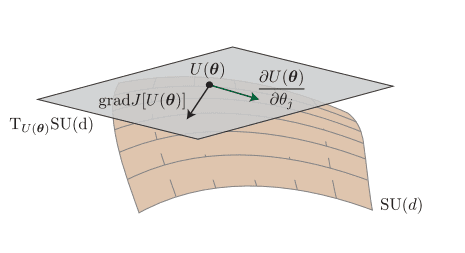
Scientists have developed a rigorous theoretical framework to determine when a variational quantum eigensolver (VQE) will converge to the optimal solution. This research pioneers a convergence theory by focusing on the properties of the parameterized unitary transformations used within the VQE algorithm. The team proves a sufficient criterion for guaranteed convergence, establishing that if a parameterized unitary allows movement in all tangent-space directions, a property termed ‘local surjectivity’, and the gradient descent used for parameter updates terminates, the VQE will converge to a ground state with high probability. The team meticulously analyzed the conditions required for local surjectivity, demonstrating that the Lie algebra elements defining possible transformations must be uniformly bounded.
This ensures gradients remain Lipschitz continuous, a crucial technical requirement for the convergence theorem. Scientists constructed specific unitary transformations demonstrably exhibiting local surjectivity, resolving a debate regarding its feasibility. The approach enables precise characterization of critical points in the optimization landscape, revealing they correspond to global optima or saddle points with at least one negative eigenvalue. To illustrate the importance of local surjectivity, researchers examined commonly used parameterized quantum circuits, specifically single-qubit Euler angle rotations. They demonstrated that at certain parameter settings, optimization routines can prematurely terminate, failing to reach the optimal solution due to a loss of a degree of freedom in the parameter space. The study establishes that, for almost all initial parameter settings, the VQE, when updated by gradient descent, will either diverge or converge to a ground state, providing strong guarantees on the algorithm’s performance and paving the way for more reliable quantum computations.
VQE Convergence Depends on Local Surjectivity
Scientists have established a convergence theory for the variational quantum eigensolver (VQE), addressing the long-standing question of when this optimization approach yields a globally optimal solution. The team proves a sufficient criterion demonstrating that VQE converges to a ground state for almost all initial parameter settings, provided certain conditions are met. Specifically, the research demonstrates that if a parameterized unitary transformation allows movement in all tangent-space directions, a condition termed local surjectivity, and the gradient descent used for parameter updates terminates, then convergence is guaranteed. The findings reveal that constructing parameterized unitary transformations free of singular controls is crucial for satisfying local surjectivity, thereby eliminating suboptimal solutions corresponding to strict saddle points.
Researchers established that these saddle points are avoided almost surely by gradient descent algorithms when gradients are Lipschitz continuous, meaning the optimization process is highly likely to find the global minimum. However, ensuring the termination of gradient descent presents a technical challenge, as fully satisfying this condition can be difficult with unconstrained parameters. Analysis of two commonly employed circuit ansätze, the SU(d)-gate ansatz and the product-of-exponentials ansatz, revealed that singular points, where local surjectivity breaks down, always exist when the number of variational parameters is limited. Notably, the team proved that for the SU(d)-gate ansatz, these singular points cannot be removed, even with extensive overparameterization of the quantum circuit. Despite these challenges, the main theorem provides a clear criterion for VQE convergence, offering valuable insights into the conditions required for successful quantum optimization and paving the way for more reliable quantum algorithms.
Guaranteed Convergence in Variational Quantum Algorithms
This research establishes a sufficient condition for guaranteeing convergence in Variational Quantum Eigensolver (VQE) algorithms, used to find solutions to complex problems in fields like quantum chemistry and optimization. The team demonstrates that if a parameterized quantum circuit allows movement in all relevant directions and the optimization process terminates, the algorithm will, with high probability, converge to a ground state solution. This addresses a fundamental gap in understanding when these widely used algorithms are actually guaranteed to succeed. The work identifies two key requirements for convergence: ‘local surjectivity’, the ability of the circuit to explore all possible transformations, and termination of the gradient descent.
👉 More information
🗞 On the convergence of the variational quantum eigensolver and quantum optimal control
🧠 ArXiv: https://arxiv.org/abs/2509.05295