Scientists at the University of Wisconsin–Madison, led by Professor Randall Goldsmith, have developed a highly sensitive method for detecting and profiling single molecules. This breakthrough could enhance our understanding of how matter’s building blocks interact and could impact fields like drug discovery and advanced materials development. The technique, published in the journal Nature, allows for the observation of individual molecules without the use of fluorescent labels, which can alter molecules and obscure their natural interactions. The team’s method uses an optical microresonator, or microcavity, to trap light and interact with a molecule, providing information about the molecule’s shape and movement.
A New Method for Single Molecule Detection
Scientists at the University of Wisconsin–Madison have developed a highly sensitive method for detecting and profiling individual molecules. This new technique could potentially revolutionize our understanding of how the fundamental building blocks of matter interact with each other. The implications of this development could be far-reaching, impacting fields as diverse as drug discovery and the development of advanced materials.
The method, detailed in the journal Nature, represents a significant step forward in the field of observing individual molecules without the use of fluorescent labels. These labels, while useful in many applications, can alter molecules in ways that can obscure their natural interactions. The new label-free method makes the molecules so easy to detect, it is almost as if they had labels.
The Power of Single Molecule Observation
The ability to observe the behavior of and interactions between individual molecules is crucial for contextualizing information gathered from studying materials and biological systems at larger scales. This perspective can often lead to new insights. As Randall Goldsmith, a UW–Madison professor of chemistry who led the work, explains, understanding complex systems often comes down to understanding the interactions at the level of single molecules.
Goldsmith has been pursuing the study of single molecules since his time as a postdoctoral researcher at Stanford University, where he worked under the chemist W.E. Moerner, who received the Nobel Prize in chemistry in 2014 for developing the first method of using light to observe a single molecule.
The Role of Optical Microresonators
The method developed by the UW–Madison team relies on a device called an optical microresonator, or microcavity. This microcavity is an extremely tiny space where light can be trapped in both space and time, allowing it to interact with a molecule. These microcavities are more commonly found in physics or electrical engineering laboratories, not chemistry labs.
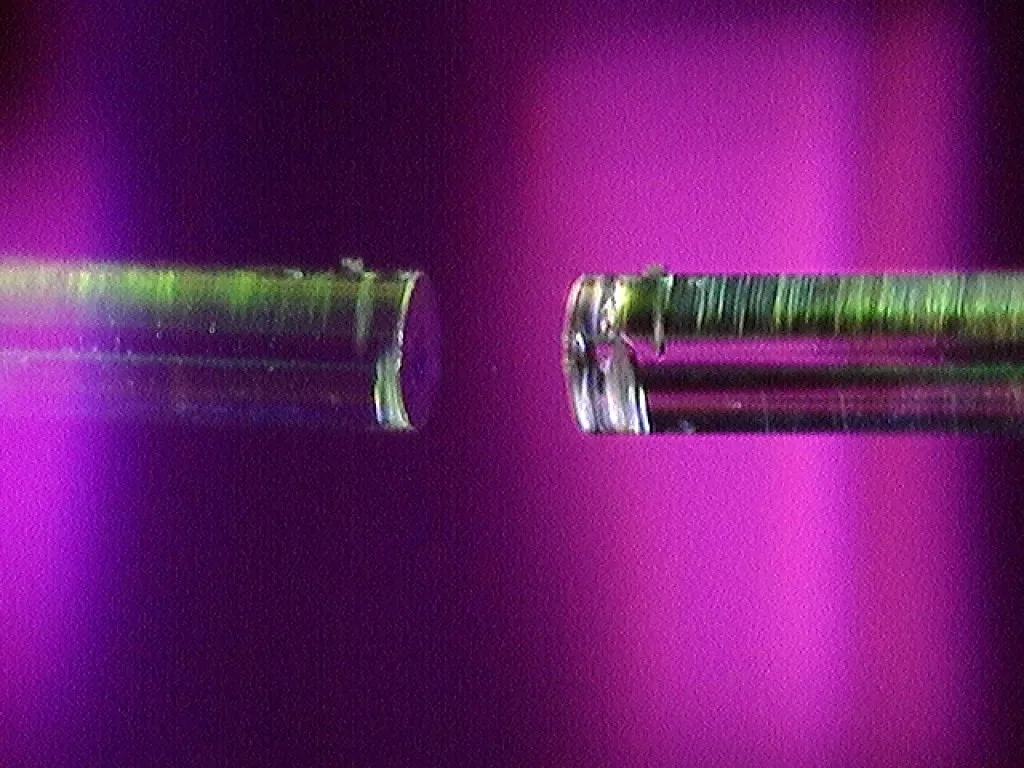
Microcavities are built from incredibly small mirrors fashioned right on top of a fiber optic cable. These fiber optic mirrors bounce the light back and forth many times very quickly within the microcavity. The researchers let molecules tumble into the cavity, let the light pass through it, and can not only detect the molecule’s presence, but also learn information about it, such as how fast it moves through water. This information can be used to determine the molecule’s shape, or conformation.
Implications for Drug Discovery and Beyond
Understanding the conformation at the molecular level is incredibly important, particularly for understanding how biomolecules interact with each other. For example, in drug discovery, it is crucial to understand if a potential drug can interact with a protein in a way that introduces a conformational change.
Current methods for determining this require large amounts of sample material and time-consuming analyses. With the newly developed microcavity technique, Goldsmith says, “we can potentially build a black-box tool to give us the answer in tens of seconds.”
The team has filed a patent for the device and plans to refine the device and methods over the next couple of years. In the meantime, they are already considering the many ways it could be useful, including applications in spectroscopy and other ways to learn about molecules.
Funding and Future Developments
This research was primarily funded by the National Institutes of Health, with resonator construction supported by the Q-NEXT Quantum Center, a U.S. Department of Energy, Office of Science, National Quantum Information Science Research Center. As the team continues to refine their device and methods, they are excited about the potential applications and the new insights this tool could provide into the world of molecules.
External Link: Click Here For More