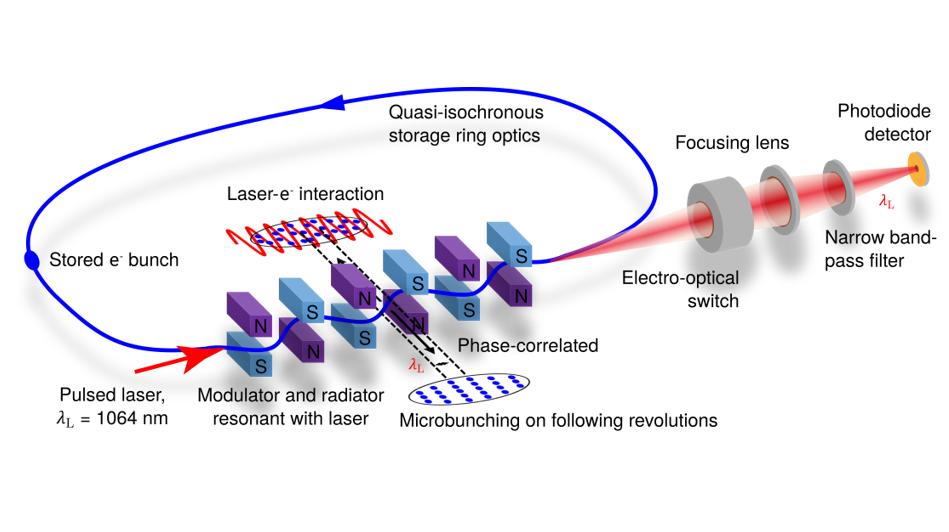
Scientists have made a breakthrough in developing a new source of powerful, coherent light that could revolutionize research and industry applications. An international team has demonstrated the functional principle of Steady-State Microbunching (SSMB), which enables the creation of efficient and powerful radiation sources for coherent UV radiation.
This technology has the potential to deliver monochromatic, coherent light with outputs of several kilowatts, similar to a high-power laser. The research was led by PhD student Arnold Kruschinski from Helmholtz-Zentrum Berlin (HZB) and involved collaboration with Tsinghua University and PTB.
The team used the Metrology Light Source (MLS) in Adlershof, a storage ring designed for low-alpha operation, to verify the theory proposed by Chinese theorist Xiujie Deng. Project manager Jörg Feikes from HZB notes that this development is just the beginning of a long-term process, similar to the development of free-electron lasers. The potential applications of SSMB are vast, including materials research and the semiconductor industry.
Harnessing the Power of Synchrotron Radiation: A New Era in Coherent UV Light Sources
Synchrotron radiation, a phenomenon where ultrafast electrons emit light when deflected, has been a valuable tool for materials research. However, its longitudinal incoherence and broad spectrum of wavelengths limit its applications. Researchers have long sought to develop a source of coherent UV radiation with high radiant power, analogous to a high-power laser. A recent breakthrough in the field of synchrotron radiation may hold the key to unlocking this potential.
The Concept of Steady-State Microbunching (SSMB)
In 2010, physicist Alexander Chao and his doctoral student Daniel Ratner proposed an innovative solution to overcome the limitations of traditional storage rings. They discovered that if electron bunches orbiting in a storage ring become shorter than the wavelength of the light they emit, the emitted radiation becomes coherent and millions of times more powerful. This concept, known as Steady-State Microbunching (SSMB), has sparked intense research efforts to develop a new type of radiation source.
The SSMB principle relies on creating short particle bunches that are only one micrometre long, which is six orders of magnitude shorter than traditional electron bunches in storage rings. Chinese theorist Xiujie Deng has defined a set of settings for a specific type of circular accelerator, the isochrone or “low-alpha” rings, to achieve this goal. By interacting with a laser, these accelerators can create micro-bunches that emit coherent radiation.
Experimental Verification and Proof-of-Principle
In 2021, an international research team from HZB, Tsinghua University, and PTB successfully demonstrated the SSMB concept in a proof-of-principle experiment using the Metrology Light Source (MLS) in Adlershof. The MLS is the first storage ring designed for low-alpha operation, making it an ideal platform for testing the SSMB principle. The team has now fully verified Deng’s theory through extensive experiments, marking a significant milestone on the path to developing a new type of SSMB radiation source.
The Road Ahead: Challenges and Opportunities
While the experimental verification of the SSMB concept is a crucial step forward, researchers acknowledge that it will take time to develop this technology into a practical radiation source. HZB project manager Jörg Feikes draws parallels between the SSMB and the development of free-electron lasers, which required decades of research and development efforts. The journey ahead will involve overcoming technical challenges, refining the design of low-alpha accelerators, and scaling up the technology to achieve high radiant power.
Despite these challenges, the potential applications of SSMB radiation sources are vast and varied. They could revolutionize materials research by providing a powerful tool for studying material properties at the nanoscale. The semiconductor industry may also benefit from this technology, enabling new manufacturing techniques and improving device performance. As researchers continue to push the boundaries of what is possible with synchrotron radiation, they may unlock new opportunities for scientific discovery and technological innovation.
External Link: Click Here For More