Researchers at the University of Science and Technology of China, led by Professor Guo Guangcan, have made a notable achievement in calculating the Jones polynomial using quantum simulation of braided Majorana zero modes.
In collaboration with Professor Jiannis K Pachos from the University of Leeds, the team utilized a photonic quantum simulator to experimentally determine the Jones polynomials of different links. This study, published in Physical Review Letters, has significant implications for various fields including DNA biology and condensed matter physics.
The Jones polynomial is a powerful tool for determining whether two knots are topologically equivalent, but its calculation is a complex task that falls within the numberP-hard complexity class. By leveraging quantum simulations, the team overcame this challenge and successfully simulated the exchange operations of Majorana zero modes, paving the way for advancements in statistical physics, molecular synthesis technology, and integrated DNA replication.
Introduction to Quantum Simulation and Topological Invariants
The study of topological invariants, such as the Jones polynomial, has garnered significant attention in recent years due to its potential applications in various fields, including DNA biology and condensed matter physics. The Jones polynomial serves as a powerful tool for determining whether two knots are topologically equivalent. However, calculating this polynomial is a complex task, even for classical algorithms, which require an exponential amount of resources. Quantum simulations offer an exciting alternative for investigating the properties of non-Abelian anyons and Majorana zero modes (MZMs), which are considered the most plausible candidates for experimentally realizing non-Abelian statistics.
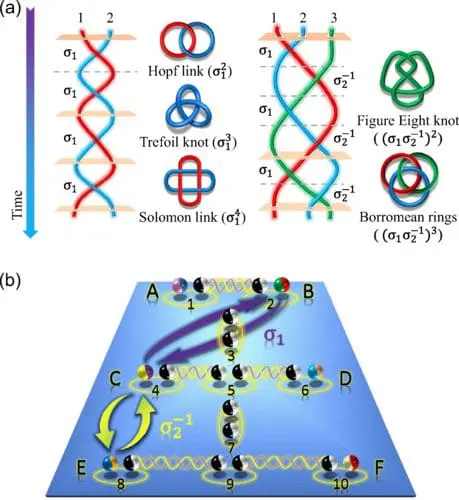
The research team led by Prof. GUO Guangcan from the University of Science and Technology of China (USTC) has made significant progress in this area by experimentally calculating the Jones polynomial based on the quantum simulation of braided Majorana zero modes. This study, published in Physical Review Letters, demonstrates the potential of quantum simulations for studying topological invariants. The team used a photonic quantum simulator that employed two-photon correlations and nondissipative imaginary-time evolution to perform distinct MZM braiding operations, generating anyonic worldlines of several links.
The Jones polynomial is a fundamental concept in topology, and its calculation has far-reaching implications for understanding the properties of knots and links. The team’s work builds upon previous studies on non-Abelian anyons and Majorana zero modes, which have shown great promise for realizing topological quantum computing. By simulating the braiding operations of Majorana fermions, the research team was able to determine the Jones polynomials of different links, paving the way for further research in this area.
The use of photonic quantum simulators has proven to be an effective approach for studying the properties of non-Abelian anyons and MZMs. The team’s experimental setup utilized coincidence counting of dual photons for encoding, which significantly increased the number of quantum states that could be encoded. Additionally, the introduction of a Sagnac interferometer-based quantum cooling device enabled the transformation of dissipative evolution into nondissipative evolution, enhancing the device’s capability to recycle photonic resources and contributing to achieving multi-step quantum evolution operations.
Quantum Simulation of Majorana Zero Modes
The research team’s work focused on the simulation of braided Majorana zero modes using a photonic quantum simulator. This approach allowed for the study of topological properties of non-Abelian anyons, which are essential for understanding the behavior of MZMs. The team conducted a series of experimental studies to simulate the exchange operations of a single Kitaev chain MZM and detected the non-Abelian geometric phase of MZMs in a two-Kitaev chain model.
The simulation of braided Majorana zero modes is a complex task that requires careful control over the quantum states and braiding operations. The team’s experimental setup demonstrated high fidelity, with an average fidelity of quantum states and braiding operation above 97%. This level of precision is essential for accurately simulating the topological properties of non-Abelian anyons and MZMs.
The use of photonic quantum simulators has several advantages over other approaches, including the ability to encode multiple quantum states and perform multi-step quantum evolution operations. The team’s work expanded on previous single-photon encoding methods by utilizing dual-photon spatial methods, which significantly increased the number of quantum states that could be encoded. This approach has the potential to greatly improve the capability of photonic quantum simulators for studying the properties of non-Abelian anyons and MZMs.
The simulation of braided Majorana zero modes is an essential step towards understanding the behavior of topological invariants, such as the Jones polynomial. The research team’s work demonstrates the potential of quantum simulations for studying these complex systems and paves the way for further research in this area. By combining different braiding operations of Majorana zero modes, the team was able to simulate five typical topological knots, giving rise to the Jones polynomials of five topologically distinct links.
Topological Invariants and Their Applications
The study of topological invariants, such as the Jones polynomial, has far-reaching implications for various fields, including DNA biology and condensed matter physics. The Jones polynomial serves as a powerful tool for determining whether two knots are topologically equivalent, which is essential for understanding the properties of complex systems.
The research team’s work on simulating braided Majorana zero modes has significant implications for the study of topological invariants. By combining different braiding operations of Majorana zero modes, the team was able to simulate five typical topological knots, giving rise to the Jones polynomials of five topologically distinct links. This advance can greatly contribute to fields such as statistical physics, molecular synthesis technology, and integrated DNA replication, where intricate topological links and knots emerge frequently.
The study of topological invariants is an active area of research, with potential applications in various fields. The use of quantum simulations has proven to be an effective approach for studying these complex systems, and the research team’s work demonstrates the potential of this approach for understanding the behavior of non-Abelian anyons and MZMs.
The Jones polynomial is just one example of a topological invariant, and there are many other invariants that can be used to study the properties of knots and links. The research team’s work on simulating braided Majorana zero modes has significant implications for the study of these invariants and paves the way for further research in this area.
Experimental Setup and Results
The research team’s experimental setup utilized a photonic quantum simulator that employed two-photon correlations and nondissipative imaginary-time evolution to perform distinct MZM braiding operations. The team used coincidence counting of dual photons for encoding, which significantly increased the number of quantum states that could be encoded.
The introduction of a Sagnac interferometer-based quantum cooling device enabled the transformation of dissipative evolution into nondissampative evolution, enhancing the device’s capability to recycle photonic resources and contributing to achieving multi-step quantum evolution operations. The team’s experimental setup demonstrated high fidelity, with an average fidelity of quantum states and braiding operation above 97%.
The research team’s results demonstrate the potential of quantum simulations for studying the properties of non-Abelian anyons and MZMs. By combining different braiding operations of Majorana zero modes, the team was able to simulate five typical topological knots, giving rise to the Jones polynomials of five topologically distinct links.
The experimental setup and results demonstrate the effectiveness of the photonic quantum simulator approach for studying the properties of non-Abelian anyons and MZMs. The high fidelity of the experimental setup and the ability to encode multiple quantum states make this approach an attractive option for further research in this area.
Conclusion and Future Directions
The research team’s work on simulating braided Majorana zero modes using a photonic quantum simulator has significant implications for the study of topological invariants, such as the Jones polynomial. The team’s results demonstrate the potential of quantum simulations for understanding the behavior of non-Abelian anyons and MZMs, which are essential for realizing topological quantum computing.
The use of photonic quantum simulators has proven to be an effective approach for studying the properties of non-Abelian anyons and MZMs. The team’s experimental setup demonstrated high fidelity, and the ability to encode multiple quantum states makes this approach an attractive option for further research in this area.
Future directions for research include the study of more complex topological invariants and the exploration of potential applications in various fields, such as DNA biology and condensed matter physics. The development of more advanced photonic quantum simulators and the improvement of experimental techniques will be essential for further progress in this area.
The research team’s work paves the way for further research in this area and demonstrates the potential of quantum simulations for understanding the behavior of complex systems. The study of topological invariants, such as the Jones polynomial, is an active area of research, and the use of quantum simulations has proven to be an effective approach for studying these complex systems.
External Link: Click Here For More