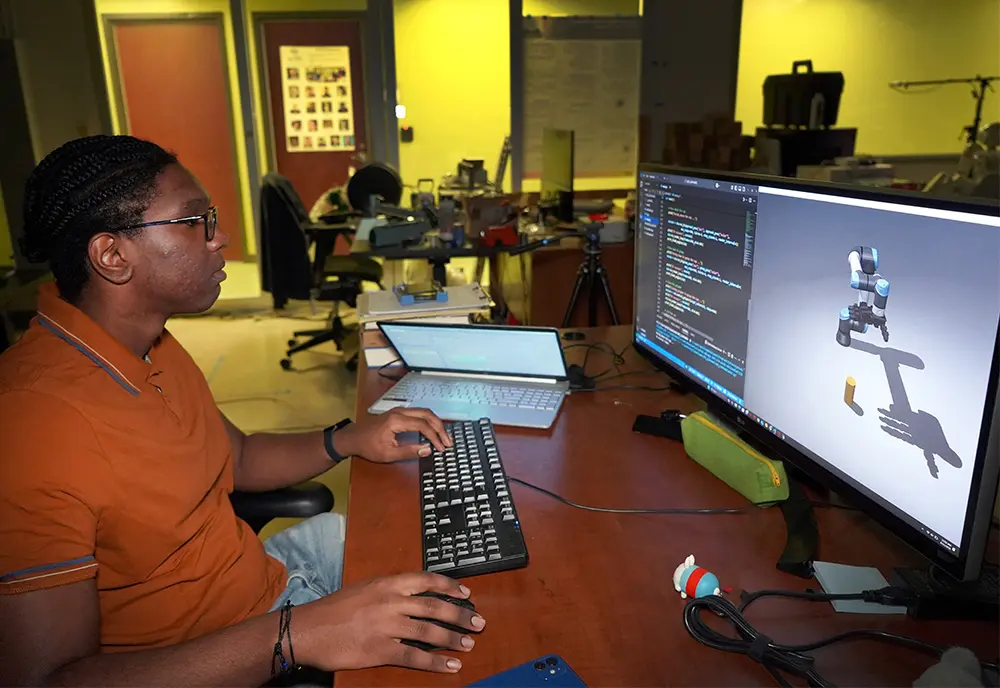
Researchers at the University of South Florida’s Bellini College of Artificial Intelligence, Cybersecurity and Computing, in collaboration with the University of Rhode Island and funded by the Florida High Tech Corridor and USF Research & Innovation, have completed a ten-week undergraduate research programme as part of the USF Bridge Coalition. The initiative paired three students – Texeira, Sicaju, and Semedo – with USF faculty to address practical challenges in robotics, cybersecurity, and artificial intelligence. Specifically, Denilo Semedo gained experience within the USF Robot Perception and Action Lab, focusing on the technical domain of multi-object grasping, while the broader programme, led by Saundra Johnson Austin, director of USF’s Office of Student Engagement in Research and Innovation, aimed to establish collaborative research pathways between Research 1 institutions and facilitate undergraduate research opportunities. This inaugural cohort represents a pilot programme preceding the college’s official launch in autumn 2025, demonstrating a commitment to intentional linkages between students, mentors, laboratories, and applied research problems.
USF College Inaugural Program
The inaugural summer research program of the University of South Florida’s (USF) Bellini College of Artificial Intelligence, Cybersecurity and Computing has concluded, representing a pivotal step ahead of the college’s formal launch in autumn 2025. Financed through a collaborative grant from the Florida High Tech Corridor and USF Research & Innovation, the ten-week program facilitated a research exchange, bringing undergraduate scholars from the University of Rhode Island to USF to address applied challenges spanning robotics, cybersecurity, and artificial intelligence. Operating under the auspices of the USF Bridge Coalition Program, the initiative prioritised experiential learning and the establishment of viable career trajectories for participating students, aligning with broader national efforts to enhance STEM education and workforce development.
The program’s design explicitly sought to cultivate partnerships between Research 1 (R1) universities – institutions characterised by substantial research output and doctoral programme provision – and those with historically constrained access to such opportunities. This strategic approach, as highlighted by Sylvia Wilson Thomas, vice president for USF Research & Innovation, demonstrates “the benefits of creating intentional links between students, mentors, laboratories, and real-world problems. ” The inaugural cohort consisted of three undergraduate researchers – Texeira, Sicaju, and Semedo – carefully matched with USF faculty mentors based on their respective academic goals and research interests, ensuring a synergistic alignment of expertise and inquiry.
Saundra Johnson Austin, director of USF’s Office of Student Engagement in Research and Innovation and the program lead, underscored that the program’s scope extends beyond the purely scientific endeavour. The initiative deliberately prioritises the construction of robust networks connecting institutions, students, and mentors, ultimately aiming to cultivate a pipeline of talent and opportunity. A notable example of the research undertaken involved Denilo Semedo, whose work within the USF Robot Perception and Action Lab focused on the complex problem of multi-object grasping – a critical capability for advanced robotic systems requiring manipulation of unstructured environments.
This involves developing algorithms enabling robots to identify, localise, and securely grasp multiple objects simultaneously, demanding sophisticated sensor fusion, motion planning, and control strategies. The program’s emphasis on undergraduate research in robotics provides valuable training in these areas, preparing students for future contributions to the field.
Collaborative Research Initiative
The Collaborative Research Initiative, central to the Robot Perception and Action Lab, serves as a prime example, focusing on the complex problem of multi-object grasping – a crucial capability for advanced robotic systems. Such research necessitates the development of sophisticated algorithms for object recognition, pose estimation, and grasp planning, often leveraging techniques from computer vision, machine learning, and robotics.
The technical challenges inherent in multi-object grasping involve not only identifying and localising multiple objects within a scene, but also determining stable and efficient grasp configurations that account for object shape, weight distribution, and potential collisions. Semedo’s research contributes to the advancement of robotic manipulation, a field with applications in manufacturing, logistics, healthcare, and disaster response. Furthermore, the program aims to broaden participation in STEM fields and cultivate a more diverse and inclusive research community. The program’s success relies on establishing a robust network that supports student researchers throughout their academic careers and beyond.
More information
External Link: Click Here For More