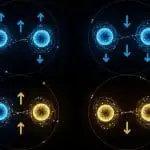
Researchers from the University of Southern California have conducted a study comparing the accuracy of quantum master equations, mathematical models used to describe the dynamics of open quantum systems. Using the damped Jaynes-Cummings model of a qubit in a leaky cavity, they compared the exact solution to several types of master equations. The results showed that all master equations performed poorly for long evolution times, highlighting the need for reliable approximation methods. The findings could have significant implications for the development of quantum technologies and the understanding of open quantum system dynamics.
What are Quantum Master Equations and How Accurate are They?
Quantum master equations are mathematical models used to describe the dynamics of open quantum systems. These systems are quantum mechanical systems that interact with an external environment, which can influence their behavior. However, the accuracy of these equations is rarely compared with the analytical solution of exactly solvable models. In this study, researchers from the University of Southern California, including Zihan Xia, Juan GarciaNila, and Daniel A Lidar, perform such a comparison using the damped Jaynes-Cummings model of a qubit in a leaky cavity.
The damped Jaynes-Cummings model is a well-known model in quantum optics that describes a two-level atom interacting with a single mode of a radiation field in a cavity. In this model, the qubit system interacts with the cavity electromagnetic field through the dipole approximation. The qubit decay rate can be associated with experimentally measurable parameters such as the dipole moment and the energy gap. The researchers solved this model analytically assuming the zero temperature limit and the 1-excitation subspace of the joint qubit-cavity system, where the cavity is populated by at most a single photon.
How do Different Types of Master Equations Compare?
The researchers compared the exact solution to several different types of master equations, including the non-Markovian time-convolutionless master equation up to the second Redfield and fourth orders, as well as three types of Markovian master equations: the coarse-grained, cumulant, and standard rotating-wave approximation (RWA) Lindblad equations. They compared three different spectral densities: impulse, Ohmic, and triangular.
The results showed that the coarse-grained master equation outperformed the standard RWA-based Lindblad master equation for weak coupling or high qubit frequency relative to the spectral density high-frequency cutoff ωc, where the Markovian approximation is valid. In the presence of non-Markovian effects, characterized by oscillatory non-decaying behavior, the time-convolutionless (TCL) approximation closely matched the exact solution for short evolution times, even outside the regime of validity of the Markovian approximations.
What are the Limitations of Master Equations?
Despite their usefulness, all master equations performed poorly for long evolution times, as quantified in terms of the trace-norm distance from the exact solution. The fourth-order time-convolutionless master equation achieved the top performance in all cases. These results highlight the need for reliable approximation methods to describe open-system quantum dynamics beyond the short-time limit.
The study of open quantum systems presents both conceptual and technical challenges due to the complexity and high dimensionality of the environment or bath. Exact analytical solutions describing the joint system-bath evolution are rarely attainable, necessitating the development of approximation methods to capture the reduced system dynamics. However, these approximation methods struggle at long evolution times, indicating a need for further research and development in this area.
What are the Implications of this Study?
This study provides valuable insights into the accuracy and limitations of different types of quantum master equations. By comparing these equations with the analytical solution of an exactly solvable model, the researchers were able to identify which equations provide the most accurate descriptions of open quantum system dynamics under different conditions.
These findings could have important implications for the development of quantum technologies, as understanding the dynamics of open quantum systems is crucial for the design and operation of quantum devices. Furthermore, the results highlight the need for further research into reliable approximation methods for describing open-system quantum dynamics beyond the short-time limit.
Conclusion
In conclusion, this study by researchers at the University of Southern California provides a valuable comparison of different types of quantum master equations. The results highlight the strengths and limitations of these equations, and underscore the need for further research into reliable approximation methods for describing open-system quantum dynamics. These findings could have important implications for the development of quantum technologies.
model of a qubit in a cavity”
Publication Date: 2024-03-14
Authors: Zhihong Xia, J. García-Nila and Daniel A. Lidar
Source: arXiv (Cornell University)
DOI: https://doi.org/10.48550/arxiv.2403.09944