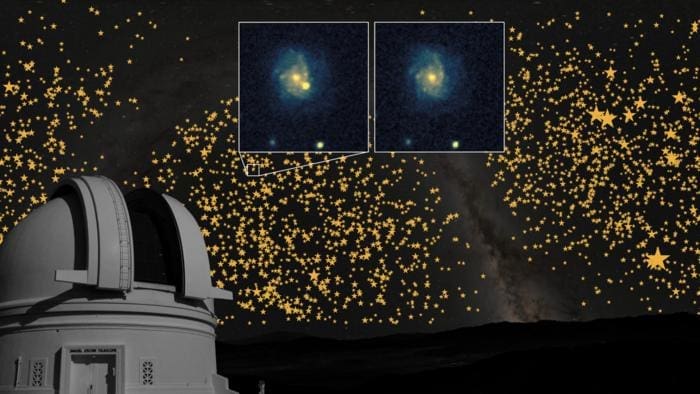
In a new development, astrophysicists have uncovered an unexpected array of mechanisms by which white dwarf stars meet their explosive ends in deep space. Based on an unprecedented dataset of nearly 4,000 such events, this revelation has been compiled by the Zwicky Transient Facility (ZTF), a Caltech-led astronomical sky survey, and Trinity College Dublin researchers led by Prof. Kate Maguire.
The findings, published in a Special Issue of Astronomy & Astrophysics, not only shed light on the enigmatic force driving the accelerating expansion of the Universe – dark energy – but also offer insights into the origins of various elements in our periodic table. These explosions, which occur at the ends of white dwarf stars’ lives, have long been instrumental in the study of dark energy and the formation of elements such as titanium, iron, and nickel.
The dataset, larger than any previous sample, has enabled significant advancements in understanding these cosmic phenomena. Among the key findings is the discovery that white dwarfs can explode in multiple exotic ways, including through collisions of two stars in spectacular stellar events, as well as through cannibalism by their companions in binary star systems.
The diverse nature of these explosive transients may have profound implications for the use of supernovae to measure distances within the Universe. As constraints on dark energy properties necessitate a standardization of these explosions, this newfound diversity could potentially reshape our understanding of cosmic distances and the enigmatic force driving the expansion of the Universe.
A new chapter in stellar evolution has been penned in the vast expanse of the cosmos, as astrophysicists uncover a surprising diversity in the explosive demise of white dwarf stars. This groundbreaking discovery, based on an unprecedented dataset of nearly 4,000 such events, could revolutionize our understanding of dark energy and distance measurement within the Universe.
The Caltech-led Zwicky Transient Facility (ZTF) has played a pivotal role in this breakthrough. Its unique ability to swiftly and deeply scan the sky has enabled the discovery of previously elusive stellar explosions. These transients, up to one million times fainter than the dimmest stars visible to the naked eye, have been captured in intricate detail by ZTF, providing a wealth of data for analysis.
The findings reveal a rich tapestry of exotic explosion mechanisms among white dwarfs, including collisions of two stars in luminous stellar spectacles and cannibalism of stars by their companions in double star systems. This diversity challenges previous expectations and offers implications for the standardization of these explosions, crucial for measuring distances in the Universe and understanding dark energy.
The dramatic explosions of white dwarf stars at the ends of their lives have long been instrumental in the study of dark energy, the enigmatic force responsible for the accelerating expansion of the Universe. These cosmic events also serve as the origin of many elements in our periodic table, such as titanium, iron, and nickel, which are formed under the extreme conditions present during their explosions.
The release of this major dataset, comprising 21 publications in an Astronomy & Astrophysics Special Issue, marks a significant milestone in our understanding of these explosive transients. With the ability to discover very faint blips combined with large sample sizes, researchers can now delve deeper into the mysteries of white dwarf explosions and their implications for dark energy and distance measurement.
External Link: Click Here For More