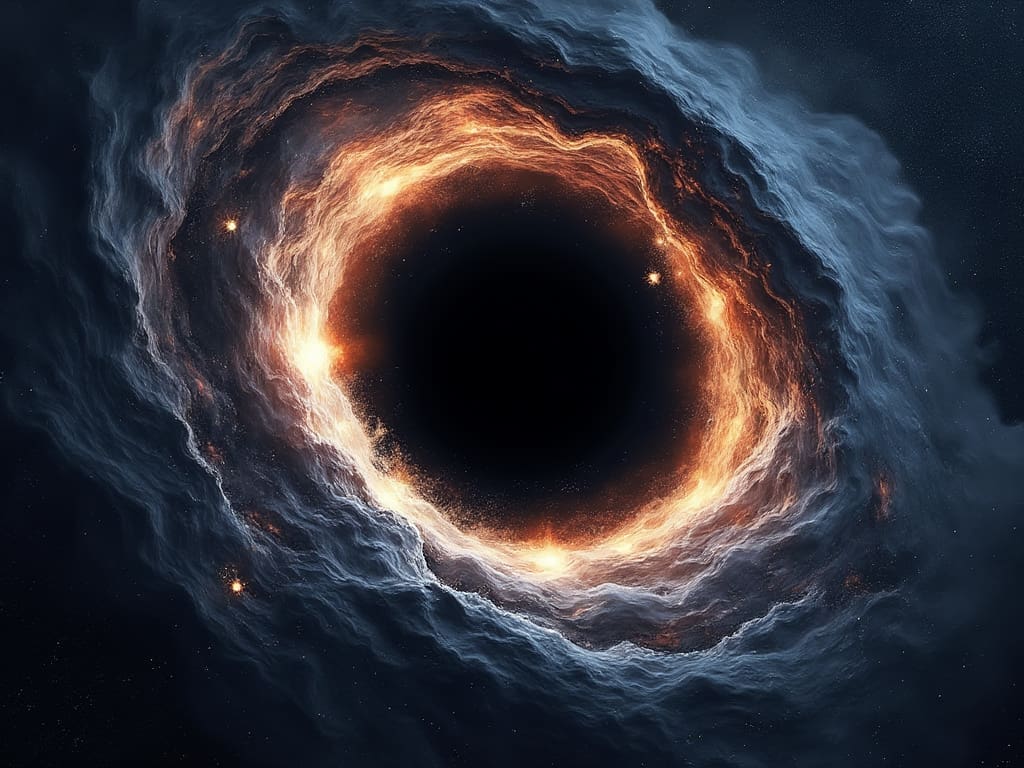
For over a century, scientists have been fascinated by the mysteries of black holes, predicted by Albert Einstein’s general theory of relativity. These cosmic phenomena have an intense gravitational pull that warps space and time, making them one of the most intriguing objects in the universe.
The journey to understanding black holes begins with Einstein’s special theory of relativity, which revealed the constancy of light speed and introduced the concept of spacetime. This fundamental framework laid the groundwork for grasping the properties and behavior of black holes, including their extreme gravitational pull and event horizon.
From Schwarzschild black holes, which describe a specific type of black hole with an intense gravitational pull, to Hawking radiation, which shows that black holes emit radiation due to quantum effects near the event horizon, scientists have made significant strides in unraveling the mysteries of these enigmatic objects. The study of black hole thermodynamics and rotation has also shed light on their behavior and properties.
As our understanding of black holes continues to evolve, we are reminded of the profound impact that Einstein’s special theory of relativity had on our comprehension of space, time, and gravity. The journey from relativity to Hawking radiation is a testament to human curiosity and the power of scientific inquiry to unlock the secrets of the universe.
Black holes are compact bodies in the universe predicted by the general theory of relativity. They have an extremely strong gravitational pull, so strong that not even light can escape from their event horizon. A black hole is a celestial body whose curvature of space-time is so great that light cannot escape from its event horizon.
The concept of black holes was first introduced by Albert Einstein‘s theory of general relativity in the early 20th century. According to this theory, massive objects warp the fabric of spacetime around them, creating gravitational fields. If a star collapses under its own gravity, it can create a singularity, a point where the density and curvature of space-time are infinite. This singularity is surrounded by an event horizon, which marks the boundary beyond which nothing, including light, can escape.
There are four main ideas about how black holes form: collapsing stars, exploding supernovae, merging multiple black holes, and primordial black holes. In this article, we will focus on Schwarzschild black holes, which are a type of black hole that is predicted by Einstein’s theory of general relativity.
The concept of black holes was first introduced in the context of special relativity, which was developed by Albert Einstein in 1905. Special relativity posits that the laws of physics are the same for all observers in uniform motion relative to one another. This led to the formulation of the Lorentz transformation, which describes how space and time coordinates are affected by relative motion.
The Michelson-Morley experiment, conducted in 1887, was a key experiment that led to the development of special relativity. The experiment aimed to detect the existence of a hypothetical substance called ether, which was thought to be the medium through which light waves propagate. However, the experiment failed to detect any evidence of ether, and instead revealed that the speed of light is constant for all observers, regardless of their relative motion.
This result led to the development of special relativity, which posits that the laws of physics are the same for all observers in uniform motion relative to one another. The Lorentz transformation was developed as a mathematical framework for describing how space and time coordinates are affected by relative motion.
In 1905, Albert Einstein revealed the fundamental insights from the Michelson-Morley experiment, which led to the development of special relativity. According to this theory, light does not exhibit a velocity addition effect and maintains a constant speed for all observers. This principle was established by Einstein as the principle of constancy of lights speed.
Using this principle, Einstein successfully derived the Lorentz transformation and formulated special relativity theory, which illuminated the relativity of space and time as well as their interrelation with matter’s motion. The Lorentz transformation describes how space and time coordinates are affected by relative motion, and it has been experimentally verified numerous times.
The principle of constancy of lights speed is a fundamental concept in special relativity, and it has far-reaching implications for our understanding of the universe. It shows that the laws of physics are the same for all observers in uniform motion relative to one another, and it has led to many important discoveries in modern physics.
Schwarzschild black holes are a type of black hole that is predicted by Einstein’s theory of general relativity. They are characterized by their extremely strong gravitational pull, which is so strong that not even light can escape from their event horizon.
The concept of Schwarzschild black holes was first introduced by Karl Schwarzschild in 1916, who showed that a star with a mass greater than a certain critical value would collapse into a singularity surrounded by an event horizon. This singularity is the point where the density and curvature of space-time are infinite, and it marks the boundary beyond which nothing, including light, can escape.
Schwarzschild black holes have several properties that distinguish them from other types of black holes. They have a specific mass-to-radius ratio, which determines their strength of gravitational pull. They also have a specific temperature, which is determined by the energy released during their formation.
There are four main ideas about how black holes form: collapsing stars, exploding supernovae, merging multiple black holes, and primordial black holes. In this article, we will focus on Schwarzschild black holes, which are a type of black hole that is predicted by Einstein’s theory of general relativity.
Collapsing stars are the most common way in which black holes form. When a star runs out of fuel, it collapses under its own gravity, creating a singularity surrounded by an event horizon. This singularity is the point where the density and curvature of space-time are infinite, and it marks the boundary beyond which nothing, including light, can escape.
Exploding supernovae are another way in which black holes form. When a star explodes as a supernova, it can create a massive amount of energy that collapses into a singularity surrounded by an event horizon.
Merging multiple black holes is also a way in which black holes form. When two or more black holes collide, they merge to form a single, more massive black hole.
Primordial black holes are hypothetical objects that are thought to have formed in the early universe before the first stars had a chance to shine. They are predicted by some theories of the early universe, but their existence has not been confirmed experimentally.
Black holes are compact bodies in the universe predicted by the general theory of relativity. They have an extremely strong gravitational pull, so strong that not even light can escape from their event horizon. There are four main ideas about how black holes form: collapsing stars, exploding supernovae, merging multiple black holes, and primordial black holes.
In this article, we focused on Schwarzschild black holes, which are a type of black hole that is predicted by Einstein’s theory of general relativity. We discussed the theoretical preparation for understanding black holes, including special relativity and the Lorentz transformation. We also discussed the formation of black holes through collapsing stars, exploding supernovae, merging multiple black holes, and primordial black holes.
Overall, black holes are fascinating objects that scientists continue to study today. They offer a unique window into the universe’s most extreme environments and have far-reaching implications for our understanding of space-time and gravity.
Publication details: “Black holes – from relativity to Hawking radiation”
Publication Date: 2024-11-01
Authors: Yan Li
Source: Theoretical and Natural Science
DOI: https://doi.org/10.54254/2753-8818/56/20240240