
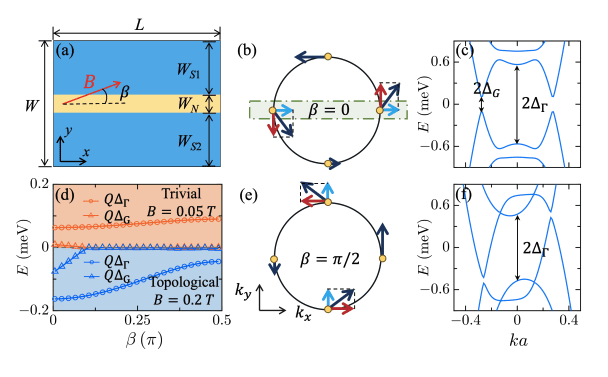
On April 28, 2025, researchers published a study titled Towards Scalable Braiding: Topological Superconductivity Unlocked under Nearly Arbitrary Magnetic Field Directions in Planar Josephson Junctions, revealing that topological superconductivity in planar Josephson junctions remains robust across various magnetic field orientations. This discovery addresses a key challenge in scalable quantum computing by enabling Majorana zero modes to survive and interact within complex networks, paving the way for advancements in fault-tolerant topological quantum technologies.
Researchers demonstrate that Majorana zero modes (MZM) in planar Josephson junctions (PJJ) remain robust under nearly arbitrary in-plane magnetic field directions. The apparent collapse of the global gap under misaligned fields is due to shifted bulk states, not destroyed superconductivity. By introducing modulations along the junction, these bulk states are scattered and gapped out, restoring the topological gap and enabling visible MZM survival across complex networks. This discovery allows for scalable braiding and fusion protocols, advancing topological quantum computing.
Spatial computing represents a transformative approach in quantum technology, leveraging spatial properties to enhance computational capabilities. At its core, this field explores how the physical arrangement of particles can be harnessed to create more robust and scalable quantum systems. Recent breakthroughs have particularly focused on Majorana fermions, particles that are their own antiparticles, offering unique potential for fault-tolerant quantum computing.
Quantum computing relies on qubits, which are highly susceptible to environmental interference, leading to decoherence and errors. Traditional approaches face significant hurdles in maintaining the stability and scalability required for practical applications. This has driven researchers to explore alternative methods, such as topological qubits, which are inherently more stable due to their non-Abelian statistics.
Recent studies have demonstrated that spatially modulated planar Josephson junctions can significantly enhance the creation of Majorana bound states. By introducing controlled variations in the width or other parameters of these junctions, researchers have observed an increased proximity effect. This modulation stabilizes Majorana fermions by making them less susceptible to disorder and decoherence.
The key innovation lies in the design of these junctions using tight-binding models and scattering approaches. These methods allow for precise engineering of the junction’s properties, enhancing spin-triplet superconductivity. The modulation creates an environment where Majorana states can persist more robustly, paving the way for more reliable quantum operations.
The ability to stabilize Majorana fermions in a scalable manner is a significant step towards realizing practical quantum computers. These advancements promise not only increased computational power but also enhanced fault tolerance, reducing the need for extensive error correction protocols. As spatial computing continues to evolve, it holds the potential to revolutionize fields from cryptography to material science.
In conclusion, the integration of spatial computing principles with advanced materials and design techniques is unlocking new possibilities in quantum technology. These innovations bring us closer to achieving scalable, fault-tolerant quantum computers, heralding a new era in computational capabilities.
👉 More information
🗞 Towards Scalable Braiding: Topological Superconductivity Unlocked under Nearly Arbitrary Magnetic Field Directions in Planar Josephson Junctions
🧠 DOI: https://doi.org/10.48550/arXiv.2504.20031