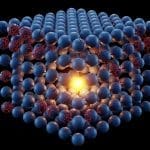
Dicke superradiance, a phenomenon where photon-mediated interactions in inverted atomic ensembles lead to a rapid release of energy, can be studied using ordered arrays of alkaline-earth-like atoms such as strontium and ytterbium. This research is crucial for harnessing these atoms as quantum optical sources and exploring many-body dissipative dynamics.
Understanding collective light-matter interactions beyond the cavity quantum electrodynamics (QED) regime could lead to applications in quantum nonlinear optics, quantum simulation, and metrology. The use of ordered atomic arrays to study many-body decay could provide valuable insights into atomic interactions and the phenomenon of superradiance.
What is Dicke Superradiance and How Does it Work in Ordered Arrays of Multilevel Atoms?
Dicke superradiance is a phenomenon that occurs in inverted atomic ensembles, where photon-mediated interactions lead to a rapid release of energy in the form of a photon burst. This form of many-body decay was initially studied in point-like ensembles, but it has been found to persist in extended ordered systems if the interparticle distance is below a certain threshold.
In a realistic experimental setting, Dicke superradiance can be investigated using ordered arrays of alkaline-earth-like atoms such as strontium and ytterbium. These atoms offer exciting new opportunities for light-matter interactions due to their internal structure, which allows for trapping at short interatomic distances compared to their long-wavelength transitions. This provides the potential for collectively enhanced dissipative interactions.
Despite their intricate electronic structure, two-dimensional arrays of these atomic species should exhibit many-body superradiance for achievable lattice constants. Moreover, superradiance effectively closes transitions such that multilevel atoms become more two-level like. This occurs because the avalanche-like decay funnels the emission of most photons into the dominant transition, overcoming the single-atom decay ratios dictated by their fine structure and Zeeman branching.
How Does Dicke Superradiance Apply to Quantum Optical Sources and Many-Body Dissipative Dynamics?
The study of Dicke superradiance represents an important step in harnessing alkaline-earth atoms as quantum optical sources and as platforms to explore many-body dissipative dynamics. Atoms in a cavity emit into the same electromagnetic mode, leading to interactions between them and a collective interaction between light and matter.
These interactions are well understood within the paradigm of cavity quantum electrodynamics (QED), as the indistinguishability of the atoms enables their description as a large spin coupled to a single radiative channel. An emblematic example of many-body physics in cavity QED is Dicke superradiance, where fully inverted atoms decay by radiating light in a short, bright pulse with a peak emission rate that scales quadratically with the atom number.
Dicke superradiance has also been observed in Bose-Einstein condensates, where a macroscopically occupied state couples to light. In these scenarios, superradiance is well understood because the permutational symmetry arising from indistinguishability restricts the dynamics to a small subspace of the full Hilbert space.
What is the Significance of Collective Light-Matter Interactions Beyond the Cavity QED Regime?
Understanding collective light-matter interactions beyond the cavity QED regime is critical not only from a fundamental point of view but also to realize applications in quantum nonlinear optics, quantum simulation, and metrology. Potentially, one could translate concepts such as the superradiant laser, driven-dissipative phase transitions, and quantum enhanced sensing into a much larger class of systems.
For instance, atomic arrays in the single-excitation regime have been proposed as promising platforms for generating novel light sources and optical components. The many-body landscape offers a far greater toolbox and could open up possibilities to create sources of light with unusual statistical properties or to generate entangled atomic states via dissipation.
In extended systems in free space, interactions between atoms depend on their relative positions. Theoretical studies of Dicke superradiance in this regime have been greatly limited as the broken permutational symmetry increases the complexity of the problem, which in principle scales exponentially with the atom number.
How Have Experiments Confirmed the Occurrence of Superradiant Bursts?
Experiments have confirmed that superradiant bursts can still occur despite the complexity of the problem. The first demonstrations were performed with thermal molecular and atomic vapors, but observations have since been made in several other systems.
Ordered atomic arrays have been recently suggested as a promising platform to study many-body decay. In contrast to other setups that typically suffer from dephasing arising from thermal motion or coherent dipole-dipole interactions, atomic arrays are supposed to experience less dephasing as the role of Hamiltonian dipole-dipole interactions in the burst is significantly reduced due to the spatial order. In these systems, atoms can decay into many radiative channels.
What is the Future of Dicke Superradiance in Quantum Physics?
The study of Dicke superradiance in ordered arrays of multilevel atoms opens up new avenues for research in quantum physics. The ability to harness alkaline-earth atoms as quantum optical sources and platforms to explore many-body dissipative dynamics could lead to significant advancements in the field.
Furthermore, understanding collective light-matter interactions beyond the cavity QED regime could lead to applications in quantum nonlinear optics, quantum simulation, and metrology. The potential to translate these concepts into a much larger class of systems could revolutionize the way we understand and utilize quantum physics.
Finally, the use of ordered atomic arrays as a platform to study many-body decay could provide valuable insights into the nature of atomic interactions and the phenomenon of superradiance. As research in this area continues, we can expect to see further exciting developments in the field of quantum physics.
Publication details: “Dicke Superradiance in Ordered Arrays of Multilevel Atoms”
Publication Date: 2024-03-14
Authors: Stuart J. Masson, Jacob P. Covey, Sebastian Will, Ana Asenjo-Garcia, et al.
Source: PRX Quantum 5, 010344
DOI: https://doi.org/10.1103/PRXQuantum.5.010344