

Quantum computing has the potential to revolutionize various fields, including quantum chemistry, materials optimization, national security, artificial intelligence, and the health sciences. However, the current noisy intermediate-scale quantum (NISQ) era poses significant challenges due to external noise issues that degrade quantum coherence before the full power of the quantum calculation can be exploited.
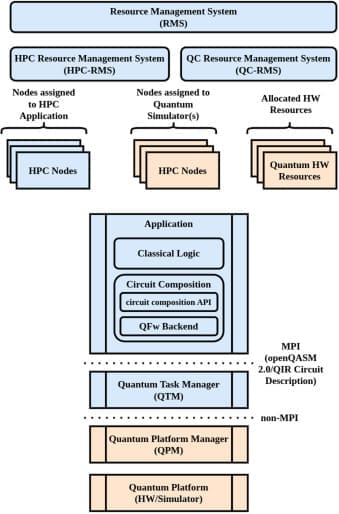
To address this challenge, Oak Ridge National Laboratory (ORNL) researchers have proposed a hardware-agnostic framework for integrating quantum computing as a computational accelerator within classical scientific high-performance computing (HPC) systems. This approach focuses on the strategic incorporation of quantum capabilities and acceleration into existing scientific HPC workflows, driven by the needs of the Department of Energy (DOE) and ORNL missions.
The comprehensive framework integrates hardware, software, workflows, and user interfaces to foster a synergistic quantum and classical computing research environment. By leveraging a broad spectrum of simulators and hardware technologies, researchers aim to unlock new computational possibilities driving forward scientific inquiry and innovation in various research domains.
Key highlights include:
- A proposed framework for integrating quantum computing as a computational accelerator within classical HPC systems
- A focus on the strategic incorporation of quantum capabilities and acceleration into existing HPC workflows
- The integration of hardware, software, workflows, and user interfaces to foster a synergistic environment for quantum and classical computing research
- The use of simulators and hardware technologies to unlock new computational possibilities
- The potential to revolutionize various fields, including quantum chemistry, materials optimization, national security, artificial intelligence, and the health sciences
Quantum computing has the potential to revolutionize various fields, including quantum chemistry, materials optimization, national security, artificial intelligence, and the health sciences. The coherent manipulation of quantum bits (qubits) is essential for achieving a speedup over classical analogues. However, in the current noisy intermediate-scale quantum (NISQ) era, external noise tends to degrade quantum coherence before the full power of the quantum calculation can be exploited.
The integration of quantum computing resources into scientific high-performance computing (HPC) ecosystems is crucial for unlocking new computational possibilities. This approach involves leveraging a broad spectrum of simulators and hardware technologies to augment classical HPC with quantum capabilities. The Oak Ridge National Laboratory (ORNL) and the Department of Energy (DOE) have expertise in HPC lifecycle management, which will be utilized to develop a comprehensive framework that integrates hardware, software workflows, and user interfaces.
The strategic incorporation of quantum computing capabilities and acceleration into existing scientific HPC workflows is essential for driving forward scientific inquiry and innovation. This includes detailed analyses, benchmarks, and code optimization driven by the needs of the DOE and ORNL missions. The proposed framework aims to foster a synergistic environment for quantum and classical computing research, enabling scientists to explore new computational possibilities.
Challenges in Quantum Computing
Quantum computing faces significant challenges due to the noisy intermediate-scale quantum era’s inherent external noise issues. Maintaining the delicate coherent state of the many-qubit system is a major scientific and technological challenge. Advanced methods for error correction and noise mitigation are currently under active development, but these methods are not yet sufficient to overcome the limitations of NISQ-era quantum computers.
The search for quantum computers capable of exploiting the speedups offered by quantum algorithms (QAs) has led to the emergence of diverse hardware technologies. These include superconducting qubits, trapped ions, and topological quantum computers, among others. However, each of these approaches has its own set of challenges and limitations, which must be addressed before they can be used for practical applications.
The integration of quantum computing resources into scientific HPC ecosystems is essential for overcoming the challenges associated with NISQ-era quantum computers. By leveraging a broad spectrum of simulators and hardware technologies, researchers can develop more robust and reliable quantum computing systems that are capable of exploiting the speedups offered by QAs.
A Hardware-Agnostic Framework for Quantum Computing
A hardware-agnostic framework is proposed for integrating quantum computing resources into scientific HPC ecosystems. This framework aims to provide a flexible and scalable architecture that can be used with various types of quantum computers, including superconducting qubits, trapped ions, and topological quantum computers.
The framework will integrate hardware, software workflows, and user interfaces to foster a synergistic quantum and classical computing research environment. It will also include detailed analyses, benchmarks, and code optimization driven by the needs of the DOE and ORNL missions. The goal is to develop a comprehensive system that can be used to explore new computational possibilities in various fields.
The proposed framework will leverage the expertise of the ORNL and the DOE’s HPC lifecycle management to ensure its success. It will also involve collaboration with other research institutions and industry partners to ensure that the framework meets the needs of the scientific community.
Quantum Algorithms and Applications
Quantum algorithms (QAs) have the potential to achieve a speedup over classical analogues by exploiting the properties of quantum mechanics. These algorithms can be used for various applications, including quantum chemistry, materials optimization, national security, artificial intelligence, and the health sciences.
The integration of QAs into scientific HPC ecosystems is essential for unlocking new computational possibilities in these fields. By leveraging a broad spectrum of simulators and hardware technologies, researchers can develop more robust and reliable quantum computing systems that are capable of exploiting the speedups offered by QAs.
Some examples of QAs include the quantum approximate optimization algorithm (QAOA), the variational quantum eigensolver (VQE), and the quantum circuit learning (QCL) algorithm. These algorithms have been used for various applications, including quantum chemistry, materials science, and machine learning.
The Role of High-Performance Computing in Quantum Computing
High-performance computing (HPC) plays a crucial role in quantum computing by providing the necessary computational resources for simulating and optimizing quantum systems. HPC systems can be used to simulate the behavior of quantum computers, allowing researchers to test and optimize their designs before they are built.
Integrating HPC into scientific research is essential for unlocking new computational possibilities in various fields. By leveraging a broad spectrum of simulators and hardware technologies, researchers can develop more robust and reliable quantum computing systems that are capable of exploiting the speedups offered by QAs.
Collaboration and Partnerships
Collaboration and partnerships between research institutions, industry partners, and government agencies are essential for the success of quantum computing. The integration of quantum computing resources into scientific HPC ecosystems requires a coordinated effort from multiple stakeholders to ensure its success.
The proposed framework will involve collaboration with other research institutions and industry partners to ensure that it meets the needs of the scientific community. It will also leverage the expertise of the ORNL and the HPC lifecycle management of the DOE to ensure its success.
Conclusion
Quantum computing has the potential to revolutionize various fields, including quantum chemistry, materials optimization, national security, artificial intelligence, and the health sciences. The integration of quantum computing resources into scientific high-performance computing (HPC) ecosystems is crucial for unlocking new computational possibilities in these fields.
The proposed framework aims to provide a flexible and scalable architecture that can be used with various types of quantum computers. It will integrate hardware, software workflows, and user interfaces to foster a synergistic environment for quantum and classical computing research.
By leveraging the expertise of the ORNL and the HPC lifecycle management of the DOE, researchers can develop more robust and reliable quantum computing systems that are capable of exploiting the speedups offered by QAs. The proposed framework will also involve collaboration with other research institutions and industry partners to ensure its success.
Publication details: “Integrating quantum computing resources into scientific HPC ecosystems”
Publication Date: 2024-12-01
Authors: Thomas L. Beck, Alessandro Baroni, Ryan S. Bennink, Gilles Buchs, et al.
Source: Future Generation Computer Systems
DOI: https://doi.org/10.1016/j.future.2024.06.058


