
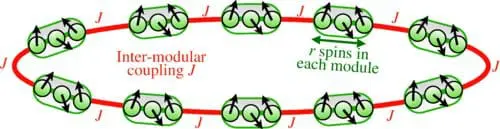
Researchers at the University of Electronic Science and Technology of China have made a groundbreaking discovery that could revolutionize sensing technologies. By developing a modular approach to introduce multiple phase transitions in quantum manybody systems, they have created a new way to enhance sensing precision beyond classical limits. This breakthrough has the potential to unlock new applications and enable more accurate measurements in various fields, including physics, chemistry, and materials science.
The researchers’ innovative approach allows for an enlarged region of quantum-enhanced precision, making it possible to achieve Heisenberg scaling for Hamiltonian parameter estimation at all phase boundaries. This can be exploited to create a global sensor that significantly outperforms a uniform probe, offering unprecedented levels of accuracy in sensing tasks. With the potential to harness criticality-enhanced sensitivity and engineer manybody sensor probes, this discovery has far-reaching implications for various fields, making it an exciting development in the world of quantum physics.
Can Quantum Many-Body Systems Be Engineered for Beyond-Classical Sensing Precision?
Quantum many-body systems undergoing phase transitions have been proposed as probes enabling beyond classical enhancement of sensing precision. However, this enhancement is usually limited to a very narrow region around the critical point. Researchers at the University of Electronic Science and Technology of China have systematically developed a modular approach for introducing multiple phase transitions in a many-body system. This naturally allows them to enlarge the region of quantum-enhanced precision by encompassing the newly created phase boundaries.
The researchers’ approach is general and can be applied to both symmetry-breaking and topological quantum sensors. In symmetry-breaking sensors, they show that the newly created critical points inherit the original universality class, and a simple total magnetization measurement already suffices to locate them. In topological sensors, their modular construction creates multiple bands, leading to a rich phase diagram.
This can be exploited to create a global sensor which significantly outperforms a uniform probe. The researchers’ approach has the potential to revolutionize sensing tasks by enabling quantum advantage over a wider range of parameters, rather than just in a small region around the critical point.
What Are Quantum Many-Body Systems and How Do They Relate to Sensing Precision?
Quantum many-body systems are complex systems consisting of multiple particles interacting with each other. These systems have been proposed as probes for achieving beyond classical enhancement of sensing precision. The idea is that phase transitions in these systems can be used to enhance the sensitivity of sensors.
Phase transitions occur when a system undergoes a sudden change in its behavior, often accompanied by a significant increase in sensitivity. In quantum many-body systems, phase transitions can be triggered by varying couplings and magnetic fields. By exploiting these phase transitions, researchers have been able to achieve enhanced sensing precision in various tasks, including NMR, NV-centers in diamond, trapped ions, and Rydberg atoms.
However, the enhancement of sensing precision is usually limited to a very narrow region around the critical point. This makes it only useful for local sensing tasks where the parameter of interest varies within a very narrow band. For global sensing tasks, where the parameter varies over a wider range, the quantum advantage disappears quickly.
How Does the Modular Approach Work and What Are Its Implications?
The researchers’ modular approach involves introducing multiple phase transitions in a many-body system. This is achieved by periodically varying couplings and magnetic fields in the XY-class of Hamiltonians. The resulting system exhibits a rich phase diagram, with multiple bands created by the modular construction.
In symmetry-breaking sensors, the newly created critical points inherit the original universality class, and a simple total magnetization measurement already suffices to locate them. In topological sensors, the modular construction creates multiple bands, leading to a rich phase diagram.
The implications of this approach are significant. By exploiting the broader phase diagram instead of only one critical point, researchers can create global sensors that significantly outperform uniform probes. This has the potential to revolutionize sensing tasks by enabling quantum advantage over a wider range of parameters.
What Are the Key Features of Symmetry-Breaking and Topological Quantum Sensors?
Symmetry-breaking sensors are a type of many-body sensor probe that exploits phase transitions in symmetry-breaking systems. These sensors have been shown to inherit the original universality class, making them suitable for locating critical points using simple total magnetization measurements.
Topological sensors, on the other hand, are a type of many-body sensor probe that exploits topological quantum phases. These sensors create multiple bands through modular construction, leading to a rich phase diagram. The resulting system exhibits Heisenberg scaling for Hamiltonian parameter estimation at all phase boundaries.
The key features of these sensors include their ability to achieve Heisenberg scaling for Hamiltonian parameter estimation and their potential to create global sensors that significantly outperform uniform probes.
How Does the Modular Approach Compare to Conventional Methods?
Conventional methods for exploiting criticality-enhanced sensitivity have been based on correlation functions and order parameters. However, these methods are limited in their ability to achieve quantum advantage over a wide range of parameters.
The researchers’ modular approach offers a significant improvement over conventional methods by enabling the creation of global sensors that significantly outperform uniform probes. By introducing multiple phase transitions in a many-body system, this approach can exploit the broader phase diagram instead of only one critical point.
This has the potential to revolutionize sensing tasks by enabling quantum advantage over a wider range of parameters, rather than just in a small region around the critical point.
What Are the Implications of This Research for Sensing Tasks?
The implications of this research are significant. By enabling the creation of global sensors that significantly outperform uniform probes, researchers can achieve quantum advantage over a wider range of parameters.
This has the potential to revolutionize sensing tasks by enabling quantum advantage in applications where the parameter varies over a wide range. The researchers’ modular approach offers a promising solution for achieving this goal.
The research also highlights the importance of understanding the phase diagram of many-body systems and exploiting it to achieve enhanced sensitivity. By doing so, researchers can create sensors that are capable of detecting subtle changes in their environment, leading to breakthroughs in various fields.
What Are the Next Steps in This Research?
The next steps in this research involve further developing the modular approach and exploring its applications in sensing tasks. The researchers plan to investigate the robustness of their approach and explore ways to scale it up for practical use.
They also aim to collaborate with other researchers to apply their approach to various sensing tasks, such as detecting subtle changes in magnetic fields or monitoring environmental parameters. By doing so, they hope to demonstrate the potential of this research to revolutionize sensing tasks and achieve quantum advantage over a wide range of parameters.
Publication Date: 2024-09-17
Authors: Chiranjib Mukhopadhyay and Abolfazl Bayat
Source: Physical Review Letters
DOI: https://doi.org/10.1103/physrevlett.133.120601