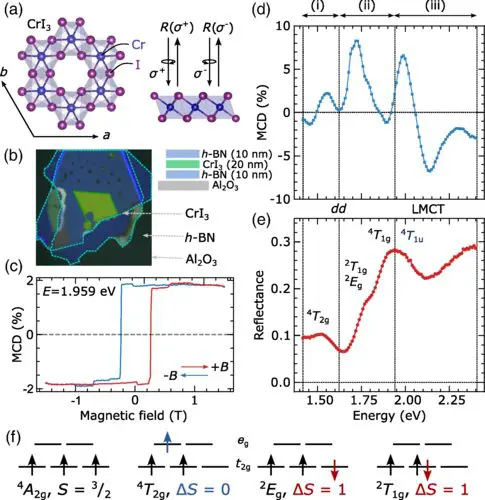
Spin-forbidden (ΔS ≠0) multiplet excitations and their coupling to magnetic properties are increasingly important for magneto-optical studies of correlated materials. Understanding how to enhance the visibility of these transitions remains a significant challenge, as these excitations are typically weak due to quantum mechanical rules, yet offer a pathway to control and manipulate magnetic order with light. Consequently, increasing their visibility is crucial for developing novel optical techniques to probe and influence magnetic materials. This research focuses on identifying and controlling the factors that govern the intensity of these spin-forbidden transitions, with the ultimate goal of achieving efficient magneto-optical control in advanced materials.
Spin-Forbidden Excitations in Chromium Halides
This collection of references details research focused on spin-forbidden excitations in materials like CrI3 and other chromium halides. The work investigates these normally forbidden transitions, which can occur weakly due to factors like spin-orbit coupling, crystal field effects, or interactions with other excitations. Understanding these excitations is crucial for understanding the material’s optical properties and magnetic behavior. A strong focus exists on two-dimensional materials and van der Waals heterostructures, a rapidly developing area of research due to the unique properties these materials exhibit.
The research relies on optical techniques, including absorption, reflectance, Raman spectroscopy, and resonant inelastic x-ray scattering, to probe the electronic structure and excitations, alongside core-level photoemission spectroscopy. Density functional theory and dynamical mean-field theory are also used to model the electronic structure and predict material properties. Spin-orbit coupling and crystal field effects are important factors influencing the strength of spin-forbidden excitations. The research determines whether these excitations are simple electron-hole pairs or more complex quasiparticles, and explores how light interacts with the magnetic properties of these materials.
Studies examine how stacking different 2D materials affects their properties, with specific materials including CrI3, chromium tribromide, chromium trichloride, nickel phosphorosulfide, lanthanum cobalt oxide, and nickel tellurate. Key techniques used include angle-resolved photoemission spectroscopy, resonant inelastic x-ray scattering, x-ray photoemission spectroscopy, optical spectroscopy, density functional theory, and dynamical mean-field theory. This reference list points to a sophisticated investigation of the fundamental electronic and optical properties of 2D magnetic materials, with a particular focus on spin-forbidden excitations and their role in determining material behavior, combining experimental techniques with theoretical calculations.
Robust Spin-Forbidden Excitations in Chromium Triiodide
Researchers have uncovered remarkable insights into the optical properties of chromium triiodide (CrI3), a material attracting significant attention for its two-dimensional magnetism. Through magneto-optical spectroscopy and resonant inelastic x-ray scattering experiments, the team identified both spin-allowed and, crucially, previously unreported spin-forbidden excitations within the material’s optical spectrum. These spin-forbidden excitations, specifically transitions between the 4A2g and 2Eg/2T1g states, were confirmed through detailed analysis and comparison with theoretical calculations and the behavior of related chromium trihalides. The experiments demonstrate that these spin-forbidden excitations remain remarkably robust, persisting even when CrI3 is reduced to a single atomic layer, a critical feature for potential applications in nanoscale devices.
Furthermore, the researchers observed a significant dependence of the magneto-optical spectrum on the applied magnetic field in few-layer samples, coinciding with a transition from antiferromagnetic to ferromagnetic alignment. By comparing the results with those obtained from chromium tribromide, the team proposes that this behavior arises from increased chromium-iodine covalency, a strengthening of the chemical bond between the atoms, which is sensitive to both the type of ligand and the magnetic state of the material. These findings provide a consistent interpretation of the magneto-optical spectra across the chromium trihalide series and highlight the crucial role of metal-ligand covalency in enhancing and tuning spin-forbidden multiplet excitations in correlated insulators. The ability to control these excitations offers exciting possibilities for optically probing and manipulating the magnetic properties of two-dimensional materials, potentially leading to novel spintronic devices and a deeper understanding of emergent magnetic phenomena. The discovery clarifies the mechanisms governing the material’s optical response and paves the way for harnessing its unique properties in future technologies.
Bright Signals and Bonding in Chromium Triiodide
The research demonstrates that strong optical signals in the van der Waals magnet chromium triiodide (CrI3) originate from transitions within chromium ions, which are typically forbidden due to quantum mechanical rules. These transitions are unexpectedly bright because of increased interaction between chromium and iodine atoms, enhancing the ability to detect and manipulate magnetism in extremely thin materials. The study establishes a link between the strength of these optical signals and the degree of chemical bonding between the chromium and iodine, suggesting that materials with stronger bonding exhibit brighter signals. Importantly, the research also highlights that these bright signals come with a trade-off: the transitions are broader than similar signals in other materials, linked to the specific properties of iodine atoms and their interaction with chromium, as well as the material’s electronic structure. The authors acknowledge that fully understanding the relationship between brightness, broadening, and the material’s properties requires further investigation, particularly quantitative modelling to connect these features with the material’s composition and electronic structure, with future work focused on exploring this relationship to uncover new properties in materials that combine strong electronic interactions with chemical bonding.
🗞 Spin-Forbidden Excitations in the Magneto-optical Spectra of ${\mathrm{CrI}}_{3}$ Tuned by Covalency
🧠 DOI: http://link.aps.org/doi/10.1103/4km4-4rvn