

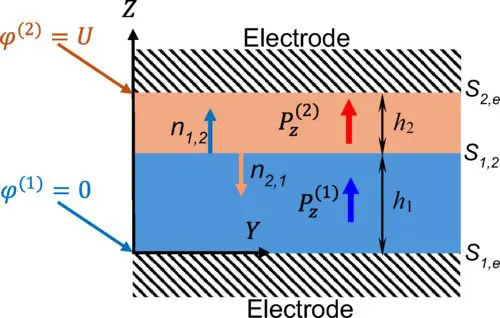
Proximity ferroelectricity represents a recently reported design paradigm for inducing ferroelectric behaviour, whereby a nonferroelectric polar material transitions to a ferroelectric state through interfacing with a thin ferroelectric layer. Strongly polar materials, such as aluminium nitride and zinc oxide, previously unswitchable with an external field below their dielectric breakdown fields, now exhibit switching behaviour with practical coercive fields when in intimate proximity to a switchable ferroelectric, opening new avenues for material design and device engineering. Consequently, this work develops a general theoretical framework to understand and predict this emergent behaviour in layered materials.
Interfacial Polarization Drives Heterostructure Ferroelectricity
This research proposes a thermodynamic theory to explain the emergence of ferroelectricity in heterostructures, specifically when a ferroelectric material is combined with a non-ferroelectric one. The central finding is that charge accumulation at the interface between the materials, known as interfacial polarization, plays a crucial role in inducing and controlling ferroelectricity in the non-ferroelectric layer, particularly relevant for materials like aluminium scandium nitride combined with gallium nitride. The theory predicts how to optimize these heterostructures for enhanced ferroelectric properties, extending the Landau-Devonshire-Ginzburg-Landau theory to account for interfacial effects and depolarization fields.
Defect-Mediated Switching in Non-Switchable Materials
Researchers have demonstrated that materials previously considered non-switchable, such as aluminium nitride and zinc oxide, can exhibit polarization switching when combined with ferroelectric layers, challenging conventional understanding and opening new avenues for material design in advanced electronics. The team discovered that internal electric fields, generated by defects within the layered materials, reshape the energy barriers that normally prevent polarization switching, effectively enabling the process. Experiments reveal that these randomly distributed electric charges significantly reduce the coercive field in a controllable manner. Specifically, the coercive field of aluminium nitride decreased from 26 MV/cm to 8.
8 MV/cm, while similar reductions were observed in aluminium scandium nitride/aluminium nitride and aluminium scandium nitride bilayers. These results demonstrate that the influence of defects is particularly strong in materials with initially high coercive fields, highlighting a nonlinear relationship between defect concentration and coercive field reduction. Data confirms that the switching behaviour is more extrinsic in aluminium nitride and less extrinsic in aluminium scandium nitride, suggesting that defect engineering can tailor the switching mechanism, and the bilayer structure remains switchable up to a critical thickness determined by the breakdown coercive field and defect concentration.
Layered Materials Unlock Unexpected Polarization Switching
This research demonstrates that materials conventionally considered non-switchable, such as aluminium nitride and zinc oxide, can exhibit polarization switching when combined in layered structures with ferroelectric materials. The team developed a thermodynamic theory explaining this phenomenon, revealing that internal electric fields reshape the energy barriers within the layered structure, effectively enabling switching in the typically passive material. The theory predicts that the properties of the combined layers become remarkably similar, exhibiting almost identical polarization behaviour, including coercive fields and remanent polarization. The significance of these findings lies in the potential to create new materials and devices with tailored properties.
By carefully selecting and layering materials, it may be possible to design structures that overcome the limitations of individual components and achieve enhanced functionality. The research shows that the ratio of layer thicknesses strongly influences the observed behaviour, allowing for a degree of control over the final properties of the combined structure. Future work could focus on experimentally verifying the predictions of the theory for a wider range of material combinations and layer thicknesses, and exploring the potential applications of these layered structures in practical devices.
🗞 Thermodynamic Theory of Proximity Ferroelectricity
🧠 DOI: http://link.aps.org/doi/10.1103/PhysRevX.15.021058


