Researchers are continually seeking ways to refine the precision of measurement, and a team led by Fabrizio Sgobba, Francesco Di Lena, and Danilo Triggiani are now pushing the boundaries of two-photon interference techniques. They demonstrate a method for high-precision position measurements that overcomes limitations inherent in conventional Hong-Ou-Mandel interferometry, a process typically constrained by the indistinguishability of photons. This new approach, which involves analysing transverse momentum, allows for measurements even when photons are not perfectly identical, opening possibilities for higher resolution imaging and sensing. The team’s findings suggest that even partial distinguishability between photons does not necessarily hinder two-photon interference, potentially broadening the scope of applications beyond simple measurement towards more complex photonic processing.
Two-Photon Interference Beats Rayleigh Limit
This research details a method for measuring the transverse displacement between two photons with exceptional precision, utilizing two-photon interference. The technique surpasses the conventional Rayleigh limit by employing independent photons and a spatially resolving detector composed of single-photon avalanche diodes. The core principle involves sampling the transverse momentum of the photons and using this data to estimate displacement with increased accuracy. This work includes a theoretical analysis of achievable precision and an assessment of experimental uncertainties. Key to this approach is understanding two-photon interference, where the interaction of two photons reveals information about their relative transverse momentum.
Measuring this momentum distribution is crucial for accurately estimating displacement. The research utilizes the Cramér-Rao bound, a fundamental limit in estimation theory, to define the theoretical minimum achievable precision. Maximum-likelihood estimation determines displacement from observed coincidence counts, while a spatial light modulator detector measures the transverse momentum distribution. This combination of techniques offers a powerful new approach to precision measurement. This research has potential applications in high-resolution imaging, allowing scientists to break the diffraction limit and achieve clearer images.
It also offers advancements in precision metrology, enabling highly accurate measurements of displacement and other physical quantities. Furthermore, the work contributes to the development of new quantum sensors and could be integrated into advanced imaging techniques like correlation plenoptic imaging. Ultimately, this research presents a robust theoretical and experimental framework for achieving high-precision displacement measurements using two-photon interference, offering a promising path forward for imaging and metrology.
Precise Position Measurement via Photon Interferometry
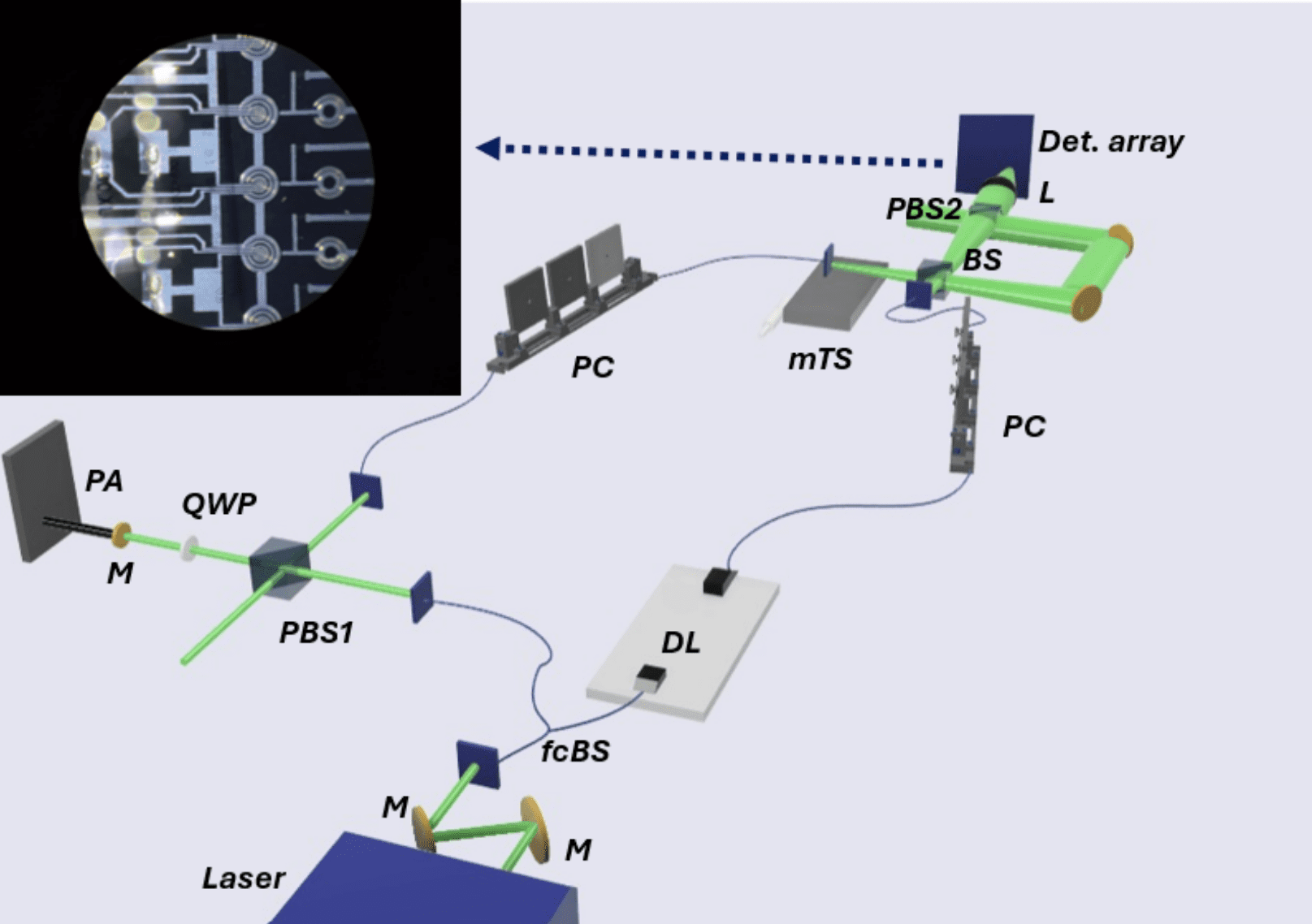
Researchers have engineered a sophisticated experimental setup for high-precision position measurements, utilizing transverse-momentum-resolved two-photon interferometry with independent photons and single-photon avalanche diode arrays. The apparatus employs a free-space Mach-Zehnder interferometer illuminated by a pulsed laser. Precise control of spatial overlap between interfering beams is achieved using a translation stage. To overcome limitations imposed by photon distinguishability, scientists implemented an optical filtering technique, achieved by modulating the path length of one beam with a piezoelectric actuator.
Polarization controllers further ensure indistinguishable polarization states, maximizing the interference signal. The resulting output propagates in free space before being detected by a linear array of single-photon detectors, each with defined dimensions and spacing. This detection array is synchronized with the laser source and utilizes a time-to-amplitude conversion ramp, achieving a tagging resolution comparable to the source pulse width. A lens focuses the image plane onto the detector, ensuring far-field conditions for precise momentum sensitivity and enabling the measurement of spatial correlations between detected photons. Researchers then analyzed the timestamps of detected photons to compute coincidence matrices, revealing both bunching and antibunching correlations at varying transverse separations.
Precise Positioning Beyond Indistinguishability Limits
Researchers have demonstrated a novel experimental scheme for high-precision position measurements, extending the capabilities of established interferometry. The team successfully implemented transverse-momentum-resolved two-photon interferometry with independent photons, overcoming constraints imposed by photon indistinguishability. This breakthrough allows for precise measurements even when photons are completely distinguishable due to substantial spatial separation. The experiment proves that measuring fourth-order correlations in the fields enables researchers to overcome spatial distinguishability between independent photons, a previously challenging feat.
By resolving coincidence events in momentum space, the team retrieved the interference phenomenon, demonstrating a reliable technique for conjugate-variable passive resolution. Results demonstrate the ability to observe quantum beats, and therefore two-photon quantum interference, between independent photons whose wave packets do not overlap, opening new possibilities for quantum communication and information processing. This innovative approach extends the operative range of established interferometry, achieving a resolution previously unattainable with standard techniques. Even a tiny displacement causes a more visible change in the beating oscillation in momentum space, enhancing sensitivity and precision. Beyond biosensing and imaging, this work demonstrates the potential for extending the technique to quantum communication and quantum information processing, utilizing photons that are not perfectly identical. The findings confirm the feasibility of observing quantum interference with independent photons, representing a substantial step towards more versatile and robust quantum technologies.
Precise Positioning with Independent Photons Demonstrated
The research team has demonstrated a new technique for high-precision position measurement, based on two-photon interferometry using independent photons and specialized single-photon detectors. This approach extends the capabilities of established methods, overcoming limitations related to the indistinguishability of photons. By measuring correlations in the fields, the technique successfully achieves precise measurements even when photons are not perfectly aligned or overlapping. The significance of this work lies in its potential for high-resolution imaging applications, particularly in fields like biosensing and correlation plenoptic imaging, where conventional methods are constrained by pixel size and the need for magnifying optics. The experiment proves the ability to detect minute displacements, much smaller than the detector pixel pitch, by observing quantum interference between independent photons. Future work will focus on increasing detector resolution and improving the performance of the single-photon detectors, leveraging advancements in current and near-future technologies to further enhance the technique’s capabilities.
👉 More information
🗞 Momentum-resolved Hong-Ou-Mandel interference of weak coherent states
🧠 ArXiv: https://arxiv.org/abs/2508.19978